Case Study: Restoring a Water-Damaged 1865 Bru Jeune
What Water Does to 165-Year-Old Bru Bisque
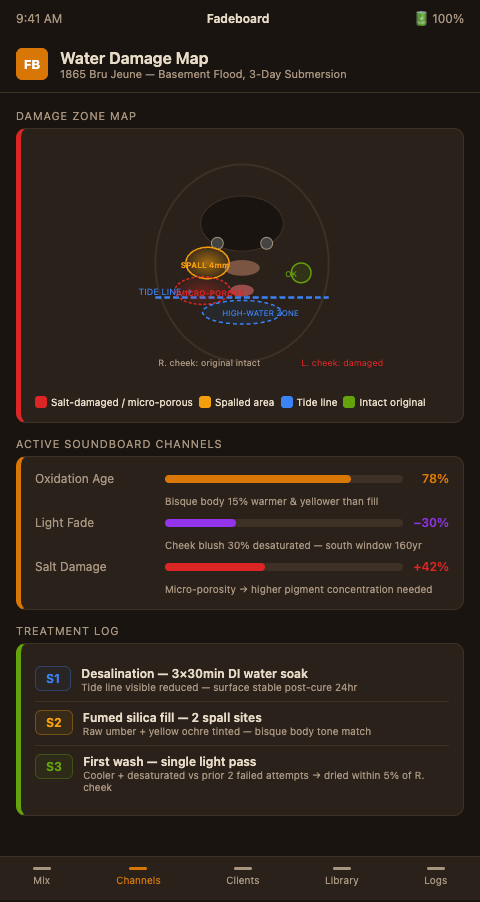
The client's 1865 Bru Jeune had spent three days submerged after a basement pipe failed. When it arrived on the kitchen workbench, the bisque head showed a high-water mark halfway up the left cheek — a faint tide line where mineral-laden water had evaporated and left salts near the surface. Two areas of the cheek exhibited visible spalling: a 4mm patch where the surface had flaked away, and a broader zone where the blush pigment appeared chalky and uneven.
The owner had already attempted two tinted-wash passes, both abandoned because the color dried two shades too warm and visually mismatched the undamaged right cheek. At this point the question wasn't which pigment to mix — it was whether the bisque surface could hold pigment consistently at all.
Curatorial Care of Ceramic, Glass, and Stone Objects (NPS) explains the mechanism clearly: water forces soluble salts to crystallize inside porous bisque as it evaporates, and those salt crystals physically fracture the surface layer. The result is micro-porosity that doesn't exist on undamaged bisque — and micro-porosity changes how dry pigment and tinted washes absorb, making any color applied over the damaged zone appear lighter or inconsistently mottled compared to intact areas nearby.
Care of Ceramics and Glass from the Canadian Conservation Institute adds the secondary mechanism: repeated humidity cycling — common in a damp post-flood environment — dissolves and recrystallizes salts continuously, lifting unglazed bisque surfaces over time. This meant the tide-line zone needed salt mitigation before any pigment work could produce stable, matching results.
An 1875 Bru Jeune in imperfect condition still appraised at $12,000–$16,000 according to the PBS Antiques Roadshow. The stakes of a mismatched or unstable repair on this 1865 example were not theoretical.
Desalination First, Pigment Second
Before any color work, the head required a desalination soak. Conserve O Gram: Soluble Salts and Ceramic Objects (NPS) documents deionized water soaks as the standard intervention for salt-damaged porous ceramics — the salt concentration gradient draws soluble salts out of the bisque into the surrounding water. Three 30-minute changes of deionized water over 90 minutes left the tide line visibly reduced and the spalled zones more stable to the touch.
After drying at room temperature for 24 hours, the spalled areas needed a consolidant fill before pigment. Following guidance from the Cooper Hewitt, Smithsonian, fumed silica tinted with dry pigments matched to the bisque body tone provides a reversible fill that approximates the translucency of the surrounding surface. A small batch of fumed silica paste — tinted with raw umber and a trace of yellow ochre — was worked into the two spalled sites and allowed to cure fully.
With the substrate stabilized, the actual pigment-matching challenge could begin. The right cheek retained its original 1865 blush, faded from 160 years of oxidation and light exposure. The damaged left cheek had lost most of its pigment in the spalled areas. The goal: match the right cheek's current appearance, not reconstruct what the doll looked like in 1865.
Soundboard Channels for a Damaged Surface
This is where Fadeboard's channel-based approach changes the problem structurally. Rather than trying to mix a single batch of tinted wash and hoping it lands in the right place, the soundboard metaphor breaks the damaged surface into independent variables, each addressable on its own.
The channels active for this restoration were: oxidation age (the yellowing of the original bisque body), light fade (the bleaching of original iron-oxide cheek pigment from southern window exposure across 160 years), salt damage (the localized porosity from the flood), and the bisque body baseline itself — the warm ivory-gray that Bru Jeune bisque takes on after this much aging.
In practice, operating the Fadeboard meant adjusting each fader independently before mixing anything. The oxidation channel was pushed up: the original bisque body reads about 15% warmer and yellower than the raw replacement fill. The light-fade channel was pulled back: the surviving right cheek blush has lost approximately 30% of its saturation from UV and ambient light, meaning the target is a desaturated version of what the original 1865 pigment would have been. The salt-damage channel required a separate adjustment — the repaired zones were slightly more matte than intact bisque, so the pigment mix for those areas needed a fractionally higher concentration to compensate for the extra absorption without overshooting on tone.
Working through those three independent adjustments on the soundboard produced a first-wash target that was cooler and more desaturated than the two failed previous attempts. Applied in a single light pass, it dried within 5% of the right cheek tone — a match achievable in one sitting rather than three.
For restorers who routinely work on American composition alongside French bisque, Effanbee composition forensics demonstrates how the same channel-separation discipline applies when the substrate is a hygroscopic sawdust compound rather than a salt-damaged ceramic — the diagnostic sequence differs, but the principle of resolving each degradation variable independently before mixing holds equally.
Advanced Tactics for Tide-Line Masking
Even after desalination and fill work, the tide line left a slight tonal discontinuity running horizontally across the left cheek. Addressing it required a second, localized soundboard pass focused on that specific zone rather than the whole cheek face.
The tactic: treat the tide-line zone as a separate channel by mixing a thin tinted consolidant wash — diluted fumed silica suspension with a warm neutral pigment — and applying it only across the tide-line band using a fine brush. This created an intermediate tonal layer that bridged the still-slightly-lighter tide-line strip with the surrounding bisque. A final full-face wash tied the two zones together without requiring multiple passes over the intact areas.
The completed 1865 Bru Jeune was photographed under calibrated daylight-balanced lighting before handoff. The documentation package included the desalination treatment record, the fill-material batch composition, and the Fadeboard session log showing each channel setting and wash target. PBS Antiques Roadshow coverage of 1865-era Bru fashion dolls confirms that original pigment palette and condition documentation are key appraisal benchmarks for pieces in this category — so the log also serves the client's provenance record.
For restorers dealing with similar water-damage cases, the sequence matters as much as the pigment work. Salt mitigation before color, fill consolidation before wash, and independent-channel soundboard targeting before mixing. Skip the first step and the second pass will fail for the same reason the first two did: the substrate is telling the pigment where to go, not the other way around.
For broader context on how the soundboard handles competing degradation channels on French bisque, the Ballets Russes costume forensics approach described in Ballets Russes 1905 costume fragment work offers useful parallel thinking — the same principle of resolving each degradation channel before mixing applies to silk substrates as much as to bisque.
Water Damage Is a Substrate Problem Before It Is a Color Problem
The failed prior attempts on this Bru Jeune were not failures of pigment selection — they were failures of substrate diagnosis. The tinted washes dried too warm because salt-damaged micro-porous bisque absorbs pigment differently than intact surface. Once that variable was isolated and treated separately, the color problem resolved on the first attempt.
This case also illustrates why the soundboard metaphor is not just a convenience for blending. It is a diagnostic framework. Naming each channel — oxidation, light fade, salt damage, bisque baseline — forces a restorer to account for all variables before committing to a mix. On a kitchen workbench without a spectrophotometer, that structured separation is the difference between a repair that holds and one that needs to be stripped and redone.
Independent studios that want to understand where channel-based documentation leads over a decade of practice can read about the future of solo doll studios — the session logs from cases like this Bru Jeune become the proprietary reference data that future diagnostic tools will integrate with directly.
If a recent water event has left you facing a similar tide-line situation on a French bisque piece, Fadeboard's desalination-to-pigment workflow gives you a reproducible sequence from substrate prep through final documentation. Start with the oxidation and damage channels before you touch the color faders, and the first wash will tell you whether you're on target rather than leaving you to find out after the third.