Advanced Fade Forensics on Cochineal Piecework Quilts
Why Cochineal Piecework Is Harder Than It Looks
A nine-patch block built from cochineal-dyed cotton looks like a single problem: pink fabric that has faded. The restoration answer seems obvious — find a matching pink dye bath and apply it. That approach produces flat, unconvincing results on almost every antique piecework quilt because the apparent uniformity of the surface conceals structural differences that the eye cannot resolve.
Cochineal yields carminic acid as its primary chromophore, and carminic acid is highly sensitive to three variables that typically vary across a piecework quilt: mordant chemistry, original dye concentration, and pH at the time of dyeing. An alum-mordanted cochineal bath produces a warm red-pink; a tin-mordanted bath on the same fiber produces a brilliant scarlet; an iron-saddened bath shifts toward a cold plum. If the quiltmaker sourced fabric from multiple suppliers — which was common in the 1840–1880 window — the "pink" blocks in the nine-patch likely have at least two different original mordant bases.
Differential fading compounds this. Change Is Permanent: Fading of Cochineal Watercolor Pigments — npj Heritage Science documents that carminic acid photodegrades at different rates depending on the medium and humidity conditions it is embedded in. On cotton, the rate varies further with fiber preparation and mordant. Blocks from a tin-mordanted dye lot fade faster than alum-mordanted blocks under the same UV load — which means a quilt that started with two similar-looking pinks can end with two visually distinct states after a century of exposure.
The Infinite Variety: Three Centuries of Red and White Quilts — American Folk Art Museum exhibition documented 651 red and white quilts, many of which showed exactly this mordant-driven fade divergence across blocks that were originally intended to read as a single color.
Forensics First: Reading the Block Before Setting the Faders
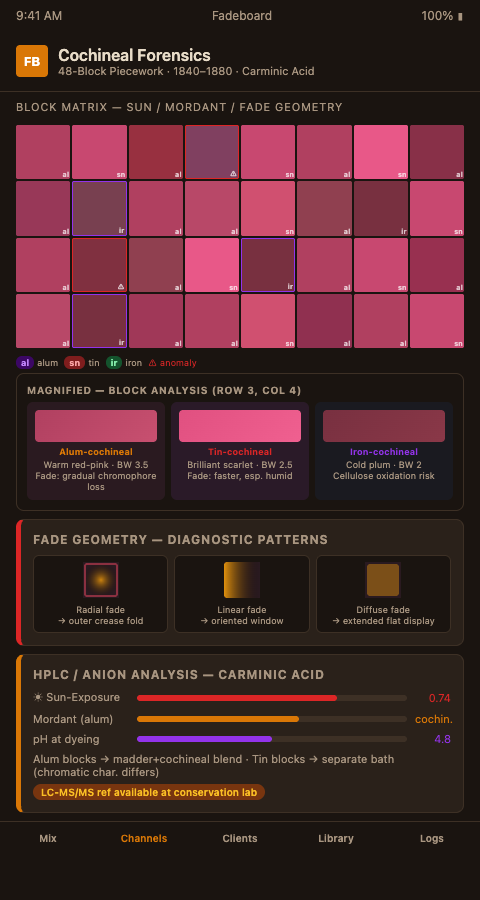
The forensics protocol begins before any dye decision is made. Each block in the piecework gets a systematic assessment covering four variables: surface color under controlled 5500K daylight-balanced light, seam-allowance reference color where accessible, reverse-side color (which accumulates less UV damage), and any visible pattern in the fade distribution — radial from a center, linear from an edge, or diffuse across the whole block.
That last variable — fade pattern geometry — is often the most diagnostic. Radial fading centered on the block's midpoint indicates the quilt was stored folded with that block at an outer crease; linear fading from one edge indicates oriented window exposure; diffuse fading with uniform gradient indicates extended flat display. Each pattern maps to a specific combination of Fadeboard channel settings.
HPLC Identification of Cochineal Colorants in Pre-Columbian Textiles — PMC demonstrates that LC-MS/MS analysis can identify specific carminic acid derivatives and their degradation products, providing a scientific basis for distinguishing original dye lot composition. Workshops without laboratory access can approximate this through comparison with reference swatches from known-mordant cochineal dye lots — the color shift under UV exposure differs detectably between mordant types within the first 50 years of aging.
For the Fadeboard session, the forensics output is a block-by-block channel matrix. The sun-exposure fader gets a reading for each block based on the fade pattern geometry and the estimated UV load. The wash-cycle fader gets a reading based on any bleed or migration pattern in the printed or dyed elements. A mordant-adjustment note — not a separate fader, but a formula modifier — records whether the block is likely to be alum, tin, or iron base, which affects the target dye concentration for the restoration bath.
Analysis of Natural Red Dyes (Cochineal) Using HPLC — PubMed confirms that HPLC-DAD can measure carminic acid concentration directly — a technique available at textile conservation labs that can verify the workshop's visual forensics against quantitative analysis for high-value pieces.
Translating Forensics Into Dye-Bath Formulas
Once the channel matrix is established, the dye-bath translation follows a consistent logic. Blocks with high sun-exposure fader readings and an alum-mordant base receive a madder-cochineal combination bath weighted toward cochineal, because pure madder will not produce the warm pink tonality that alum-cochineal creates. Blocks with lower fader readings on the same alum base receive a smaller cochineal addition — the goal is to recover depth, not to restate original saturation.
Tin-mordanted blocks, if identified, require a separate bath formulation entirely. The brilliant quality of tin-cochineal on cotton cannot be approximated with an alum bath at higher concentration — the chromatic character is different, not just the depth. Impact of Medium on Photodegradation of Carmine — ScienceDirect demonstrates that carmine stability and initial color character both depend on substrate chemistry, which confirms that the restoration chemistry must match the original mordant system, not just the apparent color.
For the stereomicroscope work that cochineal fiber analysis under magnification reveals, the forensics process often uncovers a fourth variable: fiber preparation. Cotton that was scoured differently retains mordant differently, and blocks with poor mordant uptake tend to show a characteristic patchy fade — uneven within the block, not just different from adjacent blocks. The Fadeboard session file flags these blocks for extra test-patch validation before committing to a dye bath.
Excited State Proton Transfer in Hydroxyanthraquinones — Science Advances provides the molecular mechanism for red anthraquinone fading — directly applicable to cochineal because carminic acid is an anthraquinone derivative — and predicts that fading will be uneven across piecework wherever pH gradients existed at the fiber surface during dyeing. This confirms the forensics approach: the unevenness is not random, it is chemically determined and therefore readable.
Advanced Tactics: Reference Swatches and Mordant Identification Without Destructive Sampling
Building a reference swatch library from period fabrics is the most effective long-term investment a cochineal-specialist workshop can make. A library that includes known-mordant cochineal samples aged under controlled light conditions for five, ten, and twenty years provides a physical comparison standard that accelerates block forensics from hours to minutes.
The restoration dye stability on antique cotton question becomes central here because any restoration dye applied to a cochineal piecework quilt needs to age predictably over the same timeline as the original dye. A cochineal restoration bath that is more lightfast than the surrounding original fabric will produce a visually detectable mismatch within a generation — the restored blocks will stand out by being less faded.
Identifying Natural Dyes to Understand a Tapestry's Origin — Metropolitan Museum describes the Met's dye identification methodology using flavonoid and anthraquinone analysis, which provides a non-destructive framework for confirming dye class without fiber sampling. For high-value quilt projects, arranging a dye confirmation at a conservation lab with HPLC capability before finalizing the fader matrix is standard practice.
The Effanbee composition doll pigment forensics approach in adjacent restoration disciplines follows the same read-before-formulate logic — the forensics phase determines what the intervention needs to be, and skipping it produces formulaic work that does not actually match the object's history.
When you are ready to treat cochineal piecework quilts with the precision they require — block-by-block channel assessment, mordant-specific bath formulas, and a session file that captures every decision for future reference — Fadeboard's matrix view is the tool your forensics protocol needs. Visit the waitlist page to apply for access, and request a demo focused on piecework fade analysis — we will walk through a block matrix together using a cochineal quilt from your current intake.