Chemical Stability of Restoration Dyes on 19th-Century Cotton
The 19th-Century Cotton Substrate: Not a Blank Slate
New cotton fiber presents a relatively predictable dyeing substrate: a cellulose structure with a known degree of polymerization, a fairly consistent surface chemistry, and mordant bonding sites that respond to alum, iron, or tin within established parameters. Antique cotton from an 1870s feedsack or an 1850s calico block is something different.
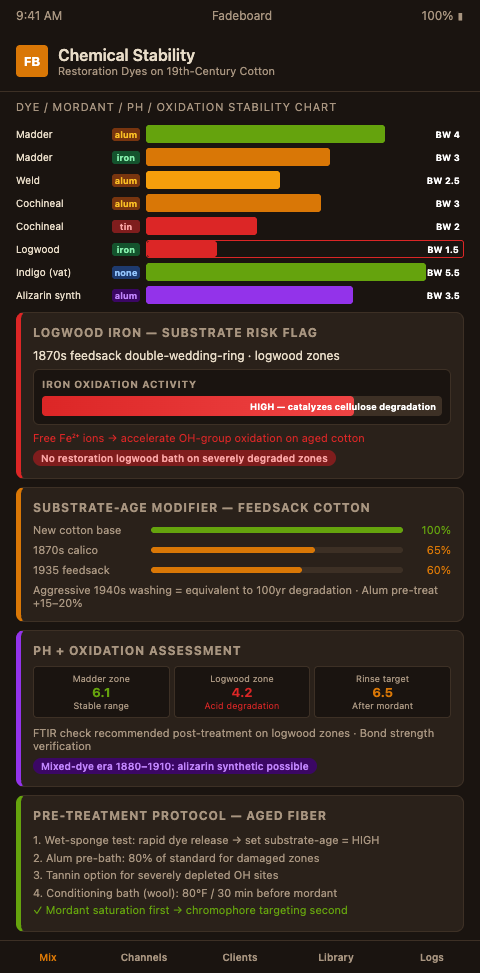
Over a century and a half, cotton cellulose undergoes acid hydrolysis driven by residual dye acids and environmental pollution, photo-oxidation from UV exposure, and mechanical stress from handling and storage. The degree of polymerization drops significantly, which means the fiber chains are shorter and the physical fiber strength is reduced. But the chemical consequences for dyeing go further than strength loss: the surface hydroxyl groups that mordants bind to are partially consumed by oxidation, reducing the mordant uptake capacity. An alum bath that produces full color depth on new cotton may yield only 60–70% of that depth on heavily aged cotton with the same concentration and contact time.
Historic Textile and Paper Materials — ACS Publications provides the foundational treatment of chemical aging in cellulose and dye interaction on 19th-century substrates — required reading for any workshop that treats period cotton as a distinct material rather than a slower version of new cotton.
Textile Conservation — RSC Education covers cellulose hydrolysis, oxidation, and dye-fiber interaction in accessible terms, confirming that both the dye bond strength and the color-depth outcome are affected by substrate age in ways that require empirical testing rather than formula scaling.
The practical consequence is that every Fadeboard session for a 19th-century cotton quilt includes a substrate-age variable in the dye concentration calculation. The channel settings record the degradation history; the substrate-age modifier adjusts the bath formula to account for reduced mordant uptake.
How Restoration Dye Stability Varies by Chemistry
Not all restoration dyes age at the same rate on antique cotton, and the differences are large enough to affect treatment decisions. Review of History, Properties, and Applications of Natural and Synthetic Dyes — PMC provides a comprehensive review of dye classes and stability across fiber types, establishing that on cotton, natural dyes applied with mordants show significantly different stability profiles depending on mordant choice.
Madder on alum-mordanted cotton is among the more stable natural dye combinations for restoration purposes: the anthraquinone chromophores bond well to cellulose-alum complexes and show relatively predictable photodegradation rates. Weld on alum is less stable — the flavonoid structure is more susceptible to UV degradation than anthraquinones. Cochineal on alum falls between the two, with a photodegradation rate that varies significantly with pH and humidity in the display environment.
Logwood black presents a specific problem on aged cotton. The iron mordant that produces the black shifts from the fiber's dye-complexed state toward free iron ions over time, which catalyzes further cellulose oxidation. On already-degraded 19th-century cotton, a logwood restoration bath with an iron mordant can accelerate physical deterioration of the fabric. Early Synthetic Textile Dyes of the Late 19th Century — ScienceDirect provides context for the transition from natural to synthetic dyes in this period, and confirms that some quilts from the 1880s–1910s contain a mixture of natural dye fabrics and early synthetic dye fabrics — which compounds the stability problem because early aniline dyes on cotton have very poor lightfastness.
The Fadeboard session for a mixed-dye-era quilt therefore needs a dye-class identification step before the channel settings can be translated into bath formulas. A block that appears to be madder-dyed might actually be an alizarin synthetic — the color is similar, the stability is different. Evaluation of Dyes Used in Conservation of Archaeological Textiles — Academia.edu tests natural versus synthetic dyes for restoration stability on historic cotton and silk, with results that directly inform the choice between restoration dye systems.
Mordant Re-Treatment on Aged Fiber
One of the most effective interventions for improving restoration dye stability on antique cotton is mordant re-treatment before dyeing. The process involves a mild alum or tannin pre-bath that partially replenishes the bonding sites consumed by oxidation, improving dye uptake consistency and increasing the bond density of the applied color.
The pre-treatment bath must be formulated conservatively for antique fiber. A mordant concentration appropriate for new cotton can cause localized swelling and fiber stress in severely degraded historic fiber. Lightfastness of Early Synthetic Organic Dyes — npj Heritage Science documents differential fading rates across synthetic and natural dyes on period cotton, which supports the argument for mordant re-treatment as a stability measure — improved bond density reduces differential fading between original and restored zones.
The Fadeboard sun-exposure fader reading for a given zone also informs the pre-treatment intensity. A high-fader zone with significant UV degradation needs a longer pre-bath at lower concentration; a moderate-fader zone can receive a shorter pre-bath at standard concentration. The channel settings therefore govern not just the dye bath parameters but the pre-treatment parameters as well.
ColourLex: Infrared Spectroscopy for Dye Analysis describes FTIR as a standard tool for assessing restoration dye stability — identifying degradation products in treated cotton confirms whether the mordant bond is holding or breaking down. For high-value quilts or pieces destined for museum loan, a post-treatment FTIR check is the analytical confirmation that the dye bath achieved the expected bond chemistry.
Advanced Tactics: Documenting Chemical Decisions in Session Files
Chemical stability decisions — mordant type, pre-treatment intensity, dye class selection — are among the most technically consequential choices in a restoration project, and they are also among the most commonly underdocumented. A treatment narrative that says "applied madder-alum bath" without specifying the mordant concentration, the pre-treatment parameters, or the substrate-age assessment gives future restorers nothing to work with.
The historical society restoration record requirements that institutions impose treat chemical specification as mandatory — the record of what was applied must include enough detail for a conservation chemist to assess long-term implications.
Fadeboard session files include a chemical annotation layer that captures mordant pre-treatment parameters, dye class identification, and substrate-age assessment alongside the standard channel settings and dye formulas. This layer feeds directly into loan documentation and institutional review packages without requiring a separate documentation step.
The future natural-dye methods for quilt workshops will include biomordant systems and enzyme pre-treatments that change the chemistry of this pre-treatment step, but the documentation framework remains constant — the chemical annotation layer in the session file will record those new parameters in the same structure.
The gesso pigment stability work in doll restoration addresses the same substrate-age problem from a different angle: antique gesso, like antique cotton, is not a neutral substrate, and restoration materials applied to it must be chosen with its degraded chemistry in mind rather than its original specification.
Common Pitfall: Applying New-Cotton Bath Parameters to Feedsack-Era Fabric
The substrate-age problem compounds in a specific direction for feedsack-era cotton from the 1920s–1940s: this fabric is old enough to have significant cellulose degradation but young enough that restorers sometimes treat it as "modern" cotton rather than antique. A 1935 feedsack Nine-Patch quilt that was washed aggressively through the 1940s and 1950s may have cotton fiber with degree-of-polymerization values comparable to a well-preserved 1880s madder quilt — the aggressive washing accelerated degradation that would otherwise have taken decades longer.
The practical test is the wet-sponge touch assessment: apply a damp sponge lightly to an inconspicuous area of feedsack cotton and observe the rinse-out rate. If dye releases rapidly onto the sponge at room temperature from plain water contact, the fiber surface is compromised and the substrate-age modifier in Fadeboard should be set to the high end of the range — equivalent to fabric that has experienced 100+ years of normal aging, not 90 years of hard use. The alum pre-treatment concentration for that zone should be raised by 15–20% above the standard 90-year estimate.
On Amish solid-color wool from the same 1890s–1920s period, the substrate-age assessment follows a different pathway. Wool cellulose does not hydrolyze the same way cotton does, but lanolin loss and felting reduce the fiber's dye-uptake consistency in ways that functionally parallel the hydroxyl-site depletion problem in cotton. A warm-water conditioning bath at 80°F for 30 minutes before the alum pre-treatment partially restores fiber flexibility and improves mordant distribution — reducing blotchiness in the restoration bath without requiring higher mordant concentrations. Fadeboard's pre-treatment annotation field captures this conditioning step alongside the mordant parameters so the full treatment sequence is recorded in a single session file.
Workshops that treat chemical stability as a documentation requirement rather than an afterthought are producing work that will survive institutional review and long-term client expectations. If you want to build chemical annotation into your Fadeboard session files, schedule a consultation to structure your substrate-age assessment protocol.