Assembling Restoration Records for Historical Society Reviews
What Historical Societies Actually Evaluate
The submission process for a quilt to a state or county historical society is not simply a quality review — it is a provenance and documentation audit. The committee members assessing the piece are typically textile historians, archivists, and conservation professionals whose primary question is not "does this quilt look good" but "do we know enough about this object to care for it responsibly and represent it accurately."
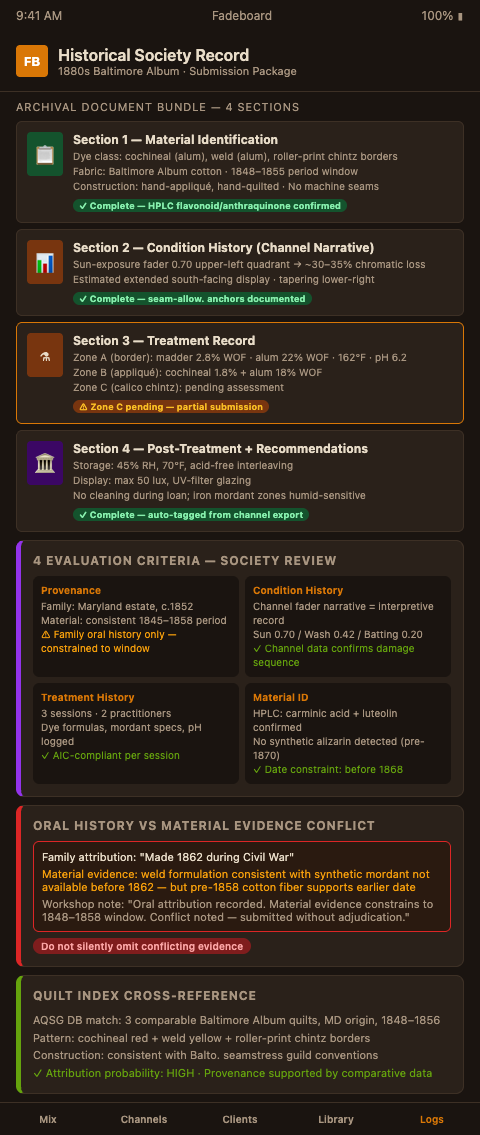
That question has four components. First, provenance: can the quilt be traced to a specific maker, time, and place with documentation rather than family tradition alone? Second, condition history: what has happened to the object physically and chemically since it was made, and what evidence supports that history? Third, treatment history: what interventions have been made, by whom, using what materials, and what was the rationale? Fourth, material identification: what dyes, fibers, and construction methods are present, and what are their conservation implications?
A workshop that completed a technically excellent restoration but documented it only with before-and-after photographs fails the third and fourth criteria entirely. The technical quality of the work is invisible without the chemical record.
Quilt Provenance — Visualizing America / Clio History explains the oral and material provenance challenges for antique quilts submitted to historical institutions, noting that undocumented assumptions about age and origin — however well-founded — do not satisfy archival standards. The documentation must be explicit, not implicit.
American Quilt Study Group — Quilt Research and Community sets interdisciplinary documentation standards that many historical societies reference when evaluating submitted quilts, particularly for multi-yard pieces from the 19th century where the construction and dye evidence is the primary historical record.
Organizing the Fadeboard Session File for Submission
The Fadeboard session archive contains most of what historical society reviewers require, but it needs to be organized for their workflow rather than the workshop's restoration workflow. The reviewer is not following the treatment sequence — they are cross-referencing the documentation components against an evaluation checklist.
The recommended organization for a submission package draws from the session file in four sections:
Section 1 — Material Identification. The dye-class identifications from the channel assessment, any fiber typing from microscope examination, and the fabric period attribution (calico, chintz, feedsack, Amish solid, Baltimore Album appliqué) form this section. Citations to reference sources — a Metropolitan Museum fabric study, a regional quilt survey, a conservator's report on comparable objects — give the identifications scholarly grounding.
Section 2 — Condition History. The channel assessment itself, translated from Fadeboard settings into narrative, documents the degradation history. A sun-exposure fader reading of 0.7 on the upper-left quadrant translates to: "significant UV damage, consistent with extended south-facing display, concentrated in upper-left quadrant and tapering toward lower-right; estimated 30–35% chromatic loss from original dye state." This is the condition history that reviewers want — not a description of current appearance but an interpretation of accumulated damage.
Section 3 — Treatment Record. The dye bath formulas, pre-treatment parameters, and mordant specifications from each zone, organized by zone identifier and cross-referenced to the condition history. AMNH Conservation Methodologies: Condition Reporting provides a framework for documentation components that historical societies use to evaluate submissions — the Fadeboard treatment record maps directly onto those components.
Section 4 — Post-Treatment Assessment and Recommendations. The post-treatment channel readings, any fiber-state concerns flagged during treatment, and specific storage and display recommendations based on the dye chemistry. National Quilt Collection — Smithsonian Institution Spotlight documents how the Smithsonian evaluates provenance, inscription, and condition factors — the same criteria that frame this fourth section.
Provenance Integration and the Limits of Material Evidence
Workshop documentation covers the treatment history and material identification components completely. The provenance component — maker, date, and geographic origin — requires integration of non-workshop sources: family records, estate inventories, maker's inscriptions, regional quilt surveys, and oral history.
The workshop's material evidence can support or constrain provenance claims but rarely establishes them independently. A turkey red and indigo double-wedding-ring quilt with calico sashing and feedsack backing, dyed with period-appropriate mordant chemistry and constructed with a hand-quilting stitch pattern consistent with regional styles, is consistent with 1870–1890 production — but that evidence narrows the attribution range rather than fixing it.
Stitched Together: Doing History with the Quilt Index — AHA Perspectives describes the 55,000-quilt searchable database that provides comparative context for attributions — a regional pattern database that can confirm whether a quilt's construction style, fabric selection, and dye palette are consistent with claimed provenance.
The natural-dye future for quilt workshops includes increasingly precise analytical tools for dye identification that will make material-based provenance attribution more precise over time — HPLC identification of specific dye lots, for instance, can in principle narrow attribution to a specific regional dye house.
Advanced Tactics: Building Submission-Ready Archives Proactively
The workshop that assembles a submission package when the historical society inquiry arrives is doing reactive work. The workshop that builds its session files in submission-ready format from the start of every project is doing the same amount of total work with dramatically better outcomes.
The investment required is primarily structural: at project intake, open the Fadeboard session file with the four submission sections pre-formatted as an organizational scaffold. The channel assessment, dye bath records, and post-treatment notes populate those sections as the work proceeds. When the inquiry arrives, the package is complete.
Collection: AQSG Quilt Research Files — Nebraska Archives Online illustrates the depth of records that historical societies expect for significant pieces — the university-archived AQSG files are the peer standard against which workshop submissions will be compared for major 19th-century quilts.
The Baltimore Album quilt accent border restoration cases that workshops encounter frequently are among the highest-value submission candidates — the historical significance of Baltimore Album quilts means that the documentation standards applied to them are the most rigorous.
The insurance portfolio documentation approach in doll restoration applies equally here: a well-documented treatment history increases the assessed value of a restored textile, which benefits both the client submitting to the historical society and the workshop's professional reputation.
Common Pitfall: Treating Oral History as Documentation
Family oral history — "my great-grandmother made this during the Civil War, around 1862" — is valuable context but does not constitute archival documentation. Historical society reviewers who receive a submission that conflates family tradition with material evidence will return the package with requests for corroborating physical evidence. The workshop's role is not to validate the oral history but to record what the material evidence supports and where it diverges.
For a quilt submitted as an 1862 Civil War sampler, the material evidence that can support or constrain the date claim includes: cotton fiber type consistent with pre-1865 production (no mercerized cotton, no synthetic fibers), dye chemistry consistent with natural colorants available before 1868 (no synthetic alizarin, no aniline dyes), construction method consistent with mid-19th-century piecework conventions (hand-stitched, not machine-sewn seams), and, if present, any inscriptions or provenance artifacts attached to the quilt. Fadeboard's dye-class annotation layer is the correct place to record the dye evidence — not as a date proof but as a date constraint.
When the material evidence contradicts the oral history — for instance, a quilt attributed to 1862 that contains weld yellow in a synthetic mordant formulation not available before 1880 — the workshop's documentation should record both the family attribution and the material evidence without adjudicating between them. The historical society's textile historians will evaluate the conflict. A workshop that silently omits the contradictory evidence to protect the client's preferred attribution is creating a documentation problem that will surface later and reflect badly on both parties.
Edge Case: Condition History for Quilts With Prior Professional Restorations
A quilt that has been through one or more previous professional restorations before reaching your workshop presents a documentation layering problem. The current material state reflects both the original manufacture and all subsequent interventions, and the historical society needs to know which elements are original and which are restorations.
When previous treatment records exist — even partial ones — attach them to the Fadeboard session file as supplementary documents and reference them in the condition history section. When no records exist but physical evidence suggests prior restoration (mismatched thread in quilting repairs, areas of suspiciously uniform color depth inconsistent with the surrounding fade patterns, modern synthetic batting in a quilt otherwise dated to the 1880s), record the evidence in the Fadeboard channel annotation without attribution. The session note might read: "Zone B3 shows uniform color depth inconsistent with surrounding fade gradient — possible prior intervention; dye class in this zone identified as early synthetic alizarin, consistent with post-1870 application, suggesting the zone was redyed at an unknown date."
That level of specificity in the condition history section is exactly what historical society reviewers need to evaluate a complex piece accurately — and it is what distinguishes a professionally documented restoration from a simple before-and-after photograph set.
Workshops that want to shift from reactive documentation to proactive archive building — and see their submissions accepted rather than returned for additional documentation — should schedule a Fadeboard consultation to restructure their session file format around historical society submission requirements.