Restoring Accent Colors on Antique Parisian Fashion Dolls
Accent Colors Are Not Uniform Surfaces
A Jumeau poupée de mode from the 1870s carries multiple distinct accent color applications that differ in substrate, binder, and original pigment chemistry. The facial accent colors — lip rouge, brow detail, cheek rouge — were applied directly to the bisque surface in the French atelier using pigments specific to that manufacturer's house palette. The accessory colors — painted trim on leather shoes, tinted kid gloves, ribbon and hat trim — were applied to different materials by different workshops and aged at entirely different rates.
The lip rouge on an 1870s Jumeau is typically iron oxide-based: durable, relatively lightfast, and still readable after 150 years even when faded. The painted brow detail is often a finer carbon-black or brown oxide line, narrower and more prone to mechanical wear. The accessory trim — particularly ribbon and fabric elements — may have used aniline dyes introduced to French fashion after the 1860s, which are significantly less lightfast than the oxide-based bisque pigments and commonly fade to near-invisibility.
Musée de la Poupée coverage from Wikipedia documents that the Paris doll museum held thousands of poupée de mode artifacts from 1994 to 2017, representing the primary institutional archive for original accent color palette reference. With that institution no longer active, the practical reference sources are auction house records, extant museum collections, and the Théâtre de la Mode.
Théâtre de la Mode from Wikipedia notes that the 1945 exhibition preserved authentic Parisian textile and accessory color conventions at miniature scale — providing documented reference for the palette palette conventions of Parisian fashion work at period-accurate scale.
The appraisal stakes are concrete. PBS Antiques Roadshow Bru doll coverage confirms that repainted accent elements reduce auction value: original paint and trimmings are key appraisal factors. A poupée de mode with restored lip rouge but clumsily repainted brow detail may recover cheek value while losing assessment points on facial accuracy — a net outcome worse than leaving the brow unrestored.
Separating What Faded From What Was Lost
The first step in accent color restoration is distinguishing between two different categories of missing color. A faded lip rouge that still shows 20% of its original saturation is a different restoration target than a lip rouge that has been mechanically abraded to the bisque surface. Both appear as "missing color" at casual inspection, but they require different approaches.
Faded pigment still reads as a color family at the surface — even 20% saturation retention gives enough information to identify the original hue and map the fade vector. Mechanical loss exposes bare bisque or the preparation layer beneath the original paint, removing the hue reference entirely. For mechanical loss, the restoration target must be derived from adjacent intact areas or from reference material.
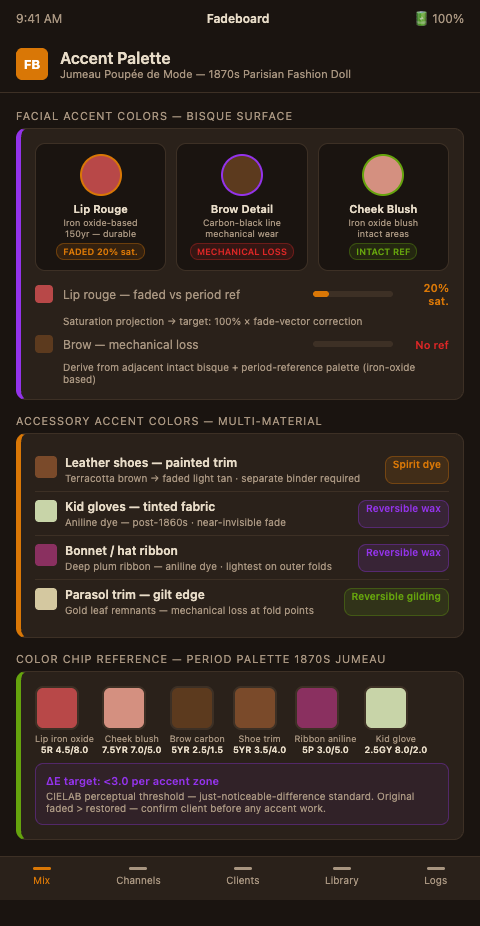
In Fadeboard's channel framework, the faded-versus-lost distinction maps to different channel configurations. For faded lip rouge, the saturation and lightness channels are adjusted from the surviving pigment reading — the remaining 20% of original iron oxide is the reference for where the mix needs to land after accounting for 150 years of light fade. For a loss area on the same surface, the oxidation and bisque-body channels from the surrounding intact bisque become the primary reference, and the lip rouge channel is set to match the period-authentic iron oxide palette documented in the reference sources.
Spectrophotometric color matching from HunterLab enables objective matching of faded fashion doll accent pigments against period-reference color data — a high-precision approach for studios with the equipment. At the workbench level, the equivalent is comparing the surviving faded area to calibrated swatches from the period-reference archive under controlled lighting, using the CIELAB color space for quantitative comparison.
CIELAB color space provides the standard framework for quantifying these differences in conservation pigment matching, and its perceptual uniformity is what makes it the conservation field's reference space. Even without a spectrophotometer, CIELAB gives the workbench restorer a working target: an accent color restoration is successful when the ΔE between the restored area and the reference is below 3.0 — the threshold of just-noticeable-difference under standard viewing conditions. Because accent color is one of the most contested categories in private commissions — clients often hold personal memories of a piece that conflict with what the physical evidence supports — sharing the faded-versus-lost channel read with the client at intake, before any mixing begins, is the practical step that prevents disputes. The full framework for structuring that intake conversation is in the client disputes documentation approach, which covers the pre-work agreements that make evidence-based accent color decisions defensible.
Advanced Tactics for Multi-Material Accent Systems
French fashion dolls present an additional complication: the accessory accent colors — painted trim on leather shoes, tinted fabric, hat ribbon — must be restored to materials that are not bisque. Each material has a different absorption coefficient for tinted washes, a different aging profile, and different compatibility requirements for the restoration binder.
Leather shoe trim that has faded from a terracotta brown to a light tan requires a different binder system than bisque facial restoration. Leather accepts spirit-based dyes and wax finishes differently than water-based pigment over bisque. The Fadeboard approach treats each material as a separate channel run — the leather trim channel uses a leather-appropriate binder and colorant system, and its settings are logged separately from the bisque facial channel settings, even if the target hue is similar.
The AIC Code of Ethics — American Institute for Conservation applies the reversibility principle equally to accent color retouching on bisque heads and ceramic accessories of fashion dolls. The key test for any accent color restoration material on a poupée de mode is whether it can be removed without damaging the substrate — which means spirit-based binders over leather, not aqueous acrylic; reversible wax consolidants over fabric, not permanent dye immersion.
Calibrated photography for cultural heritage from PMC — CIELAB correction captures true accent colors on antique objects for matching — provides the tool for verifying that the restored accent colors read correctly under the documentation photography, not just under the workbench lamp.
The historical water-damage restoration of a related Bru Jeune case — including how period-reference palette sources were used to anchor the restoration target — is covered in 1865 Bru Jeune case study, where the period-reference sourcing method is described in detail.
The commedia dell'arte accent trim restoration challenge — multi-material, multi-application-hand accent systems on historic theatrical pieces — is covered in commedia harlequin accent trims, where the same multi-channel, multi-substrate approach is applied to a textile and decorative trim context.
Accent Color Is Appraisal Territory
The restorer who touches accent colors on a French fashion doll is making decisions with direct market value consequences. Original facial accent colors in good condition contribute significantly to auction estimates. Repainted accent colors — even when technically excellent — reduce value because they break the chain of original material authenticity.
This means the decision to restore an accent color versus conserve and leave it is not purely technical — it is an appraisal-informed decision that the client must participate in. Before any accent color work on a poupée de mode, the client needs to understand that original faded is worth more than restored, and that restoration is indicated only when the surviving material is too degraded to read as a coherent surface.
Fadeboard's channel structure supports that decision by making the diagnostic evidence transparent: the faded-lip-rouge channel shows how much original material survives, and the saturation projection shows how far the current state is from the period reference. That evidence, shared with the client at intake, grounds the restoration decision in objective data rather than subjective judgment — which is the standard that makes the resulting work defensible to the next appraiser who handles the piece.
If you currently handle Parisian fashion doll commissions and have lost sessions guessing at period-accurate iron oxide lip rouge, try Fadeboard on your next poupée de mode intake — the waitlist is open and accent-color calibration templates for 1870s Jumeau and Bru production are among the first presets in the early-access release.