Handling Client Disputes About Original vs Restored Color
How Color Disputes Actually Start
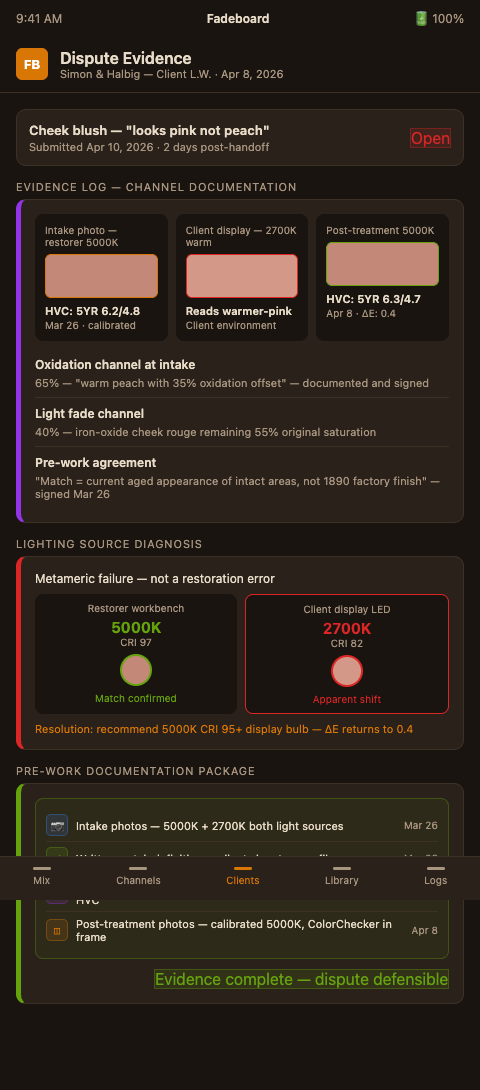
A restorer who completed a technically correct Simon & Halbig cheek restoration was facing a dispute four days after client handoff. The client's complaint: the restored left cheek "reads pink" where the original right cheek "reads more peach." Under the restorer's daylight-balanced workbench lamp, the two cheeks were indistinguishable. Under the client's display cabinet LEDs — a warm 2700K source with a strong yellow cast — the difference was visible.
This is the most common category of color dispute in private doll restoration: the restorer matched correctly under their working light, and the client evaluates under a different light source that reveals a hue difference invisible at the workbench. The underlying cause is not a bad match — it's a failure to establish, in writing, what lighting condition the match would be evaluated under and what "match" meant in this context.
A Legal Discussion on Failed Restorations from Center for Art Law documents the legal exposure: cases show restorers facing liability when outcomes deviate from client expectations without prior written agreement. The exposure is not limited to expensive institutional restorations — it applies to a $400 Simon & Halbig cheek job as readily as to a $40,000 Bru Jeune full restoration.
FAQs About Paintings Conservation from Central Coast Painting Conservation illustrates how practitioners pre-empt client confusion by clarifying "original color" limitations in writing before work begins. The language matters: "original color" to a restorer means the best-evidence reconstruction of what the piece looked like when made, accounting for 130 years of oxidation and fade. "Original color" to a client often means "what grandmother's doll looked like when I was eight."
The gap between those two definitions, left unclosed at intake, is the source of virtually every color dispute that reaches a dispute stage.
Pre-Work Documentation as the Primary Defense
The AIC Code of Ethics requires conservators to document treatment fully and communicate clearly about the limits of reversibility. The ethics framework exists because the field recognized long ago that undocumented treatment creates irreversible uncertainty — and color is one of the most contentious areas of that uncertainty.
In practice, the pre-work documentation package for every private commission should contain three elements before any mixing begins.
First, dated intake photographs under two light sources: the restorer's working light and a second standardized reference light (ideally a 5000K daylight source). These photographs establish the piece's documented pre-treatment color under calibrated conditions. If the client later claims the restored color doesn't match the original, the pre-treatment photographs show exactly what the original looked like before the restorer touched it.
Second, a written statement of what "match" means for this commission. For a piece with 130 years of oxidation and fade, "match" means matching the current aged appearance of the intact areas — not reconstructing the 1890 factory finish. This statement gets client signature at intake. A client who signs this agreement and then claims the restoration "should have been brighter" has already agreed in writing that bright-fresh was not the target.
Third, a Fadeboard session log extract attached to the intake package: the channel settings for the degradation profile of this specific piece, documenting which factors (oxidation, light fade, storage conditions) informed the target tone. This is not internal documentation — it gets shared with the client. A client who understands that the cheek reads "peach with 35% oxidation offset" rather than "factory peach" is less likely to dispute a result that correctly reflects that documented target. For commissions involving accessory and trim color — a particularly contested area — Parisian fashion doll accents covers how to document accent colors applied by multiple hands at the French manufacturer, where "original" is genuinely ambiguous and the documentation standard must acknowledge that complexity at intake.
A Guide to Condition Reports from MyArtBroker identifies pre- and post-treatment condition reports with dated photography as the baseline defense against color-change disputes. The Fadeboard log is the color-specific layer of that condition report.
Advanced Tactics When a Dispute Still Occurs
Even with pre-work documentation, disputes reach the discussion stage. The tactics that resolve them most cleanly are evidence-based rather than persuasion-based.
When a client disputes the result under their home lighting, the restorer's first step is re-examination under the documented reference light. If the piece reads correctly under the intake reference light and incorrectly under the client's display light, the issue is lighting — not the restoration. Demonstrating this side by side, with the intake photographs as reference, converts a subjective disagreement into an objective lighting-source question. The resolution is often as simple as recommending a higher-CRI bulb for the display cabinet.
When a client claims the color "looks nothing like grandmother's photos," the restorer can compare the restoration result directly to those photos using the intake documentation. Old photographs of antique dolls are often taken under incandescent light, may have color-shifted from age, and frequently show the doll in a display condition rather than under controlled color reference. A calm walkthrough of why the photograph evidence is ambiguous — and how the restoration was instead anchored to the surviving physical evidence of intact surface areas — usually clarifies the basis for the result without requiring any concession that the work was incorrect.
Does Art Restoration Risk Erasing the Past from Frieze notes that aesthetic restoration versus historical authenticity is a recurring source of collector-restorer disagreement — and it frames the underlying tension well. Clients want the doll to look "right" by their memory; the restorer's obligation is to the physical evidence. That tension doesn't go away with better documentation, but documentation provides neutral ground to stand on when it surfaces.
For cases where disputes involve appraisal value, Art Appraisal For Insurance Claims from VW Art notes that diminution in value after disputed restoration requires documented pre-treatment color and condition baselines — exactly what the intake package and Fadeboard log provide.
The same session log that resolves a client dispute also satisfies the documentation standards required for formal appraisal work — the insurance appraisal documentation covers how that log translates into the evidence an insurance adjuster or ISA appraiser needs to process a claim accurately.
Restorers who have navigated exhibit-loan color disputes with institutional committees will recognize a similar evidence-based resolution approach in exhibit loans and soundboard color evidence, where provenance documentation rather than subjective assessment determines the accepted color standard.
Documentation Is Not Paperwork — It Is the Restoration Record
The restorer who finishes a technically correct Simon & Halbig cheek job and hands the piece back with no documentation is not just vulnerable to disputes — they have produced a restoration with no provenance trail. The next person to handle that doll, whether a future restorer, appraiser, or inheriting family member, will have no way to distinguish the restored areas from the original surface, and no record of what standard the work was held to.
Fadeboard's session log closes that gap by making the channel settings and mix formula a permanent attachment to the piece's record. The dispute prevention is a secondary benefit. The primary benefit is that the restoration has an auditable, evidence-based provenance — which is the same standard that makes the original 1890 factory paint worth preserving in the first place.
If a current commission is approaching handoff and the pre-work agreement wasn't documented at intake, the best time to create that record is now — before the client sees the piece, not after they object to it.
Restorers who have faced a color dispute — or want to prevent one on the next Simon & Halbig or Jumeau commission — can open a Fadeboard account now and start building the session-log evidence package that makes those conversations straightforward instead of contentious.