Preparing Exhibit Loans With Soundboard Color Evidence
What Most Loan Packages Omit
The standard outgoing loan condition report for a textile object records fiber type, structural integrity, stain location, and perhaps a brief color description. What it almost never includes is a colorimetrically-grounded baseline that specifies what the object's colors actually measure — in coordinates a receiving conservator can compare against the object's condition at return.
The consequence is that color changes during loan travel are nearly impossible to document objectively. An archivist notes "blue sash, slight fading at left edge" at departure. Months later, at return, she notes "blue sash, slight fading at left edge." Unless the fading has advanced dramatically enough to be visible to the naked eye, the loop closes without anyone knowing whether the loan exposure added measurable degradation.
The American Museum of Natural History's condition reporting protocol specifies that color state documentation should be verifiable — not just descriptive. For textile loans, that means colorimetric data, not prose. Most theater archives lack the internal workflow to generate that data consistently, which is why most loan packages omit it.
Fadeboard's session export format fills that gap directly. A session file from the pre-loan intake generates CIELAB coordinates, delta-E readings relative to a reference standard, and the lighting-era translation needed to interpret those coordinates under the destination venue's illuminant. That data converts a descriptive color note into a verifiable color baseline.
Building the Pre-Loan Session
Preparing a loan with Fadeboard color evidence begins no later than four weeks before the planned ship date — enough time to run the session, resolve any open questions, and incorporate the output into the formal loan documentation.
The pre-loan session has a specific configuration that differs slightly from a standard restoration session. The restoration session asks: "What was the original color, and what does the restoration target look like?" The pre-loan session asks: "What is the current color, and how will it read at the destination under the destination's lighting?"
Current-state documentation requires the archivist to set the Fadeboard faders to represent the object as it exists today — not a restored state, not a theoretical original. The Time Degradation fader captures the cumulative color loss from storage and past performance use. Any previous restoration work is noted as a session annotation, but the fader values represent the physical object as measured, not as treated.
The destination-lighting translation channel is then applied on top of the current-state configuration. If the receiving institution runs a 5600K LED exhibition system, the translation channel predicts how the current-state colors will read under that illuminant, expressed in the same CIELAB coordinates. The gap between the object's native color and its LED-rendered appearance is the metamerism correction that the loan documentation records as a known factor rather than a surprise.
The Collections Trust's UK standards for costume and textile loans require that loans traveling between institutions include documentation of any known condition sensitivity — including color sensitivity to lighting change. The Fadeboard pre-loan session produces exactly the format those standards envision.
The Color Evidence Package
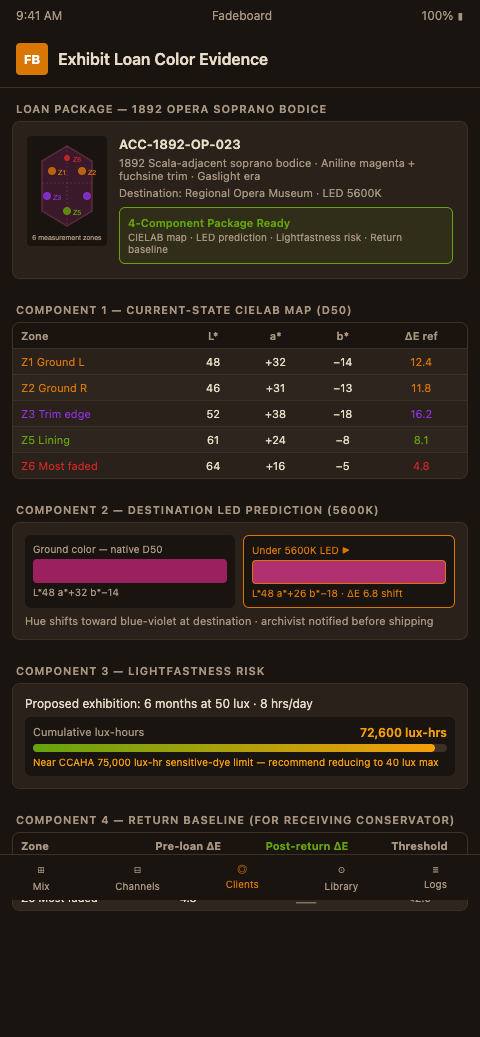
The loan color evidence package consists of four components generated from the Fadeboard session.
The first component is the current-state color map: a table of measured CIELAB values for each significant color area of the object, with the illuminant reference (typically D50 for the archive's examination lamp) noted. For a bodice with four distinct color areas — ground fabric, trim, embroidery, and lining — this is a 4-row table with L*, a*, and b* values and corresponding delta-E readings from a reference white.
The second component is the destination-illuminant prediction: the same table re-expressed under the receiving institution's specified illuminant, showing the predicted shift for each color area. For costumes traveling from a tungsten-Fresnel-era archive to a 5600K LED gallery, this column typically shows the hue shifts described in the lighting translation work.
The third component is the lightfastness risk assessment: a brief note on each color area's predicted vulnerability to the cumulative lux-hours of the proposed exhibition period. CCAHA's guidance on light exposure limits for artifacts on exhibition specifies maximum cumulative lux-hours for textile loans — typically 75,000 lux-hours for sensitive dyes, 150,000 for more stable materials. The Fadeboard session notes which color areas approach these thresholds at the proposed exhibition duration and recommends any supplemental light restrictions.
The fourth component is the return-condition baseline: a copy of the current-state CIELAB table formatted for comparison at return, with blank columns for the receiving conservator to complete upon return inspection. This creates the closed loop that most loan packages currently leave open.
ICOM's costume documentation standards now reference colorimetric baseline documentation as a recommended practice for lending institutions — a shift that positions archives with established Fadeboard workflows ahead of those still relying on photographic-only condition records.
Receiving Institutions' Responses
Archives that have adopted Fadeboard-based loan documentation report consistent feedback from receiving conservators: the quantitative color baseline changes the conversation at intake.
A conservator at a major regional museum described the difference: "When a package arrives with CIELAB coordinates, we can actually run a quick spectrophotometer check on intake and compare. When a package arrives with photographs, we look at the photographs and say 'yes, that looks like what arrived' — but that's not a measurement, it's an impression." The Fadeboard package enables measurement-to-measurement comparison, which is what condition monitoring actually requires.
For lending institutions, the secondary benefit is liability documentation. If a loaned costume returns with measurable color change that exceeds the delta-E threshold specified in the loan agreement, the Fadeboard package provides the baseline to support a damage claim. Without that baseline, color change at return is essentially unprovable.
The theater archive pipeline management post covers how loan documentation integrates into a collection-wide session management structure — so that each loan package is generated from an active session file rather than assembled from scratch for each outgoing request.
Configuring Session Outputs for Different Receiving Institutions
Not all receiving institutions request the same documentation format. A major opera archive with an in-house conservation department may want the full CIELAB table with spectral data. A small regional theater museum with no conservation staff may need a simpler format: a color swatch card with prose notes on what to watch for during exhibition.
Fadeboard session exports support both formats from the same underlying data. The full technical export provides the raw CIELAB and spectral coordinates. A simplified summary export generates the swatch card format with plain-language notes. The archivist chooses the format based on the receiving institution's capacity, and both outputs are generated from the same session file without repeating the measurement work.
For opera archive acquisition evidence packages, which typically go to institutions with strong conservation infrastructure, the full technical export is appropriate. For community theater archives or smaller regional museums, the simplified format reduces the barrier to adoption without sacrificing the underlying data.
Diocesan commission proofs in vestment conservation face an analogous documentation calibration challenge — technical color evidence presented to non-specialist reviewers — and the session export flexibility described here maps directly to that context.
If you are currently preparing exhibit loans without colorimetric color evidence in the package, join the Fadeboard waitlist and schedule a pre-loan session workflow consultation for your next outgoing piece. Run the session against your current-state measurements, apply the destination-illuminant translation, and generate the four-component evidence package. The first time a receiving institution's conservator runs a return comparison against your CIELAB baseline, the value of the investment will be obvious.