Compiling Costume Evidence for Opera Archive Acquisitions
What Acquisition Committees Actually Receive
A typical opera costume acquisition package arrives with: a provenance chain (who owned it, which productions it was documented in, what house it originated from), a physical condition report (fiber type, structural losses, stain location, storage history), and photographs — usually high-resolution but taken under unspecified lighting conditions that make color comparison difficult.
What the package almost never includes is a documented analysis of the color's current state relative to its designed state: what the colors measured at documented production time, what they measure now, and what a restoration would require to bring them back to designer intent or operational presentation quality.
La Scala's historical archive holds 45,000 costumes, 24,000 designer sketches, and documentation reaching back centuries — a scale that underscores how much color evidence is potentially embedded in operatic provenance records if archives know how to access and use it. When a piece from a Scala-adjacent production enters the acquisition market, the designer sketch record alone can provide original color intent data that most other archives cannot match.
The challenge is that color evidence from designer sketches, production photographs, and surviving contemporaneous descriptions exists in formats — watercolor, black-and-white photography, prose — that require interpretation before they can inform quantitative restoration targets. Fadeboard's session architecture provides the interpretive framework that converts those heterogeneous records into coherent CIELAB-based acquisition evidence.
The Four Layers of Opera Costume Color Evidence
For an opera archive acquisition package, color evidence typically comes from four sources with different levels of reliability.
Designer sketches represent the highest-authority source when they survive and are accessible. Opera costume designers — particularly those working with major houses from the 1880s through the mid-20th century — produced detailed watercolor sketches specifying fabric colors, trim hues, and finish treatments. The scholarly analysis of opera costume object biographies in the Journal of Documentation notes that provenance value attaches precisely to these sketch-to-costume chains: a costume with an authenticated designer sketch gains acquisition case strength from the color evidence the sketch contains.
Production photographs provide secondary evidence, with significant caveats. Early 20th-century opera production photographs were taken under arc or early tungsten illumination with orthochromatic or panchromatic film, both of which rendered colors inaccurately relative to the human visual experience. Aniline yellow reads as nearly white in orthochromatic photography; deep reds compress toward black. Fadeboard's photographic interpretation tools account for these systematic distortions when using production photographs as color reference inputs.
Surviving contemporaneous textile records — fabric receipts, dye lot records, wardrobe supervisor notes — provide direct material evidence when they survive. The Metropolitan Opera's archive dating to 1883 holds production records including some fabric and dye documentation; similar records survive at other major houses. An acquisition package that can reference a dye lot receipt for a specific color area is making a stronger evidentiary claim than one relying on photographs alone.
Finally, physical measurement of the surviving object provides the current-state baseline. FORS readings at intake, combined with the other three layers, allow Fadeboard to triangulate a restoration target with documented confidence levels for each color area.
Configuring the Fadeboard Acquisition Session
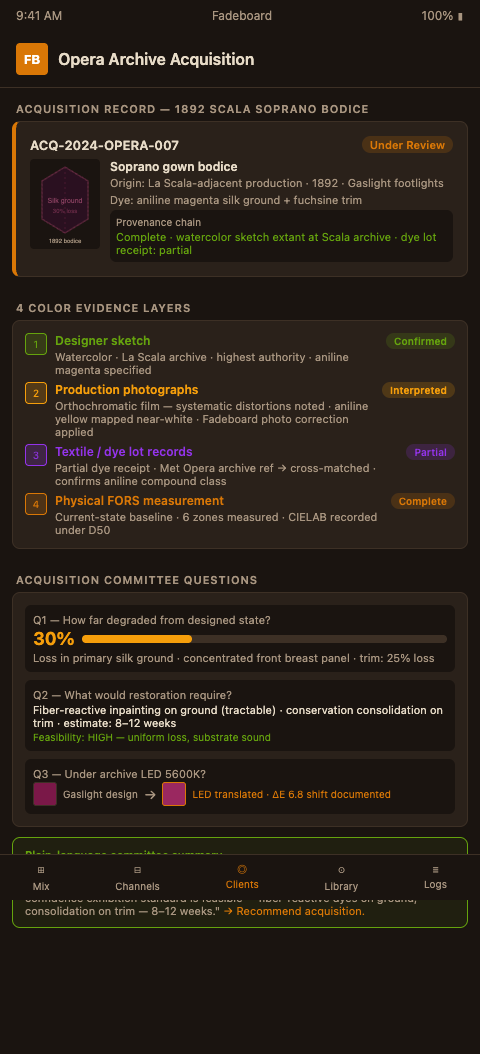
The Fadeboard acquisition session differs from a standard restoration session in its purpose: rather than targeting a treatment, it generates evidence for an institutional decision. The session should be configured to answer three questions that acquisition committees consistently ask.
The first question is: how far has the object degraded from its designed state? The Time Degradation fader, calibrated against the object's provenance exposure history and physical measurements, produces this estimate as a percentage of original saturation and a delta-E distance from the reconstructed design-time color. For a late 19th-century opera bodice with 130 years of dark storage punctuated by documented loan periods, this estimate has a range of uncertainty that the session documents explicitly.
The second question is: what would restoration require? The acquisition session does not specify a treatment plan — that comes later, after the acquisition is decided — but it characterizes the restoration scope. An object that has lost 25% of original saturation uniformly across all color areas is a more tractable restoration than one that has lost 60% in the primary silk ground while retaining original saturation in a metallic trim overlay. The Fadeboard session maps that spatial variation across color areas, giving the acquisition committee a realistic picture of the restoration investment.
The third question is: how will the restored object appear under the archive's exhibition lighting? The lighting-era translation channel, applied to the projected post-restoration state, answers this. For an opera costume that was designed for gaslight footlights and will be exhibited under 5600K LED, the translation shows the committee the expected perceptual result — whether that is a faithful designer-intent presentation, or a technically accurate but perceptually unexpected appearance.
Integrating Evidence Into the Formal Package
The formal acquisition package for an opera archive should include the Fadeboard session output as a dedicated color evidence section, positioned between the physical condition report and the conservation assessment.
The color evidence section contains: the provenance color record (which source layers were available and what color information they yielded), the current-state CIELAB measurements, the Time Degradation fader calibration with its uncertainty range, the restoration scope estimate by color area, and the post-restoration appearance prediction under the archive's exhibition illuminant.
The Royal Ballet and Opera's archive and collections policy specifies formal acquisition criteria including condition and conservation feasibility. A Fadeboard color evidence section directly addresses both: condition through the current-state measurement, and conservation feasibility through the restoration scope estimate.
For the stage pigment recovery future of opera archives, standardized color evidence packages will likely become a prerequisite for major acquisitions as digital provenance systems mature and as institutional review boards gain familiarity with colorimetric methods.
Archivists preparing acquisition submissions should note that Opéra-Comique's digitized archive provides public access to 19th and early 20th-century costume and production documentation — a research resource that can supply designer sketch color data for French operatic works that is otherwise difficult to access outside Paris.
Making the Case to Acquisition Committees
Acquisition committees at major opera archives include curators, conservators, registrars, and often board members with varying technical backgrounds. The Fadeboard acquisition session output should be presented in two formats: a technical appendix with full CIELAB data for the conservation staff, and a plain-language summary for non-specialist reviewers.
The plain-language summary addresses the acquisition question in terms committees understand: "This soprano bodice from the 1892 Scala production of [title] shows approximately 30% color loss in the primary silk ground, concentrated in the front breast panel where footlight exposure was highest. The primary trim color has degraded less severely and retains approximately 75% of the designer's specified saturation. Restoration to a high-confidence exhibition standard is feasible using fiber-reactive dyes on the ground and conservation consolidation on the trim, with projected treatment duration of eight to twelve weeks."
That summary is built on the Fadeboard session data, but it speaks the language of institutional decision-making. The committee sees a feasible acquisition with documented restoration scope rather than an expensive unknown.
The commedia harlequin accent trim restoration post covers a similar committee-communication challenge for acquisition packages involving multi-color accent elements, where the per-color restoration scope analysis is particularly important.
Episcopal review board documentation in vestment conservation presents analogous communication challenges for institutional color evidence — the two-layer (technical + plain language) format described here applies equally to liturgical acquisition reviews.
If your opera archive is submitting acquisition packages without color evidence sections, Fadeboard's acquisition session workflow gives you the structure to add that layer without requiring separate instrument investment for each submission. Run the session against the available provenance records and current-state measurements, generate the two-format output, and submit. Committees that have received these packages consistently report that the restoration scope estimate — the "what would it take" question answered quantitatively — is the single most valuable addition to their decision-making process.
Opera archive teams preparing an acquisition submission in the next production season can subscribe to the Fadeboard waitlist now and receive the acquisition-session intake template before the next committee review date. Early access includes a worked example drawn from a gaslight-era soprano bodice acquisition, showing how all four color evidence layers map to the two-format package output.