Preparing Conservation Records for Episcopal Review Boards
What the Board Actually Reads
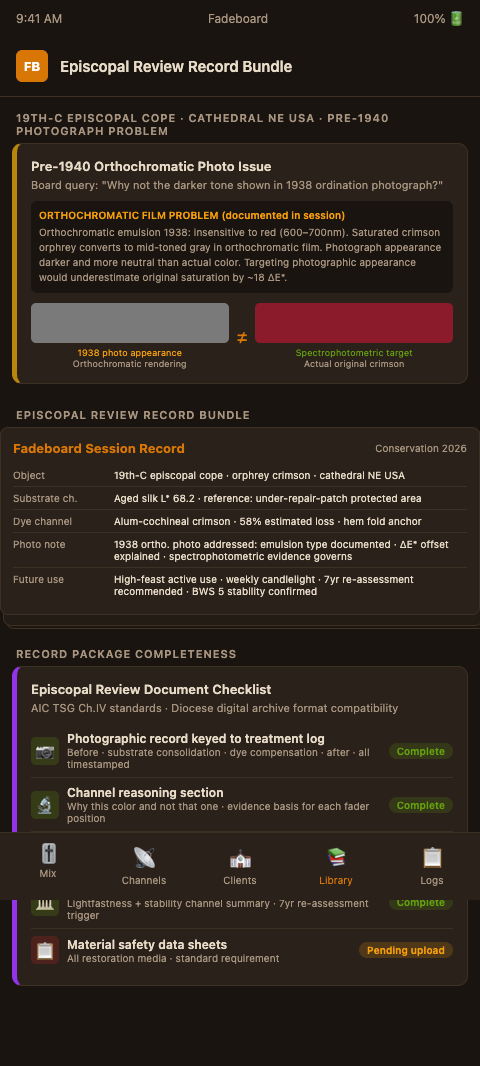
A cathedral chapter in the northeast United States submitted a vestment conservation report for episcopal review following the treatment of a 19th-century episcopal cope. The conservator had produced thorough documentation: before-and-after photographs, condition assessment, treatment summary, and material safety data for all products used. The review board returned the file with a request for clarification: could the conservator explain why the orphrey's color had been returned to a particular tone rather than a darker tone that appeared in a pre-1940 photograph of the cope in use?
The request was entirely reasonable from the board's perspective. The photograph showed the cope being worn at a diocesan ordination; the orphrey's color appeared substantially darker in that context. But the conservator had no documentation that addressed the photograph's lighting conditions, the photographic emulsion's color rendering, or the analysis that led to the current treatment target rather than the photographic appearance. The response required a supplementary memo that should have been in the original file.
This is the documentation gap that episcopal review boards encounter most often: treatment decisions that are technically sound but not explicitly connected to evidence the board can evaluate independently. The board is not doubting the conservator's judgment — it is asking to see the reasoning in a form it can record and preserve alongside the vestment's institutional history.
The pre-1940 photograph problem is common in records for Victorian and Edwardian ecclesiastical vestments, whose active liturgical periods coincided with the orthochromatic film era (sensitive to blue, insensitive to red). An orthochromatic photograph of a crimson cope orphrey will read darker and more neutral than the actual color because the film's red insensitivity converts saturated crimsons toward a mid-toned gray. A conservator who targets the photographic appearance rather than the spectrophotometric evidence will underestimate the orphrey's original saturation and warmth. The Fadeboard channel record should explicitly address any historical photographs in the file, noting the emulsion type or era and its implications for color rendering.
AIC TSG Chapter IV documentation framework for textiles establishes the professional standard: examination reports, treatment records, photographic documentation at defined intervals, and written rationale linking observations to decisions.
Structuring the Fadeboard-Derived Record
A Fadeboard session produces data across multiple record categories that map directly onto the episcopal review documentation framework.
The examination record begins with the intake session, where spectrophotometric baseline readings and the initial channel configuration are established. This record includes not just the readings themselves but the reasoning behind the channel settings — which areas were selected as reference points, what condition markers defined the substrate aging channel endpoint, and what evidence supported the dye loss channel calibration. When a review board asks "why this color and not that one," the channel reasoning section provides the answer without requiring a supplementary memo.
The treatment record draws on the running channel log, which captures every adjustment made to the channel settings during the active treatment period. This log is the most operationally specific documentation the record contains — it shows not just the final treatment outcome but the decision path that reached it, including any points where the initial channel setting was revised and why. For episcopal review purposes, this level of transparency signals professional rigor without requiring the board to evaluate technical specifics it may not be equipped to assess.
The photographic record should be keyed to the channel log. Photographs taken at key treatment stages — after substrate consolidation, after dye compensation, after any structural repair — correspond to channel log entries, so that the visual record and the reasoning record can be read in parallel. Review boards that receive integrated visual-and-reasoning documentation are far less likely to request supplementary clarification than those receiving photographs and text as separate document streams.
Historical Society of the Episcopal Church archives and records management guidance provides the institutional framework for what diocesan repositories expect when conservation records are deposited — a format specification that Fadeboard records can be formatted to meet directly. When the conservation record must address both a pre-treatment commission approval and a post-treatment episcopal review in a single integrated file, orphrey bands on Spanish cope hoods illustrates how that dual-phase record is structured for a case where historical attribution and canonical compliance are both at stake.
Research and documentation at the service of historic textile conservation — Ministry-level framework presents a government-level documentation structure covering object files and treatment reports that parallels the episcopal review standard in its expectations for evidence integrity and retrievability.
Advanced Tactics for Episcopal Review Preparation
Three preparation practices distinguish conservation records that pass episcopal review without revision from those that generate clarification requests.
The first is addressing comparative evidence proactively. If historical photographs, archival inventory descriptions, or comparative collection examples exist for the vestment, the record should address them explicitly — not by dismissing them, but by explaining how they were weighed against spectrophotometric evidence and channel modeling in reaching the treatment target. The cope orphrey case above failed at exactly this point. A one-paragraph note in the treatment summary addressing the pre-1940 photograph would have prevented the clarification request entirely.
The second practice concerns the vestment's future use context. Episcopal review boards increasingly request that conservation records address not just the treatment performed but the treatment's implications for future use — whether the vestment can return to active liturgical service, what use restrictions (if any) are recommended, and what the expected maintenance schedule is. The Fadeboard session file supports this by allowing the lightfastness and stability channel data to be summarized in a use-recommendation section at the end of the treatment record. A cope treated for a high-feast occasion can carry a record statement indicating expected color stability under weekly candlelight exposure for a specified number of years before re-assessment is recommended.
The third practice is format calibration for the specific diocese. Episcopal review boards vary in their technical sophistication. Some dioceses have a liturgical arts officer with conservation training; others rely on a general review committee with no textile background. Fadeboard's output can be formatted at different technical register levels — the full channel data for technically sophisticated reviewers, a plain-language summary for general committees. Having both available without additional writeup effort is the practical advantage of the session-derived record over manually constructed documentation.
Future liturgical pigment work examines how digitized conservation records are changing the expectations of review bodies — a relevant forward-looking context for studios investing in rigorous documentation now.
Historical society records assembly for quilt conservation presents the secular institutional parallel — the same record-structure challenges apply when quilts are treated for historical society ownership rather than diocesan custodianship, and the solutions translate with minor adjustment for ecclesiastical vocabulary.
Episcopal Church digital archives platform documentation illustrates the format and scope expectations of the official diocesan digital repository — the destination into which conservation records for significant vestments may ultimately be deposited, and whose format expectations the record should anticipate from the first session.
The Record as a Gift to the Next Conservator
The diocesan cope's review board request was, at root, a reasonable stewardship question: how do we know the decision was right? The answer to that question lives in the channel reasoning, the comparative evidence note, and the channel log. All of it should be in the primary record rather than reconstructed on request.
Consider the conservator who receives a 19th-century episcopal cope for treatment in 2045 and discovers a previous treatment from the 2020s. If the 2020s treatment produced a Fadeboard session record with channel reasoning, comparative evidence citations, and a running treatment log, the 2045 conservator can reconstruct what was done, why, and what limitations were accepted. If the 2020s treatment produced only before-and-after photographs and a material safety data sheet, the 2045 conservator has no basis for distinguishing the 2020s treatment areas from the original silk — a potentially irreversible loss of evidentiary information that no amount of future analytical work can fully recover.
The session record is not primarily for the episcopal review board. The episcopal review board is a near-term audience. The primary audience for rigorous documentation is the conservator who will next treat the vestment, which may be twenty, fifty, or a hundred years from now. Building that record with the next conservator in mind — with explicit channel reasoning, comparative evidence citations, and use-condition projections — is the highest-value single act of professional generosity a vestment conservator can perform.
If your studio is preparing for a formal episcopal review submission, or building a documentation protocol for ongoing diocesan relationships, Fadeboard's session format can be configured to produce review-ready records as a byproduct of normal treatment workflow. Contact us to discuss how to structure your intake and treatment sessions for episcopal review compatibility from the outset.