Restoring Orphrey Bands on Antique Spanish Cope Hoods
What the Hood Saw That the Body Did Not
A Castilian cope from the mid-17th century arrived at a specialist studio with its body in stable, if faded, condition and its hood in substantially worse shape. The hood had spent extended periods in contact with the collar of the cope, which had accumulated beeswax residue from liturgical use and periodic applications of a lanolin-based textile conditioner applied at an unknown point in the 19th century. The beeswax and lanolin penetration had altered the way the hood's silk brocade ground absorbed both light and humidity — creating a localized micro-environment that had accelerated the degradation of the cochineal-dyed silk weft threads on the hood while the body's comparable threads retained more of their original hue.
The orphrey embroidery on the hood depicted a full-figure saint in point-work with an architectural canopy above — a standard Spanish program for high-status cope hoods from Toledo and Castilian workshops of the 17th century. The figure's robes were worked in a red-and-gold compound embroidery whose red component had blanched differentially: the outer robes had retained color near the figure's core but blanched at the perimeter where the beeswax contamination was heaviest.
Restoring the hood required a channel model that could account for the differential degradation between contaminated and uncontaminated zones of the same color field — not just the aggregate fading of the entire hood.
First multitechnical study of Spanish liturgical cope and chasuble fabrics — EPJ Plus provides the analytical foundation for the Iberian vestment palette: indigo, alum-mordanted cochineal, and gold-silver thread alloys are confirmed as the dominant technical materials in period-appropriate Spanish liturgical textiles, with dye identification by FORS and XRF confirming what is documented in guild and inventory records.
Channel Architecture for the Spanish Hood
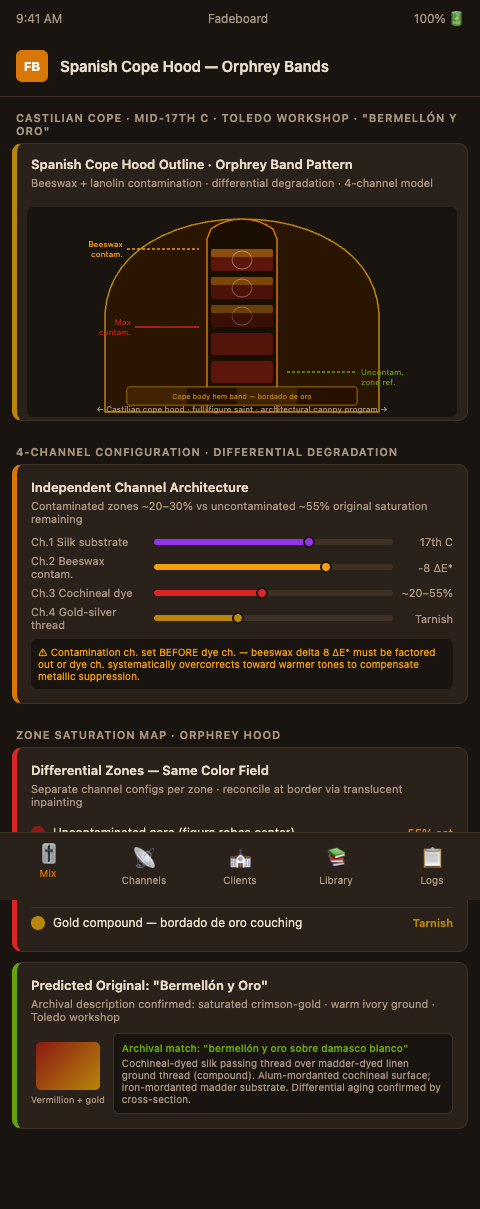
The Fadeboard session for the Castilian cope hood used four channels — a configuration justified by the material complexity of the piece.
The substrate channel addressed the silk brocade ground's ambient aging, calibrated against a reference area on the interior face of the cope body where beeswax contamination had not penetrated. This gave the baseline aged-silk reading independent of the contamination effect.
The contamination channel was a new addition specific to this case. Rather than treating the beeswax and lanolin penetration as background noise in the substrate channel, the session modeled it as a separate factor with its own fader position. The contamination channel was calibrated by comparing spectrophotometric readings from a heavily contaminated zone against the uncontaminated reference area and calculating the delta attributable to the contamination layer rather than to silk aging. At full contamination (fader at maximum), the contamination channel suppressed the substrate channel's reading by approximately 8 delta-E units — a substantial effect that would have produced a systematic error in the dye channel if left unmodeled.
The dye channel used the contamination-corrected substrate channel as its anchor. The cochineal on the uncontaminated areas had degraded to approximately 55 percent of estimated original saturation — a moderate loss consistent with 17th-century Castilian cochineal under non-contaminated sanctuary conditions. The contaminated areas showed 20 to 30 percent of estimated original saturation, the additional loss attributable to the contamination channel's accelerated degradation effect.
The fourth channel addressed the gold-silver thread separately, using the same metallic tarnish logic discussed in other high-metallic-content Spanish vestment analysis. HPLC-ESI/MS/MS study identifying natural dyes in medieval Iberian liturgical paraments provides direct methodological precedent for the dye identification step that preceded the channel configuration.
With all four channels set, the predicted original hood color emerged: a saturated crimson-gold compound embroidery on a ground that read as warm ivory under candlelight — consistent with the warm tones associated with Toledo workshop production in the 17th century and with the archival description of the vestment as "bermellón y oro sobre damasco blanco."
Advanced Tactics for Spanish Orphrey Embroidery
Spanish cope hood embroidery presents several technical features that require specific channel tactics beyond the standard configuration.
Toledo and Castilian workshops from the 16th and 17th centuries used a red-and-gold compound that layers cochineal-dyed silk passing thread over a madder-dyed linen ground thread in some programs. When both are present, the apparent surface color is a compound of two different dye systems aging at different rates. If the surface cochineal has faded while the underlying madder has not, the embroidery's apparent hue shifts toward the orange-brown of the madder rather than purely blanching toward cream. The dye channel in Fadeboard should be set for the compound read, not for cochineal alone, when this layering is confirmed by cross-section examination.
Bordado de oro (goldwork embroidery) in Spanish ecclesiastical tradition frequently uses a silk couching thread whose color was chosen to harmonize with the gold rather than to read as an independent color field. When this couching thread fades, it can subtly shift the apparent warmth of the gold-ground areas without any change in the metallic thread itself. The tarnish channel should be checked against uncontaminated couching thread samples to verify whether the apparent change in the gold ground is metallic or silk-couching in origin.
For hood-specific restoration, the most effective approach is to treat the contaminated and uncontaminated zones of the same color field as separate treatment areas with separate channel configurations and reconcile them at the border zone. Trying to apply a single channel setting to the entire hood produces a target that is too saturated for the uncontaminated areas and too muted for the contaminated ones. The reconciliation at the border zone uses translucent layered inpainting to smooth the transition, with the contamination channel serving as the quantitative basis for deciding how many layers to apply in the transition zone.
The Fadeboard 1480 Florentine chasuble orphrey case study demonstrates the channel logic for Italian orphrey panels — a useful reference for understanding how the Spanish case differs in its inclusion of the contamination channel and the compound dye structure.
For the diocesan approval stage, soundboard proofs for diocesan commission boards covers how to present a multi-channel configuration to a review body — including how to explain the contamination channel's role in producing a treatment target that differs from the uncontaminated body color.
The Opus Anglicanum analysis of the 14th-century Vic cope provides archival and technical context for Spanish cope hood construction and provenance documentation — a direct reference for studios working with Catalan and Castilian cope traditions.
Baltimore Album quilt border restoration methodology offers a structural parallel: restoring concentrated embroidery and appliqué at the perimeter of a larger textile where differential environmental exposure has produced zone-specific degradation patterns — the same differential channel problem the Spanish cope hood presented, in a different material context.
MDPI Heritage multi-analytical study of Pope Pius VII ecclesiastical vestments — using UV luminescence, NIR, and direct pigment analysis — demonstrates the multi-method protocol that supports cope hood color reconstruction when archival documentation is incomplete.
Spanish Vestments Deserve Spanish Analysis
The Spanish ecclesiastical tradition is underrepresented in the Anglo-American conservation literature relative to its historical importance and the scale of surviving vestments in diocesan and monastic collections. Studios working with Castilian, Aragonese, or Catalan liturgical textiles often need to draw on Spanish museum and university literature that does not appear in standard English-language conservation training.
Fadeboard's channel framework accommodates the analytical inputs from any source — Spanish FORS data, Iberian dye reference spectra, or regional guild-document cross-references — as channel calibration anchors, regardless of what language the underlying literature is in. If your studio works regularly with Spanish ecclesiastical textiles, contact us to discuss how to build a session library calibrated to the Iberian dye tradition and how that library can support efficient channel configuration across multiple commissions from the same regional collection context.