Case Study: Restoring a 1480 Florentine Chasuble Orphrey
When the Orphrey Tells You Nothing
A private diocesan collection in northern Italy sent a 1480s chasuble for assessment after it had been in storage for at least sixty years. The central orphrey band — a strip of figural embroidery depicting scenes from the Passion — arrived with silk ground threads so bleached that the first spectrophotometric readings returned L* values above 85 across the entire strip. The crimson that archival inventory entries described as "rosso kermes di Firenze" had vanished. What remained was structural embroidery: silk couching in cream, fragments of gilt-silver passing thread, and faint shadows of the original composition visible only under raking light.
The velvet pile of the chasuble body had fared better, retaining some of its wine-dark character in the protected folds at the hem. But the orphrey, exposed on the front panel for five centuries of liturgical use, had taken the full force of candlelight, incense smoke, and periodic cleaning with alkaline detergents.
Before treatment could begin, the conservation team needed to answer two questions separately: What had the original kermes crimson looked like on this particular silk ground? And how much of the current appearance came from the natural aging of the silk substrate itself, independent of dye loss? Conflating those two questions was the error that had produced mediocre past restorations on comparable objects. Answering them together, without a structured model, invariably collapsed both into a single eyeballed judgment.
Italian Art Society research on brocade fabrics in Quattrocento Florence documents the specific silk and metallic weft traditions of the period, confirming that kermes-dyed grounds with gilt-passing thread were the standard finish for high-status orphrey work produced in Florentine workshops during the 1470s–1490s.
Building the Fader Model for the Orphrey
Setting up Fadeboard for this chasuble required constructing two channels before touching any dye bath or inpainting medium.
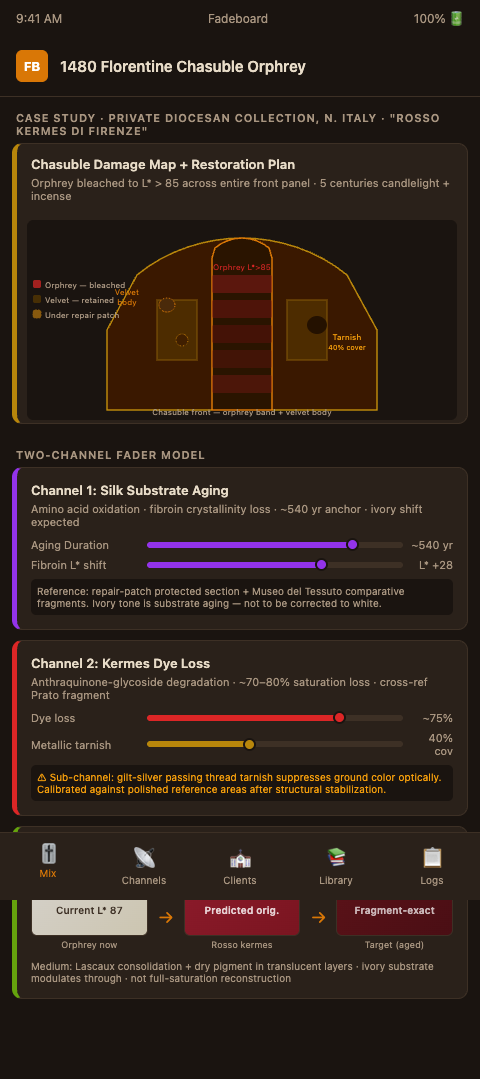
The first channel addressed the silk substrate itself. The cream-to-ivory tonal shift of aged silk follows a predictable degradation curve driven by amino acid oxidation and the breakdown of fibroin crystallinity. The channel was anchored against two reference points: the surviving silk ground in an unexposed section found under a later repair patch, and comparative spectrophotometric data from silk fragments of known age held in the diocesan collection. The fader for this channel was set to represent approximately 540 years of ambient aging — the conservative mid-point of probable manufacture date to current condition.
The second channel addressed the kermes dye itself. Kermes is among the more lightfast of the medieval red dyes, outperforming both madder and logwood under comparable light exposure, but it is not permanent. At extended exposure, the principal colorant anthraquinone-glycosides shift toward orange before blanching entirely. The dye channel fader was moved to model approximately seventy to eighty percent loss from an assumed starting saturation — a figure cross-referenced against a surviving fragment of 15th-century Florentine orphrey silk in the Museo del Tessuto collection in Prato, which retains partial color under the same aging conditions. Historic Textiles Collection at Museo del Tessuto provided the comparative datum that anchored the dye channel calibration.
With both channels set independently, the predicted original hue emerged: a dense, warm crimson with a bluish-red cast — consistent with high-quality kermes at full saturation on a weighted silk ground. Critically, the model confirmed the ivory of the current substrate was not a failure of restoration intent but an expected condition of the silk itself under identical aging. Any attempt to restore the silk ground to pure white would overshoot the actual aged substrate and produce a visible discontinuity between repaired and original areas.
The soundboard's output — the combined predicted color reading — then drove the selection of restoration media. For the silk ground inpainting, a conservation-grade Lascaux Medium for Consolidation with dry pigment toned to the predicted crimson was applied in translucent layers, allowing the ivory of the aged substrate to modulate through. The approach was fragment-exact: not a reconstruction of the original crimson at full saturation, but the original crimson as it would appear after five centuries of the same conditions the orphrey had actually experienced.
Advanced Tactics for Orphrey Color Recovery
The two-channel model works well as a starting point, but Florentine orphrey panels from the 1470s–1490s period present a third complication that benefits from a supplementary sub-channel: the gilt-passing thread tarnish layer.
Silver-gilt passing thread, when tarnished, introduces a gray-brown optical filter over whatever ground color sits below it. This is not a dye phenomenon — it is a metallic surface oxidation that changes the perceived color of adjacent embroidery without affecting the silk at all. In the chasuble under study, roughly forty percent of the orphrey surface carried this tarnish overlay. Without modeling it, the dye-channel fader would systematically over-correct toward warmer tones to compensate for what was actually a cool metallic suppression.
The solution was to introduce a metallic tarnish sub-channel operating at a partial weight within the dye channel. The sub-channel was calibrated against polished reference areas of the same passing thread where surface oxidation had been gently reduced during the structural stabilization phase. Once the tarnish suppression was factored out, the dye channel required only minor adjustment to its endpoint estimate.
The resulting treatment protocol was submitted to the diocesan commission alongside the Fadeboard session printout showing the individual channel positions and their calibration basis. This matches the approach discussed in soundboard proofs for diocesan commission review, where the channel model itself becomes part of the formal evidence package.
The Royal School of Needlework studio documentation for medieval orphrey conservation outlines the photographic and written record requirements that institutional reviewers expect when orphrey-banded vestments are treated — a benchmark the Fadeboard printout was formatted to meet directly.
Work on dye forensics in 14th-century Italian brocade addresses the analytical methods that can confirm dye identity before channel calibration begins — a step the Florentine chasuble team took as a precautionary measure given the orphrey's monetary and devotional significance.
When the chasuble returned to the sanctuary after treatment, the orphrey read correctly under candlelight. The color was not the saturated crimson of a fresh Florentine workshop commission. It was the muted, aged crimson of a vestment that had served five centuries of liturgical use — which was precisely the point.
Honor the Thread, Not Just the Hue
This case illustrates why fragment-exact restoration of Florentine orphrey pigments cannot be reduced to color matching by eye. The conservator's judgment is still essential — but that judgment is most reliable when supported by a model that separates what the silk has done from what the dye has done. Fadeboard provides that separation in a format that is both operationally usable and formally defensible.
For vestment conservators working with similarly complex Renaissance orphrey panels, particularly those with surviving archival records or comparative collection fragments, the two-channel approach plus metallic sub-channel described here offers a reproducible starting framework. The 1862 sampler quilt restoration methodology demonstrates how the same independent-channel logic applies when substrate degradation and dye loss occur at different rates — a structural parallel worth reviewing before tackling any pre-modern textile.
If your studio is working through a comparable high-stakes orphrey restoration and you need a calibrated starting model for kermes or cochineal crimson on aged silk grounds, the Fadeboard team offers session-by-session consultation support. Contact us to discuss how the channel configuration used in this case study can be adapted to your specific piece.