Advanced Dye Forensics on 14th-Century Italian Brocade
Reading Trecento Silk Without a Document Trail
A panel fragment from a 14th-century Italian brocade chasuble arrived at a textile conservation laboratory with no surviving provenance. The piece had been separated from its original vestment at an unknown point, likely during a 19th-century repair campaign that stripped the orphrey panels for reuse. The ground weave was a compound twill in silk with a gold-wrapped linen weft — consistent with Lucca or early Florentine production from the 1330s–1380s — but the color of the silk weft threads had degraded to a muted brownish-rose that gave no clear indication of the original dye or its original saturation.
Brocade conservation from this period presents a specific forensic challenge: the two great Trecento dye traditions — lac, kermes, and weld from the Italian peninsula's own trade networks versus imported indigo from the Eastern Mediterranean — leave degradation signatures that can be superficially similar in advanced stages of fading. An educated eye can narrow the range, but committing to a channel configuration in Fadeboard without analytical confirmation risks producing a color target that is simply wrong.
For the brocade fragment in question, the Lucca hypothesis was favored by the compound twill weave structure — a construction technique documented in Lucchese guild records from the 1340s through the 1380s, before the city's silk weaving families relocated to Florence after the political disruptions of that period. The gold-wrapped linen weft was consistent with Cyprus gold production, which Lucchese weavers sourced through Venetian trade networks. This circumstantial identification narrowed the dye candidates to kermes and weld, which were the dominant red and yellow colorants for high-quality Lucchese liturgical production, with lac as a secondary possibility for lower-grade red work. Without the HPLC confirmation, however, the forensic reasoning remained circumstantial — useful for narrowing but not sufficient for committing to a channel target.
HPLC-ESI/MS/MS identification of orcein and natural dyes in medieval liturgical paraments provides direct methodological precedent: the study used high-performance liquid chromatography with electrospray mass spectrometry to identify orcein, kermes, madder, and weld in actual liturgical vestment fragments from the 14th and 15th centuries, achieving dye identification from micro-samples of under 0.5 milligrams.
Forensic Analysis as Channel Input
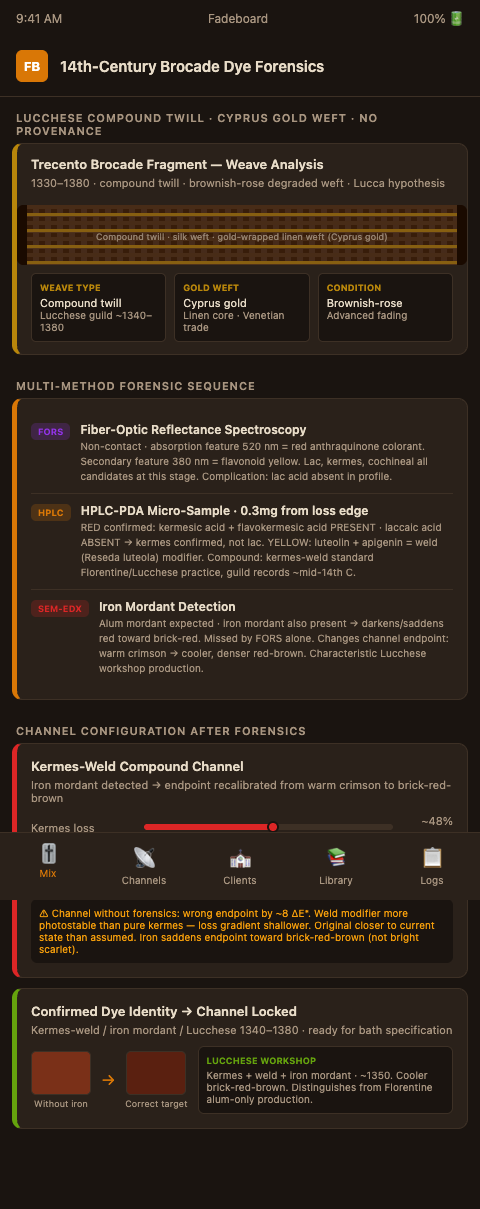
The analytical protocol for the brocade panel began with FORS (fiber-optic reflectance spectroscopy), a non-contact method that produces reflectance curves for comparison against reference spectra. FORS is fast and leaves no mark on the textile, making it the appropriate first-pass tool on a fragment of uncertain condition. The reflectance curve showed an absorption feature centered near 520 nanometers — consistent with a red anthraquinone colorant — and a secondary feature near 380 nanometers that suggested a flavonoid yellow component was also present in the weave.
The flavonoid signal complicated the identification. Lac, kermes, and cochineal all produce the primary anthraquinone feature; the yellow component could indicate a compound dye using weld (Reseda luteola) as a modifier, or it could be a secondary color field from a different weft thread crossing through the sampling area. A micro-sample of approximately 0.3 milligrams was extracted from a loss area at the panel edge for HPLC-PDA analysis.
HPLC confirmed the red component as kermes (kermesic acid and flavokermesic acid markers present, laccaic acid absent) and identified luteolin and apigenin as the yellow component — confirming weld as the modifier. The compound was a standard Florentine or Lucchese practice for producing warm, slightly orange-tinted reds on brocade grounds. IK Foundation documentation of Italian silk and velvet production in medieval Trecento Florence contextualizes this compound dyeing practice within the broader workshop tradition, noting that weld modification of kermes grounds was documented in guild records from the mid-14th century.
With the dye identity confirmed analytically, the Fadeboard session could proceed with genuine confidence. The dye channel was configured for a kermes-weld compound on a weighted silk substrate, with the channel endpoint calibrated against reference spectrophotometric data from comparable fragments of known Trecento provenance. The substrate channel addressed the silk's amino acid degradation separately, using L* values from the gold-weft areas where the silk was partially protected from direct light exposure.
From Forensics to Channel Calibration
The forensic results changed the channel configuration in two ways that would not have been apparent from visual assessment alone.
First, the kermes-weld compound degrades more uniformly than pure kermes, because weld's luteolin is slightly more photostable than kermesic acid under the specific conditions of candlelit sanctuary use. The dye channel's loss gradient was therefore shallower than it would have been for a pure kermes ground — the original saturation was closer to current condition than an untested assumption would have suggested. Without the analytical confirmation, the dye channel would have been set too high, producing a color target that overstated the original crimson.
Second, the HPLC data revealed traces of an iron mordant alongside the expected alum. Iron mordanting on a kermes-weld compound darkens and saddens the red toward a brick-red tone rather than the bright scarlet associated with pure alum mordanting. This mordant signature was not visible in the FORS curve and would have been missed without the micro-sample analysis. Once factored into the dye channel endpoint, the predicted original color shifted from warm crimson toward the cooler, denser red-brown characteristic of Lucchese workshop production.
npj Heritage Science review of advanced analytical techniques for heritage textiles documents the integration of HPLC-MS, FORS, and Raman in a single analytical workflow — the multi-method approach that produced the brocade panel's reliable dye profile.
For vestment conservators working with comparable Trecento fragments, the principle holds regardless of laboratory access level: Fadeboard channel settings are only as reliable as the dye identification that anchors them. For pieces with clear provenance and well-documented dye traditions, educated inference from period and region may be sufficient. For undocumented fragments or pieces where the stakes of an error are high — a chasuble that will return to active liturgical use at a cathedral, a brocade panel destined for a museum loan — analytical confirmation before channel calibration is the defensible standard. The cost of a 0.3 milligram micro-sample and HPLC analysis is trivial relative to the cost of a channel configuration that was built on a wrong assumption.
Raman-informed soundboard adjustments on metallic grounds extends the forensic approach to gilt threads, where Raman spectroscopy identifies the metallic composition that drives the secondary channel configuration for metallic ground vestments.
The cochineal forensics work in medieval piecework quilts demonstrates the same principle in a different textile context — HPLC confirmation of dye identity before channel calibration, applied to cochineal on cotton rather than kermes on silk, but structurally identical in its logic.
Why Forensics Belongs at the Front of the Workflow
The brocade panel case underlines a sequencing principle that experienced conservators have always understood but that becomes explicit in a channel-based workflow: the forensic question and the color-channel question are not the same question, and answering them in the wrong order wastes time and introduces compounding errors. For a 14th-century Italian brocade chasuble without provenance, committing to a channel target before dye identification means building on an assumption that may be wrong — and when the HPLC results contradict the assumption, every channel setting must be rebuilt from scratch rather than refined from a correct starting point.
Fadeboard's architecture makes this sequencing explicit by requiring dye identity inputs before the dye channel can be meaningfully configured. If your studio is working with undocumented Italian brocade fragments, the silk weft thread dye stability work covers what happens at the other end of the forensic pipeline — once dye identity is confirmed and channels are set, how does the restoration dye chosen for compensation compare to the original in terms of long-term chemical stability?
If your practice includes Trecento or Quattrocento brocade vestments and you are building a forensic-to-channel workflow for the first time, Fadeboard's team can advise on the analytical handoff points and how to structure your session files for maximum usefulness in future comparable commissions. Learn more and get started by joining the Fadeboard waitlist — conservators working with undocumented Italian brocade fragments can open a session now and use the kermes-weld channel configuration as the starting framework before their next commission is submitted for diocesan approval.