Chemical Stability of Restoration Dyes on Silk Weft Threads
What Goes Into the Silk Must Come Out Eventually
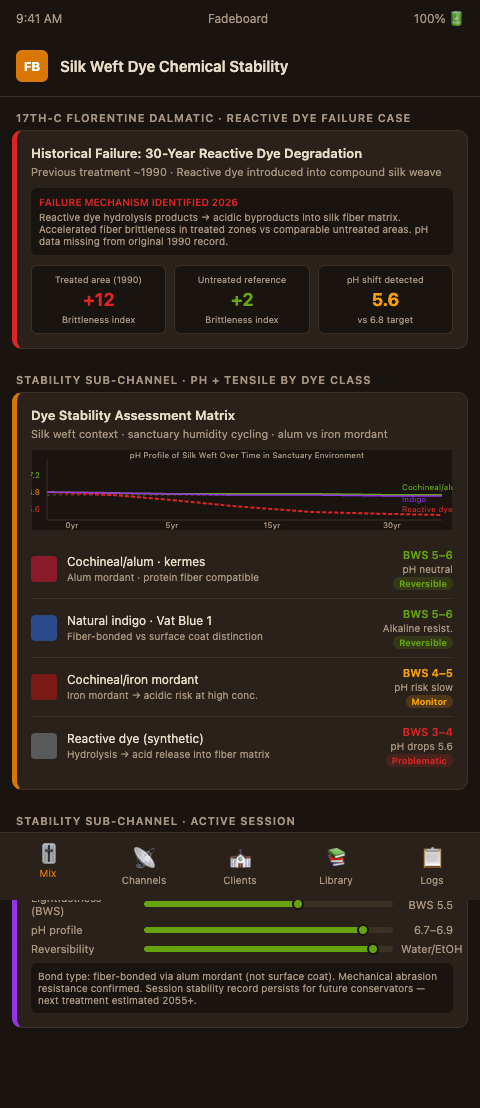
A conservation laboratory treating a 17th-century Florentine dalmatic discovered during treatment review that a previous restoration — carried out approximately thirty years earlier — had introduced a synthetic Reactive dye into a loss area of the weft ground. The dye had been carefully matched in color at the time of the earlier treatment. But over three decades of sanctuary use, the reactive dye had begun releasing acidic hydrolysis products into the adjacent silk fiber matrix. The area showed accelerated silk brittleness relative to comparable areas treated with natural dye media or left as bare warp.
The failure was not the dye selection itself — reactive dyes were considered acceptable conservation materials in some contexts at the time of the earlier treatment. The failure was the absence of a recorded stability assessment that would have flagged the pH implications for silk fiber contact under the specific humidity cycles of the sanctuary environment.
This case sits at the center of the chemical stability question for restoration dyes on silk weft threads. The restoration dye is not an isolated intervention — it is a material placed in direct contact with a fiber that may already be weakened, that will experience humidity cycling, candlelight heat, periodic cleaning, and incense resin deposition for an unknown future period. The stability of the dye-fiber system over that future period is a conservation responsibility that begins at the moment of dye selection.
AIC TSG Chapter VI guidance on compensation dyes for textile loss areas establishes the professional standard for restoration dye selection: reversibility and chemical compatibility with the substrate take precedence over color accuracy when the two are in tension. Formatting the stability channel data for institutional review is covered in conservation records for episcopal review boards — including how to present the dye-fiber pH data in a form that a diocesan archivist can interpret without conservation training.
The Stability Channel in Fadeboard
Fadeboard addresses dye stability not as a separate assessment but as an embedded channel variable that connects the current treatment decision to the long-term record.
After the primary color channels are set — substrate aging and dye loss — the session includes a stability sub-channel for the proposed restoration medium. This sub-channel records three parameters: the dye's measured or cited lightfastness rating (ISO Blue Wool Scale or equivalent), its known pH profile under ambient humidity conditions relevant to sanctuary use, and its reversibility status under the solvents appropriate for future conservation access.
For the dalmatic case, this sub-channel would have recorded that the reactive dye's hydrolysis products lower the local pH of the silk fiber matrix over time — a known property of unreacted reactive dye residues. That entry, persisting in the session file, would have flagged the degradation pathway for the laboratory that encountered the problem three decades later, and would have prompted an earlier intervention before the fiber brittleness became significant.
The stability channel does not make the dye selection decision — the conservator makes that decision based on all available information. But it makes the basis of the decision explicit and retrievable. Future conservators who open the session file see not just what dye was used and what color it produced, but what the selecting conservator knew about its stability profile and what limitations were accepted as part of the treatment compromise.
ResearchGate study on cochineal dyeing and ageing of silk provides experimental data on cochineal's color change trajectory in aged silk under light and thermal stress — a direct example of the kind of stability data that feeds the stability sub-channel when cochineal is the selected restoration medium.
Evaluation of dyes for conservation and restoration of archaeological textiles presents a comparative stability assessment of natural and synthetic dyes across multiple criteria — lightfastness, reversibility, pH profile, and fiber compatibility — providing a reference framework for populating the Fadeboard stability sub-channel across dye types.
Stability Tactics for Specific Silk Weft Contexts
Different silk weft contexts present different stability challenges, and the channel configuration should reflect the specific context of each vestment.
For compound weaves with both silk weft and linen or wool weft threads in the same fabric — common in Baroque-era European liturgical brocades — the stability channel must account for the different fiber chemistries present. A dye that is pH-neutral on silk may behave differently where it contacts the adjacent wool weft under humidity cycling. The sub-channel in Fadeboard accommodates this by allowing fiber-type variables to be noted alongside the dye data, so the stability assessment applies to the specific fiber context rather than the dye in isolation.
For Marian blue vestments where indigo is the original colorant and the restoration medium is likely to be either natural indigo extract or a synthetic Vat Blue 1 equivalent, the stability comparison is relatively favorable — both materials have well-documented alkaline resistance and low acid release profiles. The primary stability variable for indigo restoration on silk weft is dye penetration: whether the restoration medium bonds to the fiber or rests as a surface coating. Surface coatings on weft threads are subject to mechanical abrasion during active liturgical use in ways that fiber-bonded dyes are not. The stability sub-channel records the bond type along with the lightfastness and pH data.
For kermes and cochineal restoration on red-ground vestments — the most common color in high-feast vestments — the stability question centers on mordant type. Alum-mordanted cochineal on silk has excellent fiber compatibility; iron-mordanted cochineal introduces the same acidic pH concerns as reactive dyes at high concentration, though at a slower rate. When iron mordanting was identified in the original dye through forensic analysis, Fadeboard's stability sub-channel is used to flag that any restoration cochineal using an alum mordant will be chemically distinct from the original dye system — a difference that may have long-term implications for differential aging.
Future liturgical pigment work addresses how emerging analytical methods for in-situ dye-fiber stability assessment will change the standard of care for restoration dye selection over the coming decade.
quilt cotton stability provides a useful comparative case — the stability channel logic is identical for cotton-based textile conservation, and the dye evaluation frameworks transfer directly with appropriate adjustment for protein versus cellulose fiber chemistry.
NIST foundational study on accelerated aging protocols for silk fibers establishes the accelerated aging methodology that underpins stability predictions for silk under controlled conditions — the experimental foundation that modern stability assessments are designed to update and extend.
The Stability Record as Institutional Memory
The dalmatic case that opened this post is instructive not because the earlier treatment was negligent — it was not — but because the absence of a stability record meant the laboratory treating the vestment thirty years later had no way of knowing what had been introduced into the silk fiber matrix and why. That institutional memory gap is preventable.
Fadeboard's stability sub-channel is one of the lowest-cost, highest-value additions to a conservation studio's session protocol. The data entry is brief; the benefit to future conservators is substantial. If your studio is treating silk weft vestments where restoration dyes are applied to loss areas that will remain in sanctuary use for decades, contact us to discuss how to configure the stability channel for your standard dye palette.