Raman-Informed Soundboard Adjustments on Metallic Grounds
The Ground Color You Cannot Trust by Eye
A private collector brought in a mitre of Eastern European Orthodox origin, probably 18th-century, with a ground embroidered in a medium that appeared, under standard studio lighting, to be a faded dark blue. The conservator's first instinct — indigo on a damask silk ground — was consistent with the piece's period and probable region of origin. Byzantine-influenced Orthodox vestments of this period routinely used indigo for episcopal ground colors, and the visual appearance was plausible.
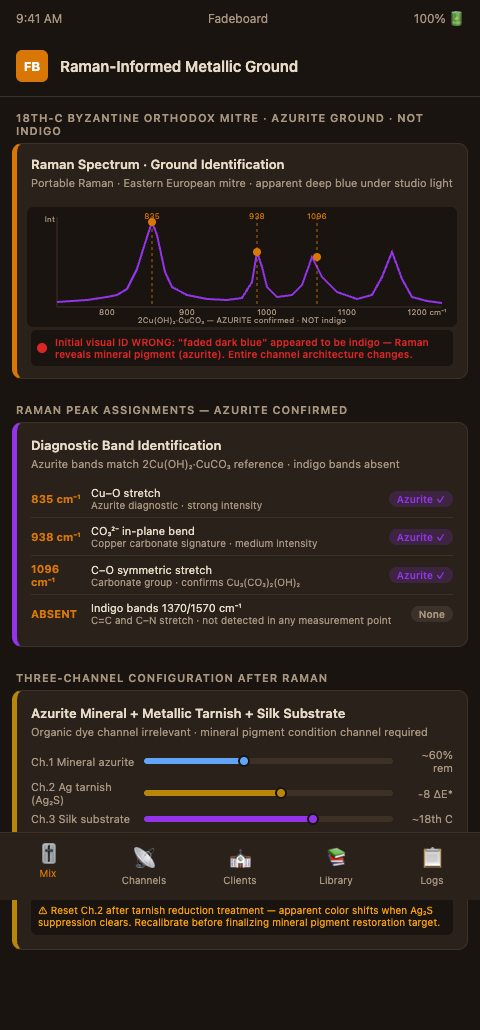
Before configuring any channel in Fadeboard, the studio ran a portable Raman spectrometer over the ground areas. The spectral signature returned characteristic bands at 1096, 938, and 835 cm⁻¹ — not the broad, featureless profile expected from aged indigo, but the diagnostic bands of azurite (2Cu(OH)₂·CuCO₃). The ground color was not a dye at all; it was a mineral pigment applied in a binder over the silk ground weave, a technique documented in Byzantine embroidery but uncommon in Western ecclesiastical work. The gray-green shift at the surface was copper corrosion, not dye fading.
This identification changed the entire channel configuration. Azurite's degradation pathway is not a photochemical dye loss process — it is a chemical transformation of the copper carbonate mineral under alkaline conditions and humidity. The dye channel, as configured for an organic colorant, was irrelevant. What was needed was a mineral pigment condition channel and a separate metallic corrosion sub-channel for the tarnished gold-silver passing thread that ran through the embroidery.
The misidentification risk is not theoretical. In Eastern European Orthodox vestment production from the 17th through the 19th century, episcopal grounds in blue and blue-green tones used both indigo and mineral pigment applications, sometimes in the same workshop and sometimes on the same vestment — indigo for the woven silk fields and azurite-in-binder for applied embroidered medallions. Without Raman confirmation, the conservator has no reliable way to distinguish the two from visual examination alone, particularly after two centuries of differential fading have brought both toward a similar grayish-blue tone.
MDPI Molecules 2024 review of Raman spectroscopy in cultural heritage documents the expanding use of portable Raman instruments for in-situ pigment identification on ecclesiastical objects — precisely the application that averted the misidentification in this case.
Configuring Metallic Ground Channels
Fadeboard's channel architecture accommodates metallic grounds by separating the organic and inorganic degradation pathways into distinct channels with independent calibration.
For the mitre, the configuration used three channels rather than the standard two. The mineral pigment channel tracked the azurite's original saturation against its current degraded state, using the reflectance curve from a protected area under an embroidered appliqué as the baseline anchor. Azurite at original condition produces a characteristic blue with L* around 40–45 and strong b* negative values; the current surface showed L* near 58 and a greenish b* positive shift, representing substantial mineral conversion. The channel fader was set to model approximately 60 percent of the original saturation remaining in the most degraded areas.
The metallic thread tarnish channel addressed the silver-gilt passing thread separately. Raman confirmed that the thread was silver-gilt over a linen core, with surface corrosion products producing Ag₂S (silver sulfide) and Ag₂SO₄ bands. The tarnish layer was suppressing the reflectance of the adjacent azurite ground, contributing to the apparent darkening of the blue tone. Once calibrated, this channel's output was subtracted from the mineral channel's reading to produce the apparent color in current condition — confirming that the visual impression of the ground's current state was a compound effect of two independent degradation processes, not a single dye fading event.
The third channel was the silk substrate condition channel, set to account for the silk ground weave's own aging independent of the pigment layer. Silk beneath a binder-applied pigment degrades differently from silk dyed in solution — the binder layer provides partial mechanical protection from direct light exposure but can trap alkaline cleaning products that accelerate silk fiber degradation in specific areas. When the mineral identification reveals a compound ground with both organic and inorganic colorants, the channel model must be built from analytical evidence rather than visual assumption — the methodology covered in Italian brocade dye forensics for how multi-technique analytical pre-work shapes a complex channel configuration.
npj Heritage Science non-invasive analysis of heritage textiles with MA-XRF mapping — a study specifically examining Bishop Jacques de Vitry's mitres — demonstrates how MA-XRF combined with SEM-EDX identifies gold-silver thread alloy composition and the mineral ground pigments beneath metallic embroidery, the multi-technique protocol that underpinned the mitre's channel configuration.
Advanced Tactics for Metallic Ground Work
Metallic embroidery grounds require two additional considerations beyond the channel configuration itself.
The first is the restoration medium selection for mineral pigments. Unlike organic dye restoration where a reversible conservation-grade material approximates the original dye chemistry, mineral pigment restoration on silk grounds typically uses reconstructed azurite-in-binder — a mixture of conservation-grade azurite powder in an appropriate binding medium (Paraloid B-72 in acetone, for example) applied in controlled layers. The channel configuration determines the target color, but the medium must be tested for compatibility with the existing binder layer before application. Incompatible solvents can reactivate the original binder and cause the mineral layer to shift under the brush.
The second consideration is the predictive relationship between the metallic tarnish channel and the restoration outcome. If the tarnish layer on the silver-gilt thread is partially reduced during treatment (a standard conservation step for metallic embroidery), the apparent color of the adjacent ground will shift because the tarnish suppression effect disappears. The metallic tarnish channel must be reset after tarnish reduction and before finalizing the mineral pigment restoration target — otherwise the restored azurite will be calibrated against a tarnish-suppressed reading and will appear too saturated once the tarnish is cleared.
For the weft thread stability considerations that follow metallic ground restoration, restoration dye stability addresses how restoration materials applied to adjacent silk weft areas are evaluated for long-term compatibility.
Stereomicroscope integration with quilt fiber damage assessment describes a comparable use of high-magnification analytical work to inform channel adjustments in a textile conservation context — the same principle as Raman informing Fadeboard channel settings, applied to quilt fiber rather than vestment metallic grounds.
ColourLex Raman spectroscopy reference guide provides an accessible band-by-band interpretation resource for the pigments most commonly encountered in ecclesiastical art — a working reference for studio use when interpreting spectra before channel configuration. For studios beginning to integrate portable Raman into their intake protocol, the ColourLex reference paired with the MDPI Molecules 2024 review gives sufficient coverage to distinguish the most commonly encountered inorganic pigments — azurite, malachite, lead white, vermilion, and various iron oxides — from the organic dye baselines that the standard Fadeboard channel model expects.
Starting With the Right Question
The mitre case is a reminder that Fadeboard channel calibration is preceded by a more fundamental question: what material am I actually working with? The answer drives the channel architecture. For organic dyes on aged silk, the standard two-channel model is the right starting point. For mineral pigments on silk grounds, metallic embroidery, or compound grounds with multiple material types, the channel model must reflect the actual material reality — and Raman spectroscopy is the instrument that confirms that reality before the session begins.
For studios that have not yet integrated portable Raman into their intake protocol, the minimum viable alternative is UV fluorescence examination combined with FORS where available — both are non-contact methods that can distinguish organic from inorganic colorants in many cases before any micro-sampling is considered. Document the analytical method used in the Fadeboard session intake record, so that any future conservator reviewing the channel configuration knows whether it was anchored on Raman identification or on optical methods with their attendant ambiguity range.
If your studio encounters vestments with metallic grounds, mineral pigment layers, or compound embroidery where standard color-channel logic seems to be producing inconsistent results, contact us to discuss how Raman-informed multi-channel configurations can be adapted to your specific material context. Apply to join the Fadeboard waitlist and configure your first three-channel metallic ground session before your next Byzantine or Orthodox vestment commission requires it.