Presenting Soundboard Proofs to Diocesan Commission Boards
The Commission Board Is Not the Problem
A conservator treating a cope for a cathedral chapter submitted a detailed treatment proposal — spectrophotometric data, comparative photographs, dye identification by HPLC, material safety data sheets for the proposed restoration media. The commission board, composed of a canon liturgist, an architect, and two lay advisors, approved the proposal after a twenty-minute meeting. Three months later, when the cope was returned and placed in the sanctuary for the first time, the canon liturgist requested revisions because the hood's Sarum red orphrey did not read as "canonical red" in the context of the high altar.
The conservator's data had been impeccable. The problem was that none of the submitted materials had explained, in terms the commission could evaluate, how the restoration color related to the vestment's liturgical color category — or how it would appear specifically under candlelight at the altar rather than under the ISO D65 lighting of the conservation lab. The commission had approved the technical proposal without understanding what the color outcome would look like in use.
This is the gap that Fadeboard's proof format addresses: not better data, but a translation layer between conservation science and liturgical judgment.
GIRM Chapter V prescriptions on vestment quality and approval standards establish that liturgical vestments require episcopal approval to ensure they meet the qualitative and aesthetic standards of sacred use — a mandate that places the commission's aesthetic judgment at the center of the process, not the conservator's technical authority.
What a Channel Proof Communicates
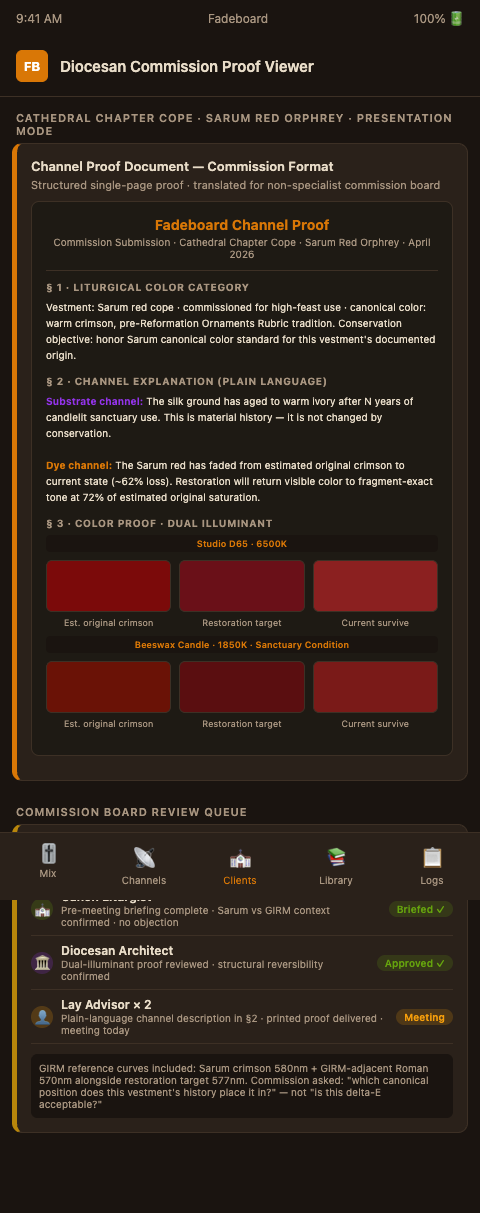
The Fadeboard proof for diocesan commission presentation is a structured single-page document derived directly from the session's channel configuration. It is not a raw spectrophotometric report. Its structure follows the commission's actual decision framework. For studios managing multiple simultaneous diocesan relationships, vestment studio soundboard pipeline expansion describes how proof generation integrates into a scaled workflow where multiple commissions are active in parallel.
The first section identifies the vestment's liturgical color category — in this case, Sarum red as the canonical color for the feast-day cope — and states the conservation objective in those terms. The commission is not being asked to evaluate a delta-E; it is being asked to confirm that the proposed color honors the liturgical color standard for the vestment's use context.
The second section presents the two channels in plain language. The substrate channel is described as: "The silk ground has aged to this tone after [N] years of use under candlelight and ambient light conditions. This is not color to be changed; it is the material history of the vestment." The dye channel is described as: "The red dye has faded from [estimated original] to [current state]. The restoration will return the visible color to [predicted fragment-exact tone], which represents [X] percent of the estimated original saturation." Non-specialist reviewers consistently find this framing accessible — it explains what has happened to the vestment and what the conservator proposes to do about it, without requiring any knowledge of colorimetry.
The third section shows two side-by-side rendered color patches: the estimated original color and the proposed restoration target. Both are shown under two lighting conditions: ISO D65 (daylight simulation) and a warm-candlelight simulation at approximately 2700K. The candlelight rendering is often the more important one for commission boards, since the vestment's liturgical context is the sanctuary rather than the conservation lab.
FDLC guidance on the role of diocesan commissions in advising bishops on liturgical art specifies that commissions function in an advisory rather than executive role — they inform the bishop's judgment rather than making binding decisions. This places the commission proof in a specific communication context: it is supporting the commission's advisory function, not seeking mere rubber-stamp approval.
Advanced Tactics for Commission Presentations
Three tactics consistently improve the commission meeting experience for vestment conservators presenting Fadeboard proofs.
The first is providing the proof in physical print rather than digital presentation. Commission boards that receive a printed proof can mark it, annotate it, and refer to it during discussion in a way that a screen presentation does not support. The proof should be printed to a calibrated standard — either on a professional photo printer with ICC profile management or through a print vendor experienced with color-critical work — so that the color patches on the print correspond to the intended values rather than drifting under an uncalibrated desktop inkjet. A proof that was accurate on screen but misrepresents the color in print has done the opposite of its job: it has introduced a new source of canonical ambiguity rather than resolving the one it was built to address.
The second tactic is sequencing the channels in the proof according to what the commission can affect versus what it cannot. The substrate channel represents existing condition — no commission decision changes it. The dye channel represents the restoration proposal — that is the decision point. Presenting substrate first, then dye, orients the board correctly: we are starting with this reality, and proposing this response.
The third tactic involves pre-meeting circulation to the canon liturgist specifically. Commission boards that include a liturgical expert tend to work most efficiently when that expert has seen the proof before the meeting and can brief the lay members on the liturgical color context. A five-minute pre-meeting conversation with the canon liturgist about whether the proposed Sarum red tone is consistent with the diocese's established color practice typically resolves the most common point of dispute before it reaches the formal review.
Preparing the session records that feed the proof is covered in conservation records for episcopal review boards — the formal documentation layer that sits behind the commission-facing proof.
For a parallel case from a different textile conservation context, museum quilt loans and soundboard records illustrates how the same proof structure functions in a secular institutional review — museum loan committees ask comparable questions to diocesan commissions, and the channel-based translation approach works in both contexts.
ICCROM conserving textiles course documentation provides a multi-institutional framework for treatment priority presentation to institutional decision-makers — a useful reference for calibrating the depth and format of commission submissions.
The Commission as Partner
The approach described here reframes the diocesan commission not as an obstacle between the conservator and the work but as a genuine partner in the liturgical stewardship of the vestment. The commission's theological judgment about what the cope's color should communicate in the sanctuary is not an interference with the conservation process — it is the destination the conservation process is serving.
This reframing has practical consequences for how the conservator presents at the commission meeting. Rather than arriving with a technical defense of why the restoration is correct — a posture that the commission may experience as dismissive of their role — the conservator arrives with a proof that invites the commission's liturgical judgment and positions that judgment as the authoritative voice in the process. The spectrophotometric precision exists to serve the commission's decision, not to pre-empt it.
For a Sarum red cope before a high-church Anglican commission, this means presenting the two reference curves — Sarum red and GIRM-compliant Roman red — alongside the restoration target and asking: which of these canonical positions does this vestment's history place it in? That question is one the commission is qualified to answer. The question "is this delta-E acceptable?" is not.
When a commission meeting produces a request for modification — the most common outcome when the proof structure is new to the commission culture — the Fadeboard session record makes that modification tractable. The conservator does not need to start over; the channel that controls the disputed attribute (usually the warmth of the red, or the blue-content of the violet) can be adjusted by a defined amount, a new proof generated, and a revised submission produced within days rather than weeks. This responsiveness is itself a form of commission confidence-building that improves relationships over multiple commissions.
Fadeboard's proof format makes that partnership concrete. If your studio is preparing for a first diocesan commission presentation or has experienced the disconnect described in the case above, contact us to discuss how to structure your proof output for the specific commission culture you are working with. Join the Fadeboard waitlist and have the proof format configured before your next Lenten, Pentecost, or Marian feast commission comes before the diocesan board.