Restoring Accent Trims on Antique Commedia Harlequin Suits
The Color Logic of the Diamond Suit
The Arlecchino costume did not always appear in its familiar diamond-lozenge form. The Metropolitan Museum's Heilbrunn timeline essay on commedia traces the costume from the rough patchwork of an early 16th-century zanni through the formalization of diamond patches in the 18th century, when the character's visual identity became codified across European theatrical traditions. By the 19th century, when many of the surviving antique harlequin suits now held in theater archives were made, the diamond pattern had become a precise grid of alternating primary and secondary colors — typically six to eight distinct hues arranged in a repeating sequence.
The restoration challenge is that the suit's meaning depends on those six to eight hues being in approximately correct proportion to each other. A faded red diamond next to a still-saturated blue diamond reads as a design error, not as an aged artifact. The Wikipedia entry on commedia costumes documents the precise pigment symbolism encoded in the diamond arrangement — some color sequences had character-specific meanings that varied between Italian, French, and English traditions. Getting the restoration wrong means misrepresenting the character's theatrical identity.
The dyes used in 19th-century theatrical harlequin suits were drawn from both natural and early synthetic sources: madder and cochineal for reds, indigo for blues, logwood or iron-mordanted tannins for blacks, weld or early aniline for yellows, and various combinations for greens and violets. Each of those dye families degrades at a different rate under the same conditions, which means a 150-year-old harlequin suit will show non-uniform fading across its diamond grid even if all the diamonds received identical light exposure.
Setting Up a Multi-Channel Harlequin Session
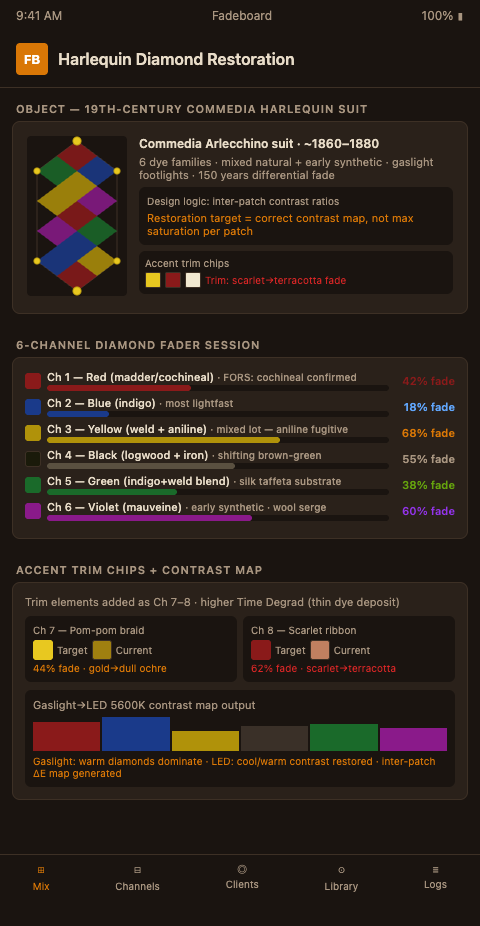
Opening a Fadeboard session for a harlequin suit requires more preparation than a session for a single-color bodice, because each distinct dye family in the diamond grid needs its own channel assignment. For a typical 19th-century theatrical harlequin with six color families, this means six active fader channels running simultaneously, each with its own dye-family degradation coefficient and each subject to the same shared lighting-era translation. The Ballets Russes case study established the template for separating multiple concurrent degradation sources within a single session — the dual-channel strategy that resolved the 1905 fragment's compound fade applies to each diamond family in a harlequin session, treating aniline and natural dye families as independent channels rather than a unified "fade."
The first step is a diamond survey: identify which diamonds belong to each color family (red, blue, yellow, black, green, violet), measure the most-faded and least-faded example within each family using FORS or contact spectrophotometry, and record the current CIELAB values for each family. The gradient between most-faded and least-faded within a family establishes the degradation range for that channel's Time Degradation fader.
Non-invasive FORS identification of natural red and purple dyes on small textile samples provides the protocol for distinguishing cochineal from madder in red diamonds — a distinction that matters for restoration because cochineal reds and madder reds respond differently to the gaslight and early carbon arc exposure common in 19th-century theatrical contexts. Getting the dye identification wrong at this stage produces a Fadeboard session with incorrect degradation rate coefficients for the red channel.
Multi-technique analysis of late-19th-century synthetic dye samples offers the parallel framework for early synthetic dyes that may appear in the yellow and green families — the presence of early aniline compounds in those positions would significantly raise the predicted degradation rate for those channels relative to a natural dye assignment.
Fader Configuration for Differential Degradation
Once the six channel assignments are set with their respective dye families and degradation rate coefficients, the session's primary analytical task is determining the restoration target for each channel. The target for each diamond family should be the color that restores the inter-patch contrast relationships to their designed state — not necessarily the maximum possible saturation for each individual family.
This is the subtlety that multi-channel sessions make tractable. A single-value "restore to original" approach would potentially over-saturate the naturally more lightfast colors (blue indigo, logwood black) relative to the more fugitive colors (aniline yellow, early synthetic green), producing a suit that looks chromatically unbalanced rather than correctly matched. The Fadeboard multi-channel session explicitly models each family's different lightfastness, and the restoration target for each channel is set to achieve perceptual equivalence across all families at the designated exhibition illuminant.
FT-IR spectroscopy as a non-invasive method for fiber identification in mixed-material trims addresses the substrate question that precedes dye identification for complex trim materials: a diamond-patch suit often uses different underlying fabrics (silk taffeta for one color family, wool serge for another, cotton twill for a third), and the substrate type affects both the dye's original anchoring and its degradation behavior. Confirming substrate identity for each diamond family allows the session to set materially accurate restoration pathways.
For the lighting-era translation, a 19th-century theatrical harlequin suit designed for gaslight footlights will show its diamond sequence under a different apparent contrast regime than under 5600K LED. Gaslight's warm-red-weighted output compresses the apparent contrast between warm (red, yellow, orange) and cool (blue, violet) diamonds; LED restores that contrast but introduces metamerism shifts in the natural dye families that shift hue angles relative to their gaslight appearance.
The Fadeboard gaslight-to-LED translation channel applies spectral model corrections that predict these inter-family contrast changes. For a harlequin suit, the output is not just per-family color targets but a contrast map showing the projected inter-patch delta-E values under the destination illuminant — the metric that determines whether the restored suit will read correctly as harlequin.
Accent Trims as Separate Session Elements
The diamond patches are the primary restoration challenge, but antique harlequin suits typically carry accent trims — pom-poms, braid edging, collar ruffles, wrist and ankle trim bands — that are made from materials entirely different from the patch fabrics. These trims may use silk ribbon, metallic braid, velvet ribbon, or wool fringe, each with their own dye chemistry and degradation history.
An accent trim that was originally a bright scarlet silk ribbon may have faded to a dull terracotta. If the restoration targets the patch reds to their original saturated state but leaves the trim at its faded terracotta, the costume reads as though the accessories were replaced with period-approximate substitutes — which is, in a sense, what fading has done, but the visual result undercuts the restoration.
The best practice is to add the trim elements as additional channels in the same Fadeboard session rather than treating them separately. This allows the session to maintain the inter-element contrast relationships for the full costume, not just for the patch grid. A trim channel with its own dye-family assignment, degradation coefficient, and restoration target is calibrated against the patch channels so that the final restored appearance is a coherent whole. The multi-element session logic that governs trim channel integration is structurally similar to the approach used in Spanish cope hood restoration in ecclesiastical conservation, where orphrey bands with multiple distinct color zones require independent channel treatment while the overall compositional logic of the vestment is maintained — a directly transferable methodology.
The Canada.ca Conservation Institute's reference on cumulative light damage mechanisms is particularly relevant for trim elements, which often have thinner dye deposits than the patch fabrics and therefore show more rapid saturation loss under the same exposure conditions. The trim channel's Time Degradation fader should typically be set at a higher loss value than the adjacent patch channel for the same dye family.
Documenting the Completed Restoration
A fully restored harlequin suit demands thorough post-treatment documentation that captures both the individual color areas and the inter-patch contrast relationships. The Fadeboard session post-treatment export includes per-channel CIELAB values, the contrast map under the exhibition illuminant, and the delta-E distance from each channel's session target.
For exhibit loan color evidence, a harlequin suit's multi-channel session export gives receiving institutions an unusually detailed color record: not just "the suit is in good condition" but a per-family saturation map, a contrast-relationship table, and the illuminant translation prediction for their specific lighting specification.
Britannica's account of Arlecchino's costume history traces the diamond lozenge from 16th-century patches to 18th-century formalization — a lineage that means the oldest antique suits in theater archives may predate the standardized lozenge arrangement and require additional research to establish which diamond color sequence represents the original design intent for that specific piece.
The Collections Trust's conservation standards for costume and textile collections apply directly to harlequin suit storage post-restoration: the multi-color structure makes flat storage in individual interleaved tissue the standard approach, and any folding or stacking that brings differently-dyed patches into prolonged contact risks dye transfer from degraded areas to adjacent fabrics.
If your archive holds antique commedia harlequin suits and has been treating them as single-color restoration problems — targeting the dominant color family while leaving other families at their faded states — Fadeboard's multi-channel session architecture gives you the tools to address the full chromatic complexity of these objects. Start with the diamond survey, configure one fader channel per color family, apply the shared lighting-era translation, and generate the contrast map as your restoration target. The result will be a harlequin suit that reads correctly as a system of color relationships rather than as a collection of individually-treated patches.