Running a Theater Archive With Soundboard Pipelines
The File-Handoff Problem
The archivist who opened the initial Fadeboard session on a 1920s vaudeville corset set the lighting-era faders, noted the aniline magenta channel readings, and documented the gaslight-to-LED translation in her session notes. Four months later, she was on sabbatical, and a colleague received a loan request for the same piece from a regional music hall museum. The colleague opened the folder, found eight photographs of varying quality and a brief condition report written in shorthand, and had no idea what color target the original archivist had established or why.
That scenario repeats across performing arts archives of every size. The Society of American Archivists performing arts resources guide identifies handoff continuity as one of the central workflow challenges in the field — not because archivists lack skill, but because color reasoning is rarely recorded in a form that another person can reconstruct without starting over.
A Fadeboard pipeline solves the handoff problem by making session files the primary record rather than a supplementary note. Every fader setting, lighting-era translation choice, and delta-E reading lives in the session file, timestamped and versioned. When the colleague opens that file, she sees exactly what the original archivist decided and why, expressed in the same soundboard vocabulary both of them were trained on.
Building the Intake Protocol
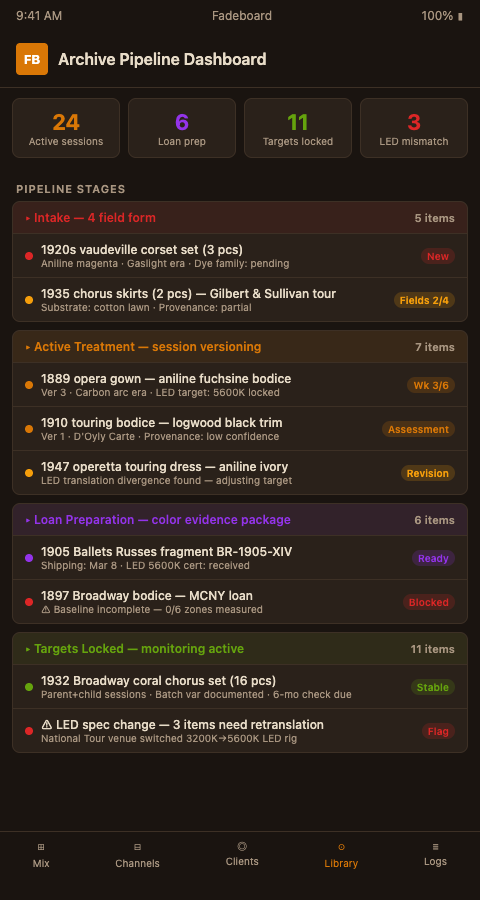
A functional pipeline begins at intake, before any color work is attempted. When a costume enters the archive — whether as a donation, an acquisition, or a returning loan — the intake archivist opens a new Fadeboard session and records four fields before touching any fader.
The first field is lighting-era assignment. Based on production records, costume construction date, or documented performance history, the archivist assigns the piece to one of the available eras: gaslight footlights, limelight, carbon arc, tungsten Fresnel, or LED. This assignment determines which translation channels appear on the soundboard for that piece.
The second field is dye family assessment. A visual inspection under raking light and examination lamp, supplemented where possible by non-invasive FORS measurement, establishes whether the dominant colorant is a natural dye (logwood black, madder red, indigo), an early synthetic aniline, or a later synthetic with better lightfastness. This assessment sets the degradation rate priors for the Time Degradation fader.
The third field is substrate condition. Silk bodices, velvet pile, cotton lawn, and wool broadcloth all behave differently under the same dye chemistry. Confirming the substrate — and noting any known treatments like tin-weighting or mordanting — ensures the session's material constraints are visible to any future user of the file.
The fourth field is provenance exposure estimate. If production records survive, log the number of documented performance seasons, touring dates, and lighting platform notes. Even rough estimates (two Broadway seasons under tungsten Fresnel, one touring leg under carbon arc) improve the degradation channel calibration significantly over treating the exposure history as unknown.
The American Theatre Archive Project's archiving manual recommends standardizing intake documentation before active treatment begins — a principle the Fadeboard intake protocol implements at the color-reasoning level.
Session Versioning and the Active Treatment Phase
Once intake fields are complete and fader calibrations are set, the pipeline enters the active treatment phase. During treatment — whether that means dye bath preparation, surface consolidation, or inpainting individual pigment losses — the Fadeboard session file is updated at each significant decision point, not just at the beginning and end.
This cadence matters operationally. A treatment that spans six weeks might involve three or four intermediate decisions: adjusting the targeted aniline magenta saturation after a test swatch comes in 4 delta-E too warm, modifying the carbon arc fader coefficient after discovering more extensive UV damage than the initial assessment showed, or shifting the LED translation target after the loan destination reports a lighting specification change. Each of those adjustments should be a new version within the same session file, with a date and a one-sentence rationale.
The ICOM guidelines for costume documentation specifically recommend that color decisions be traceable — not just the final state but the intermediate reasoning. Fadeboard's session versioning architecture implements exactly this, and the format is compatible with ICOM's Costume Documentation Guidelines, which most major theater archives already reference as a baseline standard.
For archives working across multiple institutions — a touring company's wardrobe holdings spread across three regional depositories, for instance — the session file format creates a shared reference language. Each institution can run its own Fadeboard instance and export session data in a standardized format. The receiving institution imports the session, reads the fader state, and can continue treatment from exactly where the sending institution stopped.
Loan and Acquisition Documentation
The pipeline's second major workflow is loan preparation, and this is where the operational value of a complete session history becomes most visible to external partners.
When a loan request arrives for a costume with an active Fadeboard session, the archivist generates a color evidence package directly from the session file. The package includes: the current fader state as a snapshot, the lighting-era translation applied, the predicted appearance of the piece under the loan destination's lighting specification, and the chain of session versions showing how the color documentation evolved from intake through treatment.
FADGI technical guidelines for heritage digitization require colorimetrically-grounded documentation for institutional loans — a bar that photographic records alone rarely meet. A Fadeboard session export satisfies that requirement because the underlying data is expressed in CIELAB coordinates with documented illuminant references, not just as image files.
Acquisition workflows benefit from the same structure in reverse. When the archive is evaluating a potential acquisition, the archivist runs a Fadeboard pre-acquisition session: intake fields are populated, faders are calibrated to the object's current state, and the lighting-era translation is used to estimate what a restoration would require. That session becomes part of the acquisition case file, giving curatorial and conservation staff a shared quantitative basis for the accept-or-decline decision.
For archivists building similar pipelines for opera archive evidence workflows, the loan documentation structure described here transfers directly — the main adjustment is adding the acquisition provenance fields required by opera house standards.
Scaling Across Staff and Collections
The pipeline scales because it externalizes color reasoning into a file format rather than keeping it in individual archivists' heads. A new staff member trained in the four intake fields and the soundboard channel vocabulary can contribute meaningfully to an existing session without having been present for earlier decisions. A volunteer or intern can handle the FORS measurement and delta-E logging steps without needing to understand the restoration chemistry — they record the numbers, and the session file records the interpretation.
Collections-level management benefits as well. When every costume in the archive has a Fadeboard session file, the collection manager can run a status report showing: which pieces have established restoration targets, which are still in the intake phase, which have active loan requests against partially-completed treatments, and which need lighting-era translation updates because a loan destination recently switched from tungsten Fresnel to LED.
That last point reflects a real operational challenge: LED adoption in performance and exhibition venues has accelerated substantially, and costumes whose loan documentation was prepared against a 3200K tungsten Fresnel specification may read incorrectly under the 5600K LED rig they now travel to. A well-maintained Fadeboard pipeline flags those mismatches at the session level rather than discovering them after the piece has already traveled.
The stage pigment future for theater archives depends on exactly this kind of scalable documentation infrastructure — archivists who retire or change institutions should leave behind sessions that continue to inform work, not knowledge that disappears with them.
For vestment studios managing similar pipeline complexity, the vestment studio pipeline expansion post addresses the same scaling questions in a liturgical context, with comparable session versioning approaches.
What a Mature Pipeline Looks Like
An archive that has run Fadeboard pipelines for three or more years will have a collection of session files that collectively constitute a color history of the holdings. That history is searchable: which pieces share the same lighting-era assignment, which aniline magenta formulations have been successfully matched, which logwood black treatments produced stable results over multiple monitoring cycles.
That searchability is the long-term value that justifies the investment in standardized intake protocols and session versioning discipline. Individual treatments succeed or fail on their own terms. A mature pipeline turns each treatment outcome into a data point that improves the next one.
If your archive is managing more than a handful of active costume files and finding that color rationale disappears when staff change, Fadeboard's session pipeline architecture gives you the structure to retain that reasoning permanently. Build the intake protocol first — even two or three standardized fields per session — and extend from there as staff capacity allows. The payoff compounds with every costume that enters the collection under the new protocol.
Theater archivists ready to build a pipeline that survives staff turnover and production-season pressure can open a Fadeboard account and start with the four-field intake form on the next acquisition or loan request. Contact us to schedule a pipeline orientation session before your next touring production begins pre-production work.