Growing a Quilt Workshop With Soundboard Documentation
The Bottleneck Problem in Quilt Restoration Workshops
The pattern appears in almost every workshop that has been operating for more than three years: the senior restorer's calendar fills up, intake slows down, and the waiting list grows. The work itself is not the constraint — bench time exists. The constraint is that every judgment call about dye concentration, mordant strength, or channel priority lives exclusively inside one person's head.
When a new double-wedding-ring quilt arrives showing uneven madder fade and suspected logwood black loss in the border triangles, the senior restorer can read the piece in minutes. The apprentice standing beside her cannot — not because they lack skill, but because the reasoning that connects what they see to what they should do has never been made explicit. The apprentice watches the senior work, absorbs patterns over months, and eventually develops their own intuition. That is how workshops have always trained restorers.
But intuition does not scale. It cannot be audited, handed off mid-project, or submitted to a museum's conservation review board. Practicing Textile Conservation — Studio Art Quilt Associates (SAQA) identifies documentation and professional practice as core competencies for conservation workshops, and the gap between intuitive craft and documented process becomes visible the moment an institutional client asks for a treatment record.
Fadeboard addresses this not by replacing judgment but by capturing it — channel reading by channel reading — in a format that can be read by anyone trained on the system.
The Soundboard as Documentation Infrastructure
The core shift that Fadeboard enables is this: instead of a restorer making a decision and then writing a narrative about what they decided, the restorer makes decisions by setting faders, and those settings are the documentation. The record is not a post-hoc description — it is the decision itself.
For a Dresden Plate quilt with six distinct piecework fabrics, a Fadeboard session might involve independent fader settings for the sun-exposure channel (high on the outer ring, low on the center medallion), the wash-cycle channel (moderate across all fabrics, slightly elevated on the feedsack prints that show water-soluble dye loss), and the batting-contact channel (low, concentrated in the bottom third where the quilt was stored folded). Each of those settings, combined with the fabric identification and the dye bath formula they inform, constitutes a panel-indexed recipe.
That recipe can be handed to an apprentice. More importantly, it can be picked up again six months later when the client returns with a companion piece — a second Dresden Plate from the same estate — and the workshop needs to match the earlier restoration without starting from scratch.
Textile Conservation Workshop — Documentation Standards describes AIC-compliant examination and post-treatment reporting as standard practice. The Fadeboard channel record satisfies those documentation requirements while also functioning as the working tool during treatment — it is not additional paperwork but the primary interface.
The practical consequence for workshop capacity is significant. When a senior restorer's channel settings are recorded, an apprentice can execute the dye bath for a low-complexity zone while the senior works on the technically demanding focal blocks. The growing quilt workshop documentation systems needed for historical society submissions are built from these same session files — the institutional record and the working tool are one and the same artifact.
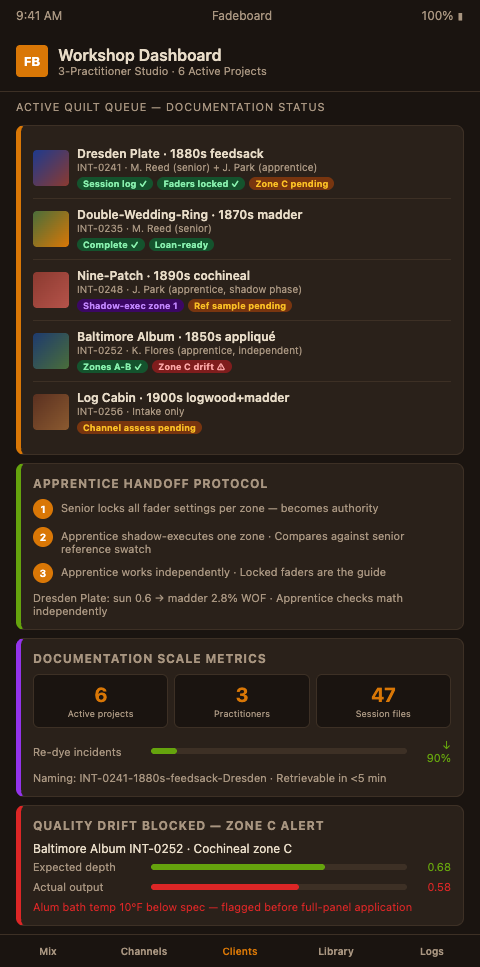
Apprentice Handoff Protocols
The apprentice handoff problem in quilt restoration has a specific shape: the work is tactile and observational, the language for describing dye states is highly specialized, and the consequences of a mismatch — a dye bath that runs 15% too concentrated on a calico panel that can't be rewetted — are irreversible.
Fadeboard's channel-reading system addresses this by giving apprentices a numerical reference they can verify against before starting work. If the sun-exposure fader for a given block is set at 0.6 and the apprentice's dye bath formula calls for that reading to produce a madder concentration of 2.8% WOF (weight of fiber), they can check the math independently. The senior restorer does not need to be present for every dye preparation.
The handoff protocol the workshop developed runs in three stages. First, the senior restorer completes the full channel assessment and locks the fader settings for each zone. Second, the apprentice shadow-executes one zone under observation, comparing their dye outcome against the senior's reference sample. Third, the apprentice works independently on assigned zones, with the locked fader settings as their authority.
ICOM-CC Textiles Working Group — Preventive Conservation standards include documentation transfer as a professional responsibility, which this protocol satisfies. The record of each apprentice's zone work — including any fader adjustments they made and their rationale — becomes part of the permanent session file.
Document Management Best Practices for Small Business — Record Storage Systems principles apply directly to managing session archives at scale: version control, naming conventions, and retrieval speed all matter when a workshop is handling twenty active projects simultaneously.
Scaling Without Quality Drift
Quality drift in growing workshops is not usually caused by incompetent staff — it is caused by undocumented variation. One apprentice uses a slightly different alum bath temperature. Another interprets "medium saturation" as a different absolute value than the senior restorer does. These small divergences compound across a multi-month project and produce quilts that do not match their own earlier restoration zones.
The Fadeboard approach eliminates this category of drift because the fader settings and the dye formulas they encode are absolute, not relative. A sun-exposure fader reading of 0.6 means the same thing to every person working on the project. When the natural-dye future for quilt workshops includes more complex dye chemistry — enzyme-assisted mordanting, for instance — the channel-recording system will absorb those variables without requiring a documentation overhaul.
AIC Textile Specialty Group — American Institute for Conservation standards define what institutional clients expect in treatment records. Workshops that can produce Fadeboard session files for every project are already meeting those expectations without needing to maintain a separate administrative documentation layer.
The solo studio scaling strategies developed in adjacent restoration disciplines apply here too: the transition from one-person operation to small team is primarily a documentation problem, and the solution is the same regardless of whether the object is a bisque doll or a Baltimore Album quilt.
Quilt Class Management 101 for Retail Stores — LikeSew addresses the operational layer — scheduling, registration, and instructor ratios — but the capacity those systems unlock is only realizable if the restoration process itself can be handed off without quality loss.
Common Pitfall: Treating Documentation as Overhead Rather Than the Work Itself
The most common mistake workshops make when implementing a channel-recording system is treating documentation as a separate administrative task rather than the primary output of the assessment phase. In practice, this means the senior restorer completes the intake session, sets the fader positions, mixes the first bath from memory, and records the settings in Fadeboard afterward — at which point the record is already at one remove from the actual decisions. Small divergences between what was done and what was recorded accumulate.
The correct sequence is the reverse: open the Fadeboard session before touching the quilt, and build the channel record as the assessment proceeds. For a Civil War-era indigo-and-madder piecework quilt entering a workshop, this means photographing each block, assigning a sun-exposure fader position for each zone, and recording the seam-allowance reference color for each identified colorant — all before the first bath is mixed. The session file is the decision record, not a post-hoc transcription of it.
For workshops handling feedsack quilts alongside 19th-century sampler work, the documentation workflow differs slightly between the two categories. Feedsack cotton from the 1930s has a simplified colorant palette — predominantly synthetic print dyes — so the dye-class annotation in the session file is a short step. An 1855 Baltimore Album with cochineal appliqué panels, weld yellow ground cotton, and roller-printed chintz borders requires a dye-class entry for each identified colorant and mordant type. Fadeboard's channel structure accommodates both without requiring a format change.
Edge Case: Multi-Project File Management for Workshop Growth
A workshop that runs six concurrent restoration projects — a typical load for a team of three — generates six simultaneous Fadeboard session files, each with independent panel maps and fader histories. Without naming conventions and file organization, the session archive becomes navigable only by the person who created it.
The naming convention that works for growing quilt workshops follows four fields: client intake number, approximate quilt date, primary colorant, and block pattern. A session file labeled INT-0241-1880s-madder-NinePatch can be retrieved, cross-referenced, and handed to an apprentice without any additional context. When a companion piece arrives from the same estate two years later — INT-0312-1880s-madder-NinePatch — the earlier session file provides the color reference for matching across the two pieces.
This retrieval speed matters more than it seems when institutional clients begin making loan requests. A museum curator requesting the treatment record for a piece restored four years ago needs the session file in days, not weeks. A workshop that can retrieve and export the complete Fadeboard record — channel settings, dye formulas, post-treatment photographs — within a morning has a competitive advantage in institutional markets over one that requires a week of file archaeology.
Your workshop's growth ceiling is set by your documentation infrastructure, not your bench space. If you are losing intake capacity because every judgment call routes back to one person, Fadeboard's panel-indexed session records are built to break that bottleneck — schedule a consultation to map your current workflow against the channel system.