Predicting Lightfastness on Restored Ecclesiastical Silks
The Mismatch That Appears Later
A conservation studio treating a 19th-century Marian stole completed what appeared to be a successful indigo restoration. The inpainted areas matched the surrounding original under both ISO D65 and warm tungsten at time of sign-off. The stole returned to a sanctuary where it was used for monthly feasts of Our Lady — not daily wear, but regular candlelight exposure and periodic proximity to stained-glass windows during afternoon services.
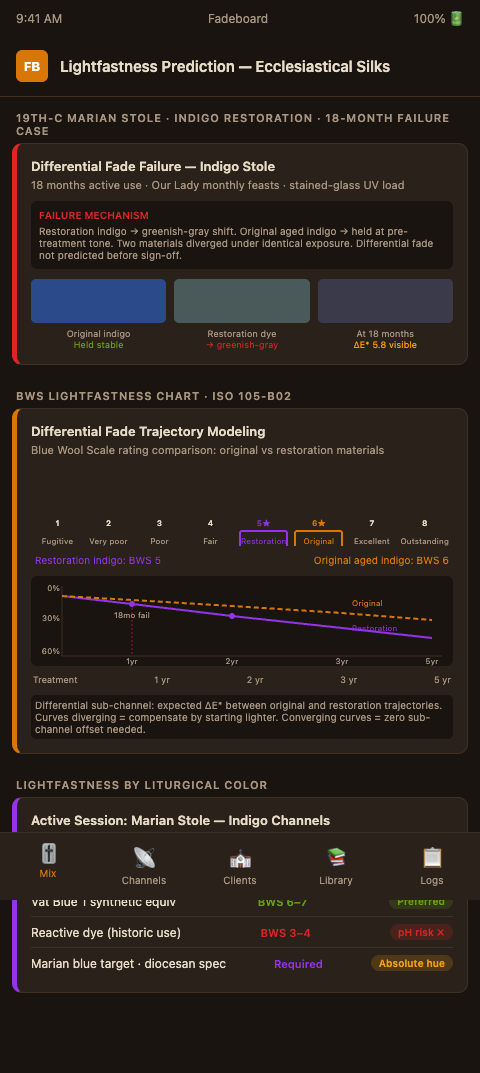
Eighteen months later, photographs from the parish showed a clear differential: the areas treated with the restoration indigo had shifted toward a greenish-gray, while the adjacent original aged indigo had remained at its pre-treatment tone. The two materials had diverged under identical exposure because their lightfastness profiles were not identical — and no one had tested them against each other before the stole left the studio.
This is the specific failure mode that lightfastness assessment for restored ecclesiastical silks addresses. It is not a question of whether the restoration dye is good in absolute terms. It is a question of whether the restoration dye ages at the same rate and in the same direction as the original dye under the actual conditions of sanctuary use.
ISO 105-B02 xenon arc fading standard documentation provides the benchmark protocol for textile colour fastness assessment — a test designed for new textiles but adaptable, with appropriate modification, for evaluating differential fade rates between original and restoration materials.
Modeling Lightfastness as a Channel Variable
Fadeboard's channel framework addresses lightfastness prediction in a specific way: rather than treating lightfastness as a binary pass/fail property of the restoration dye alone, it models the expected delta between original and restoration trajectories under defined exposure conditions.
The substrate channel, already set during the primary restoration session, provides the baseline for the original dye's current state after its historical aging. The dye channel's endpoint represents the estimated original saturation. Between those two anchor points, the channel position reflects the total dye loss the original colorant has undergone.
For lightfastness prediction, the question becomes: how will the restoration dye behave if subjected to the same exposure trajectory going forward? If the original indigo has lost approximately forty percent of its saturation over 150 years of use, and the restoration dye is rated at ISO 105-B02 Blue Wool Scale 5, the conservator needs to know whether that rating implies a faster or slower fade trajectory than the original natural indigo under the specific spectral conditions of stained-glass filtered light.
Microfade testing services from the Canadian Conservation Institute offer a direct method for assessing light sensitivity of both original and restoration materials from the same textile — producing delta-E-over-dose curves that can be compared directly. When microfade data is available for both the original dye area and the proposed restoration medium, those curves can be used to set a differential fade sub-channel within the Fadeboard dye channel.
The differential fade sub-channel represents the expected rate at which the restoration dye will diverge from the original over a specified future period. If the curves run parallel, the sub-channel position is zero and no further adjustment is needed. If they diverge, the sub-channel position quantifies the expected delta at a given time horizon — say, five years of standard sanctuary use — which the conservator can then choose to compensate by starting the restoration slightly lighter than the current original tone, so that the two materials converge rather than diverge as they age.
2024 study on photodegradation behaviors of thermal-aged silk links thermal and photodegradation mechanisms in historic silk, confirming that the two processes are coupled in ways that require modeling both the dye layer and the substrate concurrently — the exact structure that the dual-channel approach provides. Understanding what chemical processes occur at the dye-fiber interface over time is equally important: silk weft dye stability covers how the restoration dye's chemical bond to aged silk fibers interacts with the photodegradation trajectory established by the lightfastness channel.
Practical Lightfastness Tactics for Parish Vestments
Not every conservation studio has access to a microfade testing instrument or the analytical capacity to commission CCI-level light sensitivity assessments on every commission. For studios working at parish scale, the following tactics adapt the differential fade modeling principle to available tools.
The first tactic is accelerated aging comparison. Before committing to a restoration medium, apply candidate dye samples to small swatches of comparable aged silk and expose them alongside samples of thread taken from a loss area of the original vestment. Even 200 hours under a UV fluorescent lamp at controlled intensity will differentiate fast-fading restoration dyes from those with trajectories closer to the original. This is not a substitute for ISO 105-B02 testing, but it identifies obvious mismatches before they are applied to the piece.
The second tactic is channel documentation of the starting differential. If the restoration dye is known to be more fugitive than the original under UV exposure, Fadeboard allows this differential to be recorded as a named variable in the session file. Future conservators revisiting the piece — or the same studio reviewing the stole after two years of use — can retrieve the expected trajectory and compare it to actual observed change. This transforms each treated vestment from a closed file into a living record with a predicted versus actual comparison built in.
The third tactic concerns Marian indigo and Lenten purple specifically, because these liturgical colors are often specified in diocesan documents as absolute hue targets rather than relative matches. When the diocesan specification requires a particular tone of Marian indigo or liturgical violet, the lightfastness requirement is implicit: the restored vestment should maintain that specified tone for the expected service life. Fadeboard's prediction output can be framed for the episcopal commission as a lightfastness guarantee statement — the color will remain within a specified delta-E range of the target under defined use conditions for a stated number of years.
For context on how the channel record serves in the long term, future liturgical pigment work examines how studios are building durable records now that will support long-term lightfastness tracking at the parish level.
Natural-dye fade prediction for restored quilt patches applies the same differential trajectory modeling to cotton substrates — useful comparative reading for conservators working with ecclesiastical linen or cotton-silk compound weaves.
UCL research on photodegradation and photostabilization of historic silks evaluates specific UV absorber and antioxidant treatment combinations that achieved up to 63% lightfastness improvement in test silks — a direct reference for studios considering protective treatments applied to the restoration area to bring its trajectory into alignment with the original.
Closing the Prediction Gap
The stole case that opened this post was not an unusual failure. Differential fade between original and restoration materials is the most common long-term quality failure in ecclesiastical silk conservation, and it is almost always preventable with the right prediction work at the front end.
Fadeboard's channel architecture makes that prediction work explicit and recordable. If your studio treats silk vestments that will return to regular liturgical use, the lightfastness differential channel is one of the most valuable additions to your standard session configuration. Contact us to discuss how to integrate microfade testing data or accelerated aging results into your existing Fadeboard sessions.
The conservators most affected by differential-fade failures are not those handling rarely-worn coronation copes, but those handling frequently-used parish chasubles and stoles where the cumulative liturgical exposure outpaces conservation expectations within a single decade. Subscribing to the lightfastness differential discipline at the front of the next stole project is the smallest investment that produces the largest visible improvement at the five-year mark.