Predicting Fade on Freshly Restored Natural-Dye Patches
The Day-One Problem and the Year-Ten Problem
Every natural-dye restoration workshop eventually faces the complaint: the work looked perfect when it left the studio. The client did nothing wrong with storage. But the restored patches are now visibly out of step with the original fabric — either they have faded faster or, more commonly, they have held their color while the surrounding original dye has continued to drop.
Both failure modes share the same root: the restoration decision was made against current visual appearance without modeling how the new dye and the original dye will age relative to each other over the next decade. If the original weld yellow has been fading at a rate of approximately 2% per year under the client's display conditions, and the restoration dye bath uses a weld formula with higher initial lightfastness, the gap between original and restored will open visibly within five years.
This is not a hypothetical concern. ISO 105-B02 Colour Fastness to Artificial Light — ISO provides the international xenon-arc lightfastness standard against which textile dye durability is rated, and natural dyes cluster in the lower half of that scale — typically Blue Wool ratings of 2–4, compared to 6–8 for well-applied synthetics. More critically, different natural dyes and different mordant combinations produce different rates of decline within that range. A cochineal-alum bath and a madder-alum bath may both rate at Blue Wool 3, but they degrade through different photochemical pathways and at different rates under specific conditions.
Blue Wool Standards: How to Use — James Heal makes the practical application clear: the 8-level Blue Wool scale is the standard reference for estimating expected fading rates in textile specimens, and consulting it before finalizing a restoration bath formula is standard practice in conservation-quality workshops.
Soundboard Channel Settings as Aging-Rate Inputs
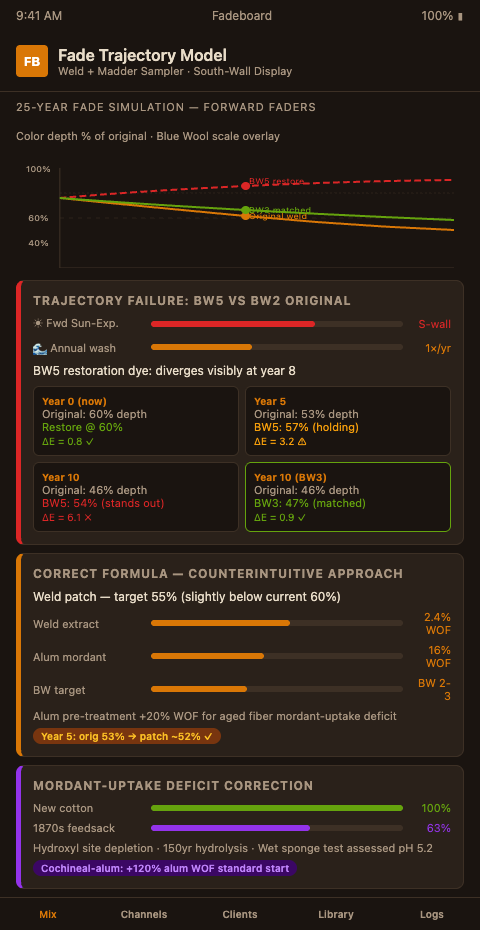
Fadeboard's channel model has a direct application to fade prediction that goes beyond the day-one color match. The sun-exposure fader setting for a given block or zone does not just describe the historical UV load that produced the current damage — it also estimates the ongoing UV load the quilt will receive in its destination environment, which is the critical variable for predicting future divergence.
When a client describes their display plan — south-facing wall, indirect light, seasonal sun movement — the workshop can set a forward-looking sun-exposure fader reading for each zone. That reading, combined with the Blue Wool rating of the proposed restoration dye, produces a fade trajectory estimate. If the trajectory shows the restored patch outpacing the original fabric within eight years, the dye formula needs adjustment before application, not after.
The adjustment logic is counterintuitive: the goal is not always maximum lightfastness. For a heavily faded original where the surrounding fabric is rated at Blue Wool 2, a restoration dye with Blue Wool 5 lightfastness will diverge visibly. The correct choice is a restoration dye at Blue Wool 2–3, applied at a concentration that matches the current faded state, with client documentation noting that periodic touch-up may be required — a choice that is far better than producing a restoration that looks wrong in five years.
Getty Conservation Institute: Accelerated Aging provides the methodological foundation for modeling these trajectories: photochemical and thermal accelerated aging protocols that predict long-term color change rates from short-term exposure data. The wash-cycle fader adds a parallel dimension — a quilt that will continue to be laundered annually has a wash-exposure trajectory that compounds the UV load in ways that affect the dye stability calculation.
Microfading as a Channel-Calibration Tool
For high-value pieces, microfading provides a direct measurement rather than a modeled estimate. The technique exposes a tiny spot on the fabric to a concentrated light source and measures the color change in real time, producing an actual fade rate for that specific combination of dye, mordant, and fiber.
Microfading Tester: Light Sensitivity Assessment — Getty Conservation Institute describes the non-invasive method in full. For quilt restoration workshops, the most useful application is comparative: run microfading on both an original undamaged zone (seam allowance or reverse) and the proposed restoration dye swatch, then compare the real-time fade rates. If they diverge by more than 20% within the test window, the dye formula needs revision.
Canadian Conservation Institute: Microfade Testing Services offers institutional access to this protocol, which is particularly valuable for quilts destined for museum or historical society display where the environmental conditions are known and the expected display period is measured in decades.
The restoration dye stability on antique cotton chemistry provides the underlying framework for interpreting microfading results: knowing how a specific dye degrades at the molecular level helps explain why its fade rate under microfading matches or diverges from its Blue Wool rating, and whether that divergence is relevant to the quilt's specific substrate.
Advanced Tactics: Matching Aging Trajectories, Not Colors
The highest-skill application of fade prediction in quilt restoration is deliberately mismatching the day-one color to achieve a better ten-year match. This sounds paradoxical but follows directly from the trajectory model.
If a weld yellow patch in a sampler quilt is currently at 60% of its original depth, and the estimated annual fade rate under the client's display conditions is 1.5%, the patch will be at approximately 53% of original depth in five years. A restoration bath that exactly matches the 60% state today will be at 85% of the current state in five years if it has a Blue Wool rating two levels higher than the original. The better technical choice is to formulate the restoration bath at 55% of original depth — slightly below the current original — using a dye with lightfastness matched to the original. In five years, the original will be at 53% and the restored patch at approximately 52%. The match holds.
Common Pitfall: Confusing Mordant Depth With Dye Depth in the Trajectory Calculation
Fade trajectory calculations frequently fail not because the dye-type fader was set incorrectly but because the mordant component of the restoration was not modeled separately from the chromophore component. A madder-alum bath on new cotton achieves mordant saturation quickly and produces the expected color depth. The same bath on 19th-century cotton from an 1870s feedsack may achieve only 60–65% of that mordant saturation in the same contact time, because the fiber's hydroxyl bonding sites have been partially consumed by 150 years of hydrolysis. The result is a restoration that starts at 60% of target depth and fades to near-invisible within five years — not because the chromophore was wrong but because the mordant bond was weak from the start.
Fadeboard's substrate-age modifier in the dye concentration panel addresses this directly: the operator records the estimated mordant-uptake deficit for the specific zone (derived from the wet-sponge touch test and the color delta between seam allowance and block face), and the bath formula adjusts the mordant pre-treatment concentration upward to compensate before the chromophore bath is mixed. This two-step adjustment — mordant saturation first, chromophore targeting second — is what separates a fade trajectory calculation that holds through a decade from one that fails at year three.
For cochineal-alum restoration on pre-1880 piecework quilts, the mordant-uptake deficit is particularly significant. Carminic acid has high initial affinity for alum-treated cotton, which can mask an insufficient mordant foundation at the day-one color check. The mismatch only becomes visible after the first season of display, when the poorly bonded cochineal releases faster than the surrounding original. Setting the alum pre-treatment concentration at 120% of the standard new-cotton rate — to compensate for the estimated 40% mordant-uptake deficit in aged fiber — is the correct starting point, with a test swatch confirming adhesion before the full panel bath.
Advancements in Sustainable Natural Dyes — MDPI Molecules reviews how modern mordant and dye extraction approaches affect post-restoration color stability, including methods that can intentionally modulate lightfastness to match historic dye behavior. For indigo, the trajectory calculation is different: indigo on cotton tends to fade by oxidative surface loss rather than photodegradation, and its rate is more strongly correlated with the wash-cycle fader than the sun-exposure fader.
The 50-year fade prediction approach developed in doll restoration studios applies the same trajectory logic to a different substrate — the channel-based prediction model is medium-agnostic, which makes it transferable across restoration disciplines.
The natural-dye future for quilt workshops points toward more precise aging prediction tools — enzyme-treated dye baths with narrower lightfastness distributions, biomordants with more predictable aging curves — but the Fadeboard channel model is the framework that will absorb those advances when they arrive.
Workshops that are delivering quilts with a ten-year performance guarantee rather than a day-one color match are operating at a different professional level. If you want to build fade trajectory modeling into your standard restoration protocol, Fadeboard's forward-looking fader system is the place to start — schedule a session to work through a current project and see how the trajectory calculation changes your dye bath decisions.