Chemical Stability of Aniline Restorations on Silk Bodices
The Instability That Defined an Era
Aniline dyes arrived in theatrical wardrobe in the 1860s and transformed the visual language of the gaslight stage within a decade. The saturated magentas, aniline yellows, and vivid blues that characterize music hall and operetta costume of the 1870s–1900s were impossible with natural dyes under production-speed and budget constraints. What wardrobe supervisors discovered — usually within one or two touring seasons — was that those colors faded at rates that natural dyes rarely matched.
The MFA Boston CAMEO conservation database entry for aniline dye documents the chemical mechanism: early aniline compounds were derived from coal tar and lacked the structural stability needed to resist photolysis. Under sustained footlight exposure — whether gaslight, limelight, or early carbon arc — the chromophore bonds in aniline structures break under UV photons, producing colorless degradation products that remain in the fiber and cannot be distinguished from a clean fade.
National Museums Scotland's case study on a Victorian aniline-dyed silk bodice showed that at museum-standard light levels of 50 lux, a replica aniline-dyed silk bodice reached measurable fade within four months of display. Under the footlight exposure levels typical of an active touring production — orders of magnitude higher than museum display — original stage costumes could lose 30–40% of saturation in a single season.
That degradation history is now embedded in the objects we are restoring, and any restoration that uses aniline chemistry faces the same instability all over again.
Stability Assessment Before Choosing Restoration Dye
Before selecting a restoration dye for an aniline-dyed silk bodice, the session archivist should run a stability assessment that evaluates three factors: the substrate condition, the original dye family's degradation state, and the proposed restoration material's lightfastness under the object's anticipated display conditions.
Degradation in tin-weighted and unweighted historic silks establishes that silk substrate condition constrains restoration options significantly. A severely degraded silk — showing shredding, brittleness, or loss of tensile strength — cannot receive immersion or surface dye treatments without risk of mechanical damage. For these substrates, the restoration approach may be limited to consolidation and minimal inpainting rather than full color recovery, and the Fadeboard session should document this constraint explicitly in the session notes.
For substrates in adequate condition, the stability assessment compares the proposed restoration dye's ISO lightfastness rating against the anticipated cumulative lux-hours of the object's display program. A restoration dye with ISO rating 5 (moderate lightfastness) on a piece that will see 100,000 lux-hours per year in an exhibition loan program is a poor choice regardless of its color match quality. A restoration dye with ISO rating 7 or 8 on the same piece provides a meaningful service life. The stability assessment also determines how prominently the piece's monitoring record will feature in future acquisition documentation — for opera archive evidence purposes, the monitoring record for aniline silk bodices often constitutes the most detailed chemical evidence in the package, precisely because the material's instability drove more intensive documentation than more stable objects receive.
Microfade testing of aniline blue on silk demonstrated that aniline blue — one of the more stable early synthetic dyes — still showed significant fading on silk within the exposure window of a standard microfade test. More fugitive aniline compounds fail even faster. For any restoration targeting aniline magenta or aniline yellow areas, the restoration dye should be a modern fiber-reactive or disperse dye with substantially higher lightfastness than the original.
Recalibrating the Fadeboard Session for Stable Analogs
When the restoration uses a chemically stable substitute rather than the original aniline compound, the Fadeboard session must be recalibrated to reflect the substitute's degradation behavior — not the original's. This is a common source of session error: archivists carry over the original dye's degradation rate coefficient into a session for the restored object, producing a long-term prediction that over-estimates future fade.
The recalibration involves three session adjustments. The first adjustment is updating the dye-family assignment in the session notes from "original aniline [type]" to "restoration analog [specific compound or ISO rating]." This sounds administrative but is critical for anyone who reads the session months or years later and needs to understand why the degradation rate differs from what the object's production era would suggest.
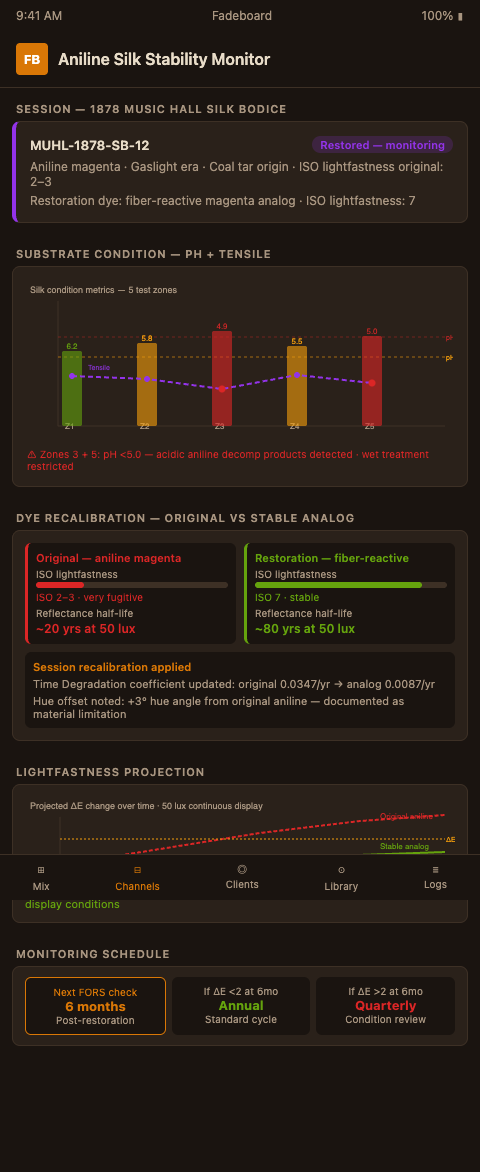
The second adjustment is updating the Time Degradation fader coefficient. For an original aniline magenta with an estimated reflectance half-life of 20 years under museum display conditions, the Time Degradation fader would project significant loss over a 30-year display program. For a fiber-reactive restoration analog with an estimated half-life of 80 years under the same conditions, the same fader at the same setting would dramatically over-predict future fade. The coefficient should be adjusted to reflect the restoration material's actual lightfastness.
The third adjustment is noting the color target offset. Modern stable analogs of aniline colors are not always perfect spectral matches for the original compounds. A fiber-reactive magenta may have a slightly different hue angle than the original aniline magenta it is replacing. The session should document this offset — typically 2–5 degrees in hue angle — and specify whether it represents a deliberate designer-intent approximation or a material limitation. The substrate-dye interaction dynamics that underlie all three adjustments are also documented in silk weft stability in ecclesiastical contexts, which covers parallel findings about accelerated silk degradation under chemically unstable dye decomposition — findings that apply equally to theatrical silk bodices.
Long-Term Monitoring After Aniline Restoration
The elevated degradation rate of original aniline chemistry — and the often uneven way it is distributed across a bodice — means that monitoring timelines for aniline-restored pieces should be compressed relative to more chemically stable objects.
Amino acid analysis of historic silk degradation in degraded versus aged samples shows that silk substrate degradation accelerates under conditions of chemical stress, including moisture, acidity from dye decomposition products, and UV exposure. An aniline-dyed silk bodice with active ongoing photodegradation in the original dye layers may be experiencing secondary chemical stress on the silk fibers themselves, independent of any restoration treatment applied.
The recommended monitoring schedule for aniline-restored silk bodices is therefore shorter than the standard annual cycle: a six-month FORS re-measurement after the first post-restoration year, followed by annual readings thereafter if the six-month reading shows delta-E change below 2 units. If the six-month reading shows change above 2 delta-E, the schedule compresses to quarterly, and storage or display conditions should be reviewed.
Each monitoring measurement generates a new session version in Fadeboard, extending the longitudinal record. When the archive prepares a loan request for an aniline-restored piece, the multi-year monitoring record demonstrates the restoration's stability over time — a significant advantage in loan negotiations with receiving institutions that may be skeptical of aniline-adjacent chemistry.
The stage pigment recovery future includes promising developments in photostabilization of restored aniline analogs through UV-absorber coatings and encapsulation techniques — improvements that will eventually extend the service life of aniline restorations and reduce the monitoring intensity required.
Communicating Stability Limitations to Stakeholders
Theater archives that restore aniline-dyed silk bodices face a communication challenge with donors, borrowers, and acquisition committees: explaining that a visually successful restoration has a finite service life and will require retreatment.
The Fadeboard session's lightfastness projection provides the quantitative basis for that conversation. Rather than saying "this restoration may fade over time," the archivist can say "this restoration is projected to show 3 delta-E color change over 15 years at 50 lux continuous display, which remains within the perceptually stable range; retreatment would be considered at the 25-year mark under the same display conditions." That specificity builds confidence with stakeholders and sets accurate expectations for long-term collection management.
If your archive is restoring aniline-dyed silk bodices with chemically stable modern analogs and finding that your Fadeboard projections seem to over-predict future fade, join the Fadeboard waitlist and open a recalibration session for your current aniline restoration cohort. Update the session's dye-family assignment and recalibrate the Time Degradation coefficient to match your restoration material's ISO rating — the likely cause is a degradation rate coefficient carried over from the original compound's lightfastness data. The resulting projections will be more accurate, your monitoring schedule will be appropriately calibrated, and your loan documentation will reflect the restoration's actual stability rather than the original material's instability.