Advanced Pigment Forensics on Early Broadway Chorus Costumes
The Batch Problem in Chorus Wardrobes
When the conservator at a major performing arts archive opened the storage cartons holding a 1932 Broadway chorus set — sixteen tap-dance costumes in a deep coral-orange — she expected fade. She did not expect that eight of the costumes had faded to a pale peach while the other eight retained substantially more saturation. Under the archive's examination lamp, the two sub-groups were unmistakably different, yet all sixteen garments had spent the same decades in the same storage environment.
The explanation emerged from the production records: the coral-orange had been achieved with two separate dye baths because the original fabric order came in on two delivery dates. The wardrobe supervisor at the time had documented this in a production log held at the New York Public Library for the Performing Arts, one of the collections holding early Broadway production documentation. Batch one used a mordant-fixed synthetic orange with reasonable lightfastness. Batch two substituted a cheaper aniline variant that was visually indistinguishable on opening night but proved substantially more fugitive over ninety years.
Forensic analysis confirmed what the production log hinted at. This distinction — between batch variation and differential exposure — cannot be resolved without both documentary research and material analysis working in parallel.
Analytical Methods for Chorus Sets
The forensic toolkit for chorus wardrobe applies the same dye identification methods used for solo-performer pieces, but the presence of multiple near-identical specimens actually improves analytical confidence. When you have sixteen examples of the same intended color with measurable variation, statistical analysis of the spectral readings can separate systematic batch effects from individual-garment exposure anomalies.
A DART-TOF mass spectrometry approach, as described in Analytical Chemistry's work on direct dye identification in textiles, offers the ability to characterize dye compounds with minimal sampling — an important consideration for chorus costumes that may have limited conservation-grade material budget. Run across multiple garments in the set, DART-TOF readings produce a compound fingerprint for each specimen that can be compared across the batch.
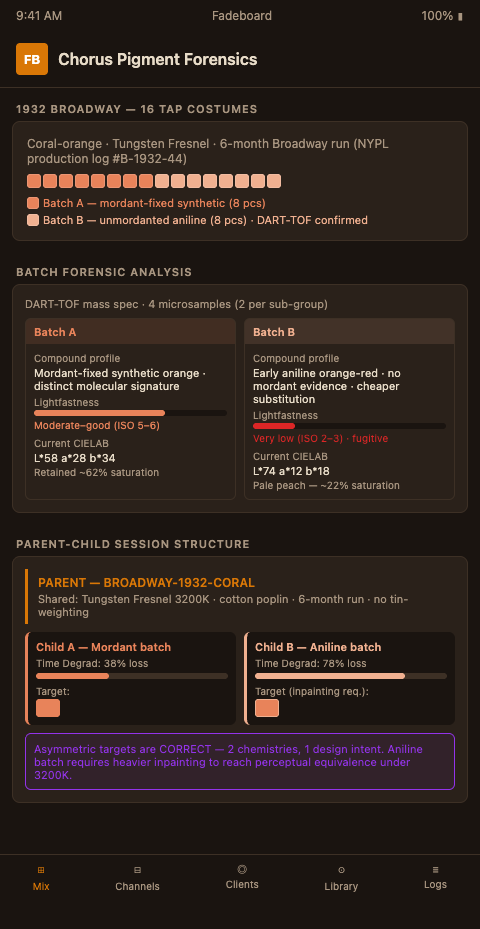
For the coral-orange set, DART-TOF analysis of microsamples from four costumes (two from each sub-group) confirmed two distinct dye formulations. The pale-peach sub-group showed a compound profile consistent with an early aniline orange-red with no mordant evidence; the more-saturated sub-group showed a mordant-fixed synthetic with a different molecular signature. The identification of dye mixtures in historic textiles using spectroscopic methods provides the multivariate clustering framework that allowed the two formulations to be separated with confidence even in samples showing overlapping degradation products.
Forensic dye analysis methods applied to heritage textiles also discuss the complication of degradation products masking original compound identity — an issue particularly acute in aniline-dyed costumes that have seen both UV exposure and greasepaint residue contamination, which is common in chorus garments worn repeatedly through a long run.
Configuring Fadeboard for Multi-Specimen Sessions
Once the forensic analysis establishes that two distinct dye formulations are present in the set, the Fadeboard session architecture must reflect that reality. Running a single session with one set of fader values for all sixteen costumes would force a false uniformity onto a set that never had uniform chemistry to begin with.
The solution is a parent-session and child-session structure. The parent session holds the shared fields: lighting-era assignment (tungsten Fresnel for a 1932 production), provenance exposure estimate (six-month Broadway run documented in the production log), and substrate condition (cotton poplin, no tin-weighting confirmed). Each child session inherits those shared values but sets its own dye-family fader and degradation rate coefficient appropriate to its confirmed formulation.
The aniline sub-group child session sets the Time Degradation fader at a higher loss value — reflecting the lower lightfastness of the unmordanted aniline orange — and uses a tungsten Fresnel spectral translation for the lighting-era channel. The mordant-fixed sub-group child session sets a lower Time Degradation loss, consistent with the better photostability of that formulation. When both child sessions are run through the LED translation (representing the archive's current exhibition lighting), they produce different restoration targets: the aniline sub-group requires a more saturated inpainting to reach perceptual equivalence with the mordant sub-group.
This asymmetric target is correct and should be documented as such. The sixteen costumes in the set are not all the same object in different states of degradation — they are two distinct objects with the same design intent but different original materials. Restoring them to a single uniform color would misrepresent the archive's collection.
Interpreting Results for Exhibition and Loans
The forensic session raises an exhibition question that the archive must address explicitly: should the sixteen costumes be displayed as a uniform chorus set, acknowledging that the original audience saw apparent uniformity, or should the two sub-groups be displayed with their restoration targets made transparent?
Most theater archives opt for apparent uniformity in exhibition contexts, on the grounds that the design intent was a matched chorus appearance under the production's lighting. Fadeboard's spectrophotometer-based stage fade work supports this choice by generating a target that represents how both sub-groups would have read under tungsten Fresnel at opening night — before differential degradation had separated them visually. The restoration brings the aniline sub-group up to that opening-night benchmark rather than to the current state of the mordant sub-group.
For Italian brocade forensics in ecclesiastical contexts, similar questions arise when matched vestment sets exhibit differential degradation — the session architecture for parent-child configurations maps directly from chorus wardrobe forensics.
For loan requests, the multi-specimen session generates a significant advantage: the archive can provide lending institutions with both the individual-garment color evidence and the forensic rationale for why the set's two sub-groups have different restoration targets. A receiving museum that understands batch chemistry is far better positioned to manage the loaned objects appropriately than one that simply receives sixteen "coral-orange tap costumes" with no further documentation.
Applying the Framework to Other Chorus Sets
The batch-variation analysis framework applies to any chorus or ensemble wardrobe where production-scale dyeing was involved. Operetta wardrobes, Gilbert and Sullivan touring sets, Broadway chorus lines from the 1920s through the 1950s — all were typically produced in batches, often from multiple dye lots, under time and budget pressures that made chemical consistency a secondary concern.
When evaluating a new chorus set, the opening forensic question should always be: does this set show evidence of batch variation in its degradation pattern? Garments that degrade uniformly are either genuinely from a single dye lot, or were subject to such consistent exposure and storage that batch differences have been masked. Either way, a single Fadeboard session with shared fader values is appropriate. Garments that degrade non-uniformly despite shared storage history are almost always showing batch variation, and the parent-child session structure is required.
Florence Klotz's documented approach to Broadway costume complexity underscores why the material record matters: production-level wardrobe decisions were driven by budget, timeline, and supplier availability — factors that systematically introduced material variability that only forensic analysis can recover.
The aniline silk stability work develops the chemical stability analysis that complements this forensic framework, covering what happens to these compounds over time at the molecular level and how that informs long-term storage and display recommendations for chorus sets.
If your archive holds chorus or ensemble wardrobe sets showing non-uniform degradation, Fadeboard's parent-child session architecture gives you the tools to document batch variation without forcing a false uniformity onto the collection. Start with the forensic analysis to confirm whether two dye formulations are present, then configure the session hierarchy to reflect the material reality. The resulting documentation will serve both your exhibition planning and your loan partners far better than a single averaged color target would.