Pigment Matching for Orphrey Strips With Fragmentary Losses
The Specific Problem of Orphrey Fragment-Only Records
An orphrey band from a sixteenth-century Italian cope arrived at a conservation studio in three pieces. The band had been separated from its cope ground at some point in the nineteenth century and stored rolled, causing the outer surface to abrade against itself for generations. Perhaps 40% of the original silk ground thread remained; the rest had worn to bare linen backing, taking the dye record with it.
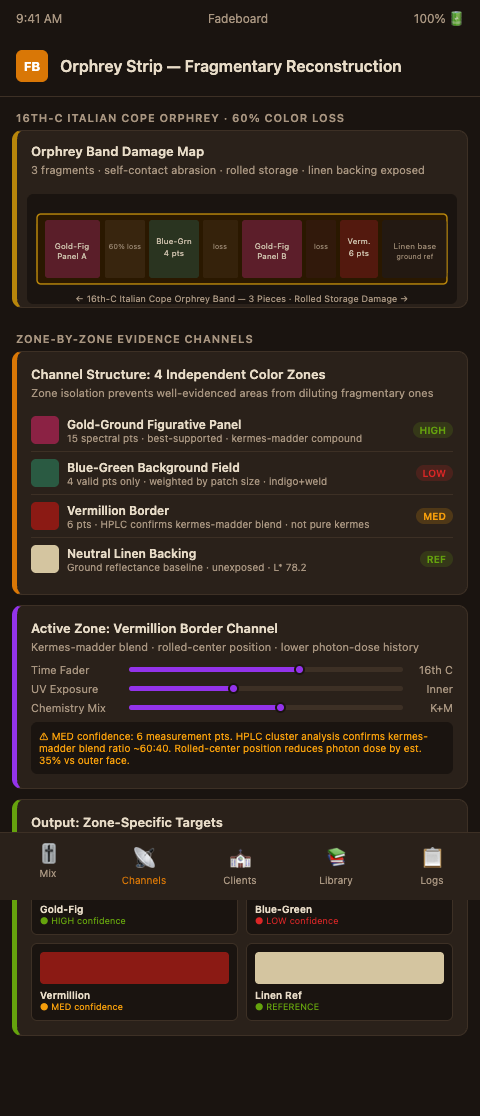
The 60% of lost area covered several distinct colour zones: gold-ground figurative panels, a blue-green background field, and a narrow vermillion border. Of the surviving 40%, the figurative panels were in the best condition; the blue-green field and vermillion border had survived only in small scattered patches at the band's rolled center, where self-contact abrasion had been minimized.
Diversity of materials, variety of problems — Conservation of the medieval cross-orphrey (CeROArt) documents a directly comparable case: conservation of a cross-orphrey with fragmentary Cyprus gold couching and pigment losses across the figurative field, where each surviving area had to serve as a spectral reference for multiple lost zones. The case study's sequenced damage mapping methodology is the starting point for any orphrey fragment work.
Orphrey (TRC Leiden Needles) provides the textile research baseline: orphrey bands typically carry multiple thread types (silk, gold, silver) and multiple dye classes in close proximity, which makes individual-zone identification critical because cross-contamination of analytical samples is a constant risk.
Building a Target From Fragmentary Evidence
The Fadeboard workflow for fragmentary orphrey work begins by treating each surviving color zone as an independent evidence channel, rather than attempting a global average that would misrepresent every zone.
Fragmentary evidence channels. For the Italian cope orphrey, the conservator created four channels: one for each distinct color zone. The figurative gold-ground panel channel had the best-supported baseline — 15 spectral measurements from surviving areas. The blue-green background channel had only 4 valid measurement points. The vermillion border had 6. A small neutral linen zone from the exposed backing provided a ground-reflectance baseline.
For the blue-green channel, Color analysis of textile fibers by microspectrophotometry (ScienceDirect) provides the protocol for non-destructive fiber-level color measurement from samples as small as a single thread cross-section — critical when the surviving blue-green patches are too small for hand-held colorimeter contact measurement. The microspectrophotometry data from the four surviving patches was averaged in the Fadeboard channel, weighted by patch size to prevent two small protected patches from dominating the baseline.
Time and chemistry faders for fragment analysis. Each fragmentary channel's time fader was set based on the photon-dose history for that zone's position in the rolled band. The inner rolled surface received less light exposure than the outer surface — a measurable difference when the band's storage history is known. The chemistry fader was adjusted using Exploring elucidation of red dye mixtures on woolen historical textiles (npj Heritage Science) cluster analysis methodology applied to the vermillion border, which showed mixed dye signatures consistent with a kermes-madder combination rather than pure kermes — a distinction the chemistry fader could model as a proportional blend.
Spectrophotometric Color Matching Breathes New Life into Damaged and Worn Goods (HunterLab) explains the reflectance spectrophotometry workflow for matching damaged heritage goods: the instrument produces a full spectral reflectance curve from 380–700 nm that the Fadeboard channel stores as a digital baseline, allowing the target reconstruction to be re-evaluated later if new evidence emerges.
With all four channels set, Fadeboard outputs four independent target specifications. The conservator applies these to the fill material — dyed silk slub threads matched to the surviving originals — in sequence, treating each zone separately rather than attempting a unified bath. Evaluation of dyes used in conservation and restoration of archaeological textiles (Academia) provides the compatibility assessment framework for choosing restoration dyes that will not discolor adjacent surviving original threads.
For the Spanish cope extension to this methodology, where orphrey hood fragments present additional analytical challenges, Spanish cope hoods orphrey bands covers the specific material variations that require adjustment to the channel setup.
Advanced Tactics for Fragmentary Orphrey Work
Establish Priority Order for Zone Restoration
When multiple zones have fragmentary evidence of different quality, restore the best-evidenced zone first. After that zone is treated and measured, its reflectance contributes contextual validation for the adjacent zones — if the restored figurative gold-ground reads correctly next to the surviving vermillion border, the border channel baseline has been implicitly corroborated. Log this sequential validation in the Fadeboard session as a confidence rating update for each channel.
Use Reference Orphreys From the Same Workshop
TSG Chapter VI. Treatment of Textiles — Section J. Compensation for Loss (Conservation Wiki) recommends referencing comparable objects from the same workshop or period when primary evidence is fragmentary. For Italian workshop orphreys, museum collections at the Victoria and Albert, the Museo del Bargello, and the Vatican Apostolic Library hold reference pieces whose dye analysis results are available in the literature. Load these reference spectral curves into the Fadeboard channel as secondary evidence alongside the primary fragment measurements.
Italian Brocade Forensics for Dye Identification
Where the orphrey's dye identity is genuinely uncertain from fragment size alone, Italian brocade dye forensics covers the analytical workflow for 14th–16th century Italian workshop materials. The HPLC-MS dye identification results feed directly into the Fadeboard chemistry fader as a confirmed dye species rather than an estimated one, tightening the channel calibration significantly.
Composition Gesso Loss Parallel
The problem of matching a missing color zone from fragmentary surviving areas is structurally identical to composition gesso loss and pigment reconstruction, where the surviving gesso surface provides the only spectral evidence for the missing area's original color. The weighted-channel averaging logic from the orphrey workflow transfers directly, and conservators working across both disciplines will find the methodology consistent.
Flag Confidence Levels in the Output Report
Each Fadeboard channel for a fragmentary piece should have an explicit confidence rating (high / medium / low) based on the number of valid measurement points and the variance between them. The output report should display these ratings prominently so the diocesan reviewer or institutional client understands which zones are spectrally documented and which are reconstructed from limited evidence. Low-confidence zones should be clearly identified as interpretive fills, not documented restorations.
Final Note for Fragmentary Orphrey Work
An orphrey strip with 60% color loss is not a failed piece — it is a partial record, and partial records can support rigorous restoration if they are analyzed zone by zone rather than globally averaged. Fadeboard's independent channel structure preserves the integrity of the fragmentary evidence by preventing well-supported zones from diluting poorly-supported ones. The output is a set of zone-specific targets, each traceable to its measurement basis, that gives the conservator and the reviewing institution a clear picture of what is known, what is inferred, and what remains uncertain.
For your next fragmentary orphrey project, open Fadeboard with one channel per distinct color zone, weight your spectral baselines by measurement quality, and produce a confidence-rated output report before any fill material is dyed. The result will be a restoration that honors what the fragment actually shows, not a smooth average that obscures the archaeological record. Sign up for the Fadeboard waitlist and get started with a zone-mapping session on your current orphrey commission — the confidence-rating workflow is ready to use before your next Corpus Christi or All Saints institutional review deadline.