Building a Liturgical Color Reference From Parish Collections
The Reference Gap No Diocese Has Filled
In 1881, the South Kensington Museum published a catalogue of church vestments, silk stuffs, and needlework in its collection — a systematic color and material record that served as the reference standard for vestment restoration across England for decades (Textile Fabrics: Descriptive Catalogue of Church-Vestments, South Kensington Museum, Internet Archive). Nothing comparable exists for most dioceses today. Vatican directive requires bishops to commission inventories of church movables including vestments, with specialist collaboration (Inventory and Catalogue of the Cultural Heritage of the Church, Catholic Culture). The directive exists. The inventories, in most dioceses, do not — or they exist as narrative lists without colorimetric data.
The practical consequence falls on the conservator. When a parish commissions a replacement chasuble, the question is always: what color should it be? If the existing vestment has faded — and if it is more than twenty years old in an active sanctuary, some degradation has occurred — the answer requires either a colorimetric record of the original or a reconstruction from the faded piece. When neither exists, the diocesan commission approves a color based on the committee members' memory, which is unreliable as a precision instrument for liturgical color.
The 19th-century South Kensington catalogue is instructive not because its color descriptions are precise — they are not, by modern standards — but because it established systematic comparison as the method. Multiple vestments from different periods and workshops, documented side by side, reveal the chromatic range of "liturgical red" or "episcopal gold" across sources and eras. A parish or diocesan collection with a Fadeboard-based colorimetric record does the same thing with measured precision.
Building the Reference: Methodology
The liturgical color reference methodology in Fadeboard is designed for staged implementation — you do not need to document every vestment in the diocese before the reference becomes useful.
Phase 1: Anchor objects. Identify the best-preserved vestments in the collection: pieces stored in stable conditions with documented provenance and limited active use. These become the colorimetric anchors for each liturgical color category. An undamaged 1920s Florentine green chasuble for Ordinary Time tells you more about what that shade of institutional-quality Gothic-revival green looked like than any number of faded weekly-use pieces. Measure the anchor objects first, under ISO D65, and enter their Fadeboard readings as the reference baseline for each color category.
Phase 2: Degrade-correct the active vestments. For vestments in current use, run each through the Fadeboard channel calibration to project backward from current condition to original. The sun-exposure fader is set based on documented or estimated liturgical use; the oxidation channel accounts for storage conditions; the candlelight fader addresses altar proximity. The projected original values are then compared against the anchor objects to validate the calibration — a correctly calibrated active vestment should project to an original value within the expected range for its manufacture period and provenance.
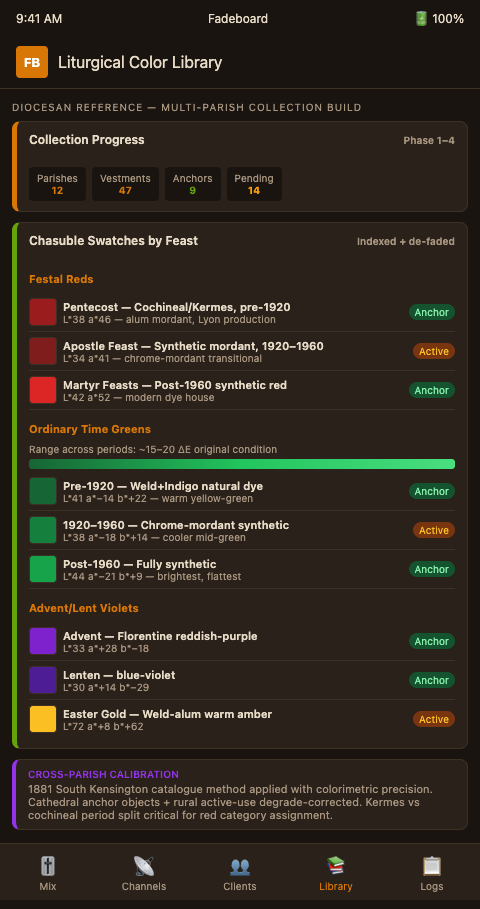
Phase 3: Aggregate by liturgical color and period. The reference library is organized by liturgical color (Advent/Lent violet, Ordinary Time green, festal red, Easter white-gold, etc.) and by manufacture period. The liturgical color categories each have a documented historical development — lux-hour dosimetry and reciprocity rules for cumulative fading across displayed color sets establish the quantitative basis for comparing vestments across different display histories (Conservation Physics: The Effect of Light on Museum Objects, ConservationPhysics.org). Within each category, the range of original values reflects the expected variation across workshops, periods, and dye-house practices.
Phase 4: Use the reference for commissions and replacements. When a parish needs to replace a vestment, the reference library provides a target range. The dyer receives a colorimetric specification drawn from documented originals rather than a description or a faded sample. When a conservator treats an undocumented vestment, the reference library provides comparanda for validating the channel calibration.
ISO Blue Wool Standards and lux-hour dosimetry are tools for calibrating fading reference samples in exhibition contexts (PMG Section 1.4.1: Standards for Light Levels During Exhibition, AIC Conservation Wiki). These same tools validate the reference samples in a parish collection library: a set of Blue Wool strips exposed alongside the vestments creates a calibrated fading benchmark that lets you measure the collection's cumulative light-dose history alongside its colorimetric history.
The history of liturgical color canon from early-church monochrome through Innocent III's 12th-century five-color system and subsequent regional variations provides the interpretive framework for organizing the reference (Catholic Encyclopedia: Liturgical Colours, New Advent). Within the Western rite, the five canonical categories (white/gold, red, green, violet, black) map to the five broad reference categories in the library; within each, period and regional variation account for the chromatic range.
Advanced Tactics: Cross-Parish Calibration
A single parish's vestment collection provides one reference cluster. A diocesan reference — drawing on vestments from multiple parishes — provides calibration across a larger range of workshops, periods, and use histories. The conservator who has documented vestments from twenty parishes in a diocese can identify regional patterns: did vestment commissions in this diocese favor a particular guild or workshop? Did the diocesan commission specify a particular shade of violet that appears consistently across the collection?
Multi-institution textile conservation studies covering documentation, dye analysis, and institutional practice — the kind of collaborative work documented in the ICCROM textile conservation series — confirm that cross-institutional comparison significantly improves the reliability of single-object assessments (Conserving Textiles in Honour of Ágnes Timár-Balázsy, ICCROM). The same principle applies to parish-to-parish comparison within a diocese: a vestment from a rural parish whose dye source is unclear becomes more interpretable when compared against a well-documented piece from the cathedral.
The reference library also supports the diocesan vestment replacement market. When a parish needs to commission new vestments and wants liturgical color authenticity, the reference provides a target specification grounded in the diocese's own documented history rather than a commercial catalogue's generic "liturgical red." This is a service that diocesan conservation offices can provide to parishes that lack in-house expertise.
For the approval workflow when reference library data is being used to support a formal treatment proposal, vestment color decisions for diocesan approval cycles covers presentation format and validation requirements. The kermes-versus-cochineal question — critical for correctly categorizing red vestments in the reference by manufacture period and dye source — is examined in detail in kermes and cochineal scarlet comparison on copes. For conservators building reference collections for secular collections alongside liturgical work, archive reference using early film costume stills offers a parallel methodology for photographic reference integration.
Starting Your Diocese's Color Library This Season
The liturgical color reference your diocese has never had can be started with the vestments in the sacristy today. A single afternoon documentation session with Fadeboard's intake workflow produces anchor-quality records for five to eight vestments, depending on garment complexity. Multiply that across three parishes and you have the beginning of a cross-parish calibration cluster.
A useful practical step before launching the diocesan reference program is to identify which parishes have the oldest vestment sets in the best-preserved condition. In most dioceses, cathedral collections and well-funded urban parishes have the longest documented vestment histories and the most stable storage conditions. These collections provide the best anchor objects — the pieces from which the reference ranges for each liturgical color category are derived. Rural and mission parishes typically have more active-use vestments with higher cumulative exposure, which are better used as degrade-corrected reference points rather than anchors.
For Ordinary Time green vestments specifically, the reference library should include examples from at least three manufacture periods: pre-1920 natural-dye production (typically weld-and-indigo compound), 1920–1960 synthetic-mordant transitional production (often chrome-mordant synthetics posing as natural-dye aesthetics), and post-1960 fully synthetic production. The chromatic range across these three periods for what every parish calls "Ordinary Time green" is substantial — typically spanning 15–20 delta-E in original condition — and the reference library needs to represent the full range so that a conservator treating an undocumented piece can position it correctly within the historical production sequence rather than applying a single canonical target to vestments that were never all the same color.
Contact Fadeboard to discuss a diocesan documentation program structured around your Easter-season schedule — the vestments coming out of storage for the feast cycle are the natural starting point. Join the Fadeboard waitlist now to secure access before the Pentecost and Ordinary Time vestments emerge from sacristy storage this liturgical year.