Building an Archive Reference From Early Film Costume Stills
The Hand-Tinted Record and Its Limits
The early cinema and late-Victorian theatrical photography era left behind a specific category of color evidence: hand-tinted lantern slides, hand-colored promotional prints, and the early tinted or toned film frames used to indicate the color character of scenes. These records were not color-accurate by modern photographic standards — the tinting was applied by workers interpreting a scene description or a designer's note, not by calibrated instruments — but they were produced close to the original performance and represent the closest available document of period audience perception.
The San Francisco Silent Film Festival's survey of early cinema color documents the range of hand-tinting and stencil-coloring techniques applied to film frames from the 1890s through the 1920s, noting that while these techniques were not photometrically precise, they constituted a deliberate record of the scene's intended color character, made by people who had seen the original. (Fantasia of Color in Early Cinema — San Francisco Silent Film Festival) A second SFSFF analysis of tinting and toning processes confirms that the specific tones chosen for dress and costume objects were generally consistent with period accounts of stage color — the tinters were following visual memory or notes, not arbitrary convention. (The Color of Silents — San Francisco Silent Film Festival)
The Oregon State University library guide on lantern slides describes the hand-tinting process: mineral and dye pigments were applied over the photographic emulsion by skilled colorists, working from the original objects, production designs, or verbal descriptions. (Lantern Slides — Oregon State University Special Collections) The result was an interpretation — but an informed one, made by someone with access to the original production.
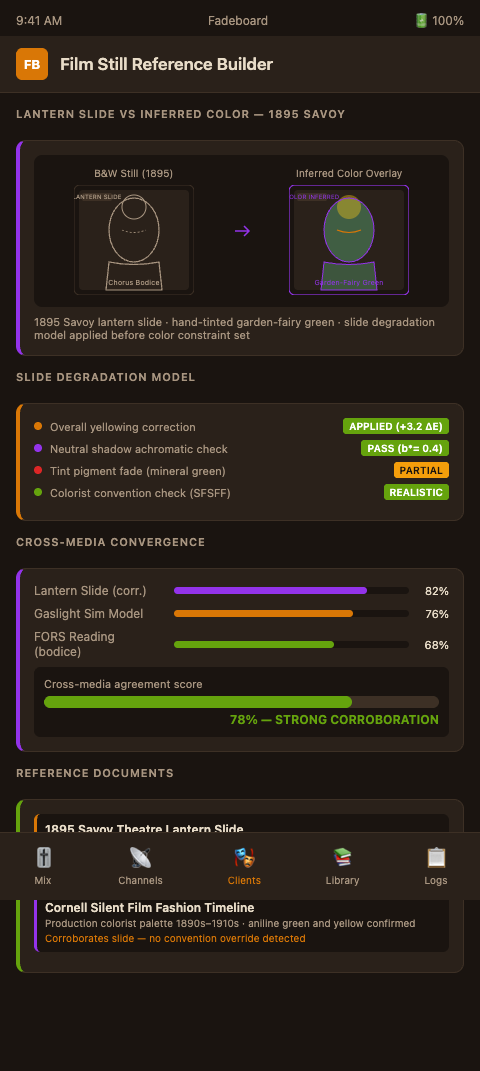
For the costume archivist, the practical problem with using these records as Fadeboard calibration anchors is that the tinted slide itself has also aged and shifted. A lantern-slide pigment applied in 1895 may have faded, yellowed, or color-shifted over 130 years of storage. The slide does not tell you directly what the original garment looked like; it tells you what the colorist applied in 1895, filtered through 130 years of its own degradation.
This is a solvable problem if it is treated as one — which is where Fadeboard's channel model extends to the reference document as well as the garment.
Using Film Stills as Soundboard Calibration Anchors
Fadeboard's approach to hand-tinted reference materials treats the slide or still as a secondary source that needs its own degradation model, not as a ground-truth input.
The workflow begins with a direct comparison between the slide's current state and what is known about the colorist's original materials. Cornell University's digital exhibit on silent film fashion documents surviving production records from several major costume houses of the 1890s–1920s period that specify the colorist's dye palette by production. (Silent Film Style: A Fashion Timeline — Cornell University Library Exhibits) When such records exist, they provide a partial correction for slide degradation: if the colorist used a known dye type for a specific color, and that dye type has a documented fade trajectory, the slide's current reading can be adjusted by a slide-degradation factor before it is used as a garment reference.
When production records are absent, the slide degradation model is built from physical analysis — looking at the density and hue shift of the slide's neutral shadow areas (which should be achromatic) to detect any overall yellowing or contrast loss, and correcting the color areas proportionally. This is analogous to a Fadeboard channel model for the slide itself: a parallel soundboard for the reference document rather than the garment.
The Machine Learning approach to film-color recovery, documented in a Nature Scientific Reports computational study, demonstrates that faded film records can be computationally corrected to recover original color intent — the same principle that underlies building a degradation model for a tinted lantern slide. (Digital Restoration of Colour Cinematic Films — Nature Scientific Reports)
The Smithsonian's photographic history collection holds documented examples of early cinema-era color evidence, including hand-colored promotional prints that have been studied in the context of their original production sources. (Photographic History Collection: Early Cinema Color — Smithsonian Institution) For archivists whose collections intersect with this period, the Smithsonian collection provides comparison material for calibrating slide-degradation models.
Once the slide degradation model is built, the corrected slide reading becomes the constraint layer in the Fadeboard garment session. It does not set the fader position directly — the slide is still an interpreted, corrected document rather than a direct measurement — but it defines a plausible range. If the gaslight-era garment simulation produces a color that falls within the range indicated by the corrected slide, the model gains corroboration. If the simulation falls outside that range, the discrepancy is flagged for investigation.
The archive decision tracking workflow covers how to document the slide-calibration decision alongside the garment session log, ensuring that the reference material's provenance and correction method are part of the permanent archive record.
Advanced Tactics for Film-Still Reference Work
Treat each reference medium separately. A single garment may have multiple reference documents: a hand-tinted lantern slide, a sepia production photograph, a colored program illustration, and an early film still. These are four different recording media with four different degradation histories and four different accuracy profiles. Do not average them — instead, build a separate degradation model for each and note where their corrected outputs agree and where they diverge. Convergence across multiple independent media is strong evidence; divergence is a signal to investigate.
Account for colorist convention. Hand tinters working on stage promotional materials sometimes followed conventions rather than copying specific garments — warm tones for feminine lead costumes, cool tones for character costumes, regardless of the actual dye. The SFSFF analysis documents several cases where tinting choices reflected colorist convention rather than garment reality. Cross-referencing the slide against surviving contemporary textile samples of known composition helps identify which slides are accurate records and which are conventionalized interpretations.
Use the Museum of the Moving Image collection for comparison. The Museum of the Moving Image holds more than 5,000 artifacts from the silent film era, including scene stills and costume documentation from productions contemporary with late-Victorian and Edwardian theatrical costuming. (The Silent Film Era — Museum of the Moving Image) If your archive's slide references a production type or performance context that is also documented in the MoMI collection, comparison across institutions can calibrate the slide's interpretation quality.
Build the slide-correction model into the session log. The slide degradation correction is itself a documented analytical step, not a preliminary off-the-record adjustment. The session log should record the slide's current measured state, the degradation model applied to correct it, and the resulting corrected color range used as the garment constraint. Future archivists reviewing the record need to understand that the constraint range came from a corrected slide, not a direct measurement.
Flag logwood-black and aniline-black boundaries in film references. Early film tinting rarely distinguished between black dye types — a logwood black and an aniline black both rendered as "black" to the colorist. For archivists working on mourning or formal evening costumes where dye-type identification matters, the film still cannot distinguish between dye chemistries. The mourning black comparison workflow covers the dye-type identification protocol that film reference work cannot resolve.
For archivists building reference libraries that extend beyond film stills to include paper-based color records — period fashion illustrations, watercolor costume sketches, production lithographs — the methodology for building a costume swatch library for single-client doll work offers a directly applicable reference-curation approach.
Build Your Period Reference Library
If your archive holds early film costume stills, hand-tinted lantern slides, or other photographic color records from the late-Victorian or Edwardian era, Fadeboard can help you build a structured reference model that corrects for each document's own degradation and integrates the corrected outputs into garment-level soundboard sessions.
The reference model is most valuable when it is built before the garment session, not after. Starting the Fadeboard work with a corrected slide reading in hand means the garment's channel calibration can be constrained from the first fader adjustment — the slide defines the plausible range before any spectrophotometric reading is loaded. When the slide is processed after the garment session, it serves only as a post-hoc check, and the most useful result it can produce is flagging a discrepancy that requires starting the garment session again.
For archives whose reference inventory extends across multiple production types — an 1890s Savoy Opera lantern slide and a 1905 music hall promotional print in the same collection — building the reference models in batch before any garment work begins creates a correction library that reduces per-garment setup time on subsequent sessions. A slide degradation model for Savoy Theatre materials from the 1882–1896 gaslight era is applicable to all lantern slides from that venue and period; it does not need to be rebuilt for every garment the collection holds.
Contact us with your reference inventory — slides, production photographs, program illustrations — before the next remount or exhibit project, and we will build the reference model alongside the garment work. Archives that begin with a structured period reference library consistently produce more defensible restoration targets than those working from visual impression alone.