Comparing Logwood and Aniline Blacks for Mourning Costumes
The Victorian Mourning Black Transition
Victorian mourning culture generated a sustained commercial market for deep, uniform black dyed textiles — and the textile trade responded with competing black-generating chemistries that coexisted, blended, and transitioned across the 1860s–1900s production era. 19th-Century Mourning Veils Were Made of a Cocktail of Poisons — Racked documents the logwood-to-aniline-black transition as a documented historical shift with measurable health consequences for mourners wearing the transition-era garments — a vivid illustration of how the dye chemistry affected not only color longevity but the physical experience of the costume.
The two dominant black systems are chemically distinct. Logwood black is a natural dye produced from haematoxylin, the active colorant extracted from the Haematoxylum campechianum tree, fixed to fiber through iron mordanting. Logwood — Encyclopaedia Britannica describes the haematein chemistry that produces the deep blue-black characteristic of well-mordanted logwood: the iron mordant shifts haematein from its natural blue-purple absorption toward the near-neutral dark hue. Department of Pathology: Logwood — University of Michigan traces logwood from its Central American trade origin through the Victorian dye bath, and Hematoxylin: From Logwood Trees to Microscope Slides — Mayo Clinic Proceedings provides peer-reviewed haematein chemistry that explains the mordant-dependent color range.
Aniline black is a synthetic oxidative dye that produces a deep black through the polymerization of aniline compounds on the fiber surface — a fundamentally different mechanism with a different degradation pathway. An Introduction to Early Synthetic Dyes in Cultural Heritage — MDPI Heritage covers aniline black identification by analytical methods, confirming that the two black types are readily distinguished by fiber cross-section microscopy, UV fluorescence, and spot testing, if not always by eye in the faded state.
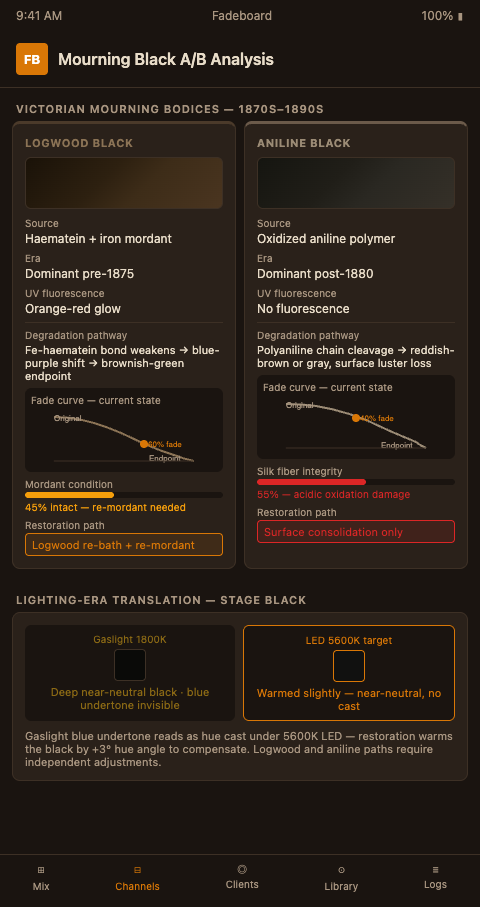
The theatrical relevance is acute. A mourning stage costume from the 1870s is likely logwood black. The same production's costume from the 1890s revival may be aniline black. A touring company's version of the same production may carry both, with the original pieces logwood and the replacement pieces aniline. Under identical aging conditions, logwood black shifts toward a brownish or greenish hue as the iron-haematein complex degrades, while aniline black shifts toward a reddish-brown or gray as the polyaniline chain breaks down. The two degraded blacks may look similar to the unaided eye but require entirely different restoration approaches.
On stage, both degraded states read as wrong. Under gaslight footlights, a properly mordanted logwood black read as a deep, near-neutral black with a slight blue undertone. Under carbon arc lighting, that same logwood black appeared very deep and slightly cool. Under modern 5600K LED, a logwood black that has shifted toward brownish green will read as distinctly off-black — undermining the period audience perception of mourning severity that the costume was designed to convey.
The Fadeboard Channel Approach to Mourning Black Analysis
Channel 1 — Black chemistry identification. The starting point for any mourning costume assessment is confirming which black chemistry is present. UV fluorescence provides a first-pass screen: logwood-derived haematein fluoresces faint orange or reddish under UV; aniline black produces little or no fluorescence. Fiber cross-section microscopy can confirm aniline black's surface polymerization pattern. HPLC from a micro-sample is confirmatory for either compound.
Chemistry of Logwood Dyes — University of the West Indies provides the detailed academic treatment of mordant-dependent logwood colors, including the iron-mordanted black profile and its degradation spectrum, that maps to the Fadeboard identification channel's reference library.
The chemistry identification channel records the confirmed black type — logwood, aniline, blend, or other — and links it to the relevant degradation reference for that compound class. For silk mourning pieces specifically, the chemistry identification step must also assess fiber structural condition — aniline silk stability data for the aniline black dye generation shows that first-generation applications used acidic oxidizing conditions that damaged silk fiber simultaneously, creating structural weaknesses that affect both the treatment path and the risk assessment before any restoration begins.
Channel 2 — Degradation profile. Logwood black on iron mordant degrades through mordant dissolution: as the iron-fiber bond weakens, the haematein reverts toward its unmordanted blue-purple natural color. A logwood black bodice that has degraded 60% may exhibit a brownish-purple tinge that is unmistakably different from the near-neutral original. Aniline black degrades through polyaniline chain cleavage: the degraded state shifts toward reddish or yellowish brown, sometimes with a distinctive surface luster change.
The degradation profile channel maps the current spectral reading of the faded costume against the known degradation trajectory for the confirmed black type, calculating an approximate position on the degradation curve — early (within 20% of original), moderate (20–60% fade), or advanced (>60% fade, approaching endpoint). This calculation determines whether full restoration is achievable or whether the treatment goal should be stabilization and color consolidation rather than complete recovery. When the mourning costumes originate from a commercial theatrical production rather than a private wardrobe, cross-referencing against Broadway chorus forensics records at this stage can distinguish poorly-preserved high-quality pieces from well-preserved low-quality pieces — a distinction that affects the degradation profile calculation significantly.
Channel 3 — Mordant condition (logwood only). For logwood blacks, the iron mordant condition is a separate restoration variable from the haematein dye condition. A garment with degraded haematein but intact mordant sites can be re-dyed with logwood bath to restore the black. A garment with both degraded haematein and damaged mordant sites requires re-mordanting before re-dyeing — a more invasive treatment with greater risk to fiber integrity.
Channel 4 — Lighting-era translation for stage black. A mourning bodice from an 1870s music hall or operetta mourning scene was designed to read as near-neutral deep black under gaslight footlights. Under those warm, low-CCT sources, a slightly blue-undertoned logwood black read as the deepest available black — the period eye did not register the blue undertone as a hue, only as depth. Under modern 5600K LED, that same blue undertone is perceptible as a distinct color cast.
The lighting-era translation channel converts the restoration target from the original gaslight-appropriate black to the LED-appropriate equivalent. For most mourning costume restorations destined for modern stage use, this means slightly warming the black to compensate for the LED's blue bias — producing a near-neutral black under LED rather than the gaslight original's slightly cool-toned black.
Channel 5 — Restoration path selection. Based on channels 1–4, the restoration path channel recommends one of three approaches: logwood re-bath (for logwood-identified, moderate degradation, intact mordant sites), aniline black surface consolidation (for aniline-identified, moderate degradation), or inpainting (for advanced degradation where full bath treatment would damage fragile fiber). The path selection is explicitly documented as a decision, not a default.
Advanced Tactics for Mourning Costume Restoration
Test the mordant before committing to a re-bath. For logwood blacks, a 1cm test patch treated with a fresh logwood bath (no additional mordanting) will either deepen to a near-black (intact mordant sites) or shift toward purple (damaged or absent mordant sites). This diagnostic takes under 30 minutes and definitively determines whether re-mordanting is necessary before committing to a full treatment.
Use the degradation endpoint as the exhibition design constraint. A mourning bodice that has reached advanced logwood degradation (>60% fade, shifting toward purple-brown) may not be restorable to a convincing stage-performance black without treatments that pose unacceptable risk to fiber integrity. For such pieces, the conservation-appropriate outcome may be a stabilized, partially-restored state displayed with documentation of the original black condition — rather than a fully restored black that required hazardous treatment to achieve.
Account for the mix in transitional-era pieces. For mourning costumes dated to the 1880s–1890s, a blended logwood-aniline bath was common: the dyer applied both compounds to achieve depth and uniformity that neither delivered alone. Treating a blended black garment with a logwood-only bath will restore the logwood fraction but may shift the aniline fraction toward reddish-brown. The blend must be confirmed before the restoration path is selected. For collections that span multiple theatrical contexts — operetta, music hall, and vaudeville mourning wardrobe alongside dramatic production pieces — the vat mordant comparison methodology from quilt conservation provides a systematic framework for distinguishing mordant-fixed natural dyes from vat-applied synthetics across a mixed lot, which is the same analytical step required before the blended black restoration path can be reliably selected.
For silk mourning pieces from the 1870s–1880s, confirm fiber structural integrity before committing to any wet treatment. First-generation aniline blacks were applied with acidic oxidizing conditions that damaged silk fiber as well as dyeing it — mourning bodices from this era may have structurally weakened fibers beneath the black surface, which constrains treatment options even when the color restoration target is clearly established.
Theater archivists managing mourning costume lots should begin every new lot with the chemistry identification channel before any other treatment planning. The logwood-aniline distinction is the single most consequential variable in a mourning black restoration — and it is one that cannot be determined by eye, regardless of how experienced the conservator. Committing half an hour to UV fluorescence and spot testing at the start of the lot saves hours of incorrect treatment and potential irreversible harm to the most visually and historically significant pieces in the mourning wardrobe collection.
Fadeboard's channel architecture for mourning blacks — particularly the mordant condition fader that has no direct analog in standard dye bath workflow — represents the most concrete single benefit of the soundboard approach for archivists working in this historically dense and technically demanding area of theatrical costume conservation.