Comparing Vat and Mordant Dyes for Quilt Restoration
The Indigo That Outlasted Everything Else
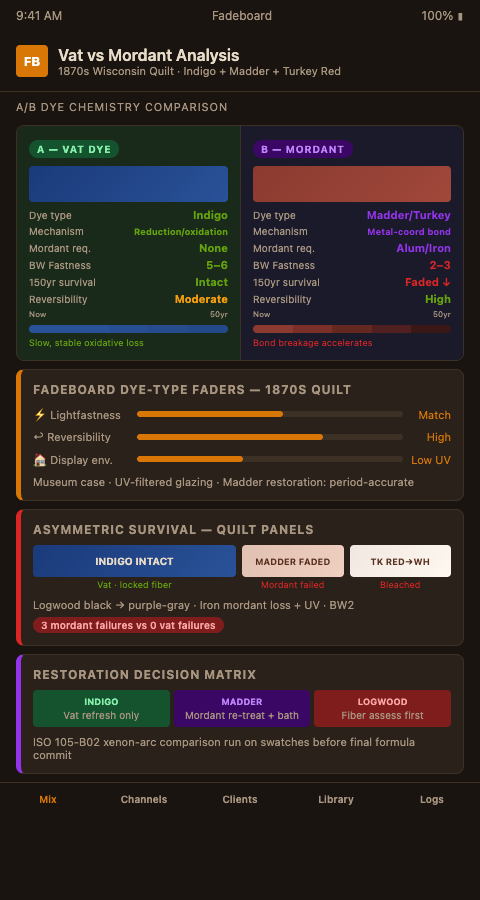
A hand-pieced quilt from the early 1870s arrived at a Wisconsin workshop with its indigo still largely intact. The surrounding madder red had faded to a pale dusty rose. The turkey red accent strips had bleached nearly to white. The black sashing — logwood with iron mordant — had gone grey-purple. The indigo, which in the original quilt had probably read as deep blue-black, now read as medium blue against the faded neighbors. It had not faded appreciably in 150 years.
Indigo is documented as often the last surviving color in faded 19th-century quilts. The reason is its chemistry: indigo is a vat dye, and vat dyes work through a fundamentally different mechanism than mordant dyes. Vat dyes require reduction to the leuco form; oxidation post-immersion produces physically entrapped insoluble color within the fiber. The dye molecule is not attached to the fiber through a metal-salt bridge — it is locked inside the fiber structure mechanically. It cannot be washed out by alkaline detergents, pulled out by water-soluble mordant loss, or degraded by the same oxidative pathways that destroy mordant-dye chromophores.
Indigo vat chemistry requires no mordant; the reduction-oxidation cycle differs fundamentally from mordant-dye coordination chemistry. This is why a 19th-century quilt with both indigo and madder shows such asymmetric survival: the indigo is chemically independent of the mordant history; the madder is entirely dependent on it.
Indigo's colorfast vat chemistry explains why it survives in quilts where mordant-dyed colors fail. For the workshop restorer facing the 1870s quilt, this asymmetric survival creates an immediate diagnostic question: should the madder and turkey red restoration use mordant dyes (period-accurate but fast-fading) or synthetic equivalents (period-inaccurate but more stable)?
The Fadeboard Framework for Dye-Type Selection
Fadeboard approaches the vat-vs-mordant choice as a fader decision rather than a categorical one. The core fader is the lightfastness-match fader: it represents the expected future lightfastness of the restoration dye relative to the original surviving dyes. A lightfastness-match fader set to "match" means the restoration dye will age at the same rate as the original; a fader set to "exceed" means the restoration dye will outlast the original and eventually read more saturated than its neighbors.
For the quilt with surviving indigo surrounded by faded madder, the choice is not obvious. If the madder restoration uses a mordant dye matched to the original chemistry, the restored madder will begin re-fading within a decade of display, and the restoration will need to be revisited. If the restoration uses a more lightfast synthetic equivalent, the restored sections will hold color while the surviving original areas continue to fade, and within twenty years the restored patches may read visibly more saturated than the background.
Vat dyes offer superior light and wash fastness over mordant dyes and are well suited to high-durability restoration. For quilts intended for display, the argument for vat dye substitution on the faded madder and turkey red areas is strong on durability grounds. The counter-argument is reversibility: conservation dye evaluation criteria include reversibility alongside lightfastness match (from the chintz appliqué context), and some vat dye applications are more difficult to reverse than mordant dye applications.
Fadeboard encodes this tradeoff in two additional faders: the reversibility fader (how important is the ability to undo the treatment?) and the display-environment fader (how much light exposure will the restored piece receive?). A quilt destined for a museum case under controlled UV-filtered lighting has a different optimal dye-type profile than a quilt going back into domestic display on a bed.
The mordant — which forms coordination complexes binding dye to fiber; different metal salts alter final color — Wikipedia describes the chemistry that makes mordant dyes both flexible and fragile. The flexibility is the range of colors achievable through mordant variation (alum gives warm tones; iron gives cooler, darker tones; chrome gives earth tones). The fragility is that the mordant bond is the weak link — the dye sits in coordination with the metal salt, and any disruption of that coordination — washing, humidity cycling, UV exposure — can break the bond and release the chromophore.
For natural dye fade prediction in restoration contexts, the vat-vs-mordant choice is one of the primary inputs — a vat dye restoration will follow a very different fifty-year trajectory than a mordant dye restoration applied to the same panel.
Advanced Tactics for Dye-Type Selection
ISO 105-B02 comparative testing. For any quilt project where the dye-type choice is consequential — museum loan, insurance appraisal, high-value commission — ISO 105-B02 xenon arc protocol provides comparative fastness data for vat vs. mordant dyes under standardized aging. Running comparative swatches of the candidate restoration dyes through an accelerated aging test before committing to the project gives objective lightfastness data that can inform and document the Fadeboard fader-type choice.
Mixed-chemistry quilts. Many 19th-century quilts contain both vat-dyed and mordant-dyed elements — indigo and madder were commonly used together, with the indigo applied first (as it requires no mordant and would be unaffected by a subsequent mordant bath). Vat dyes provide the highest colorfastness class; mordant dyes are more color-flexible but lower fastness. In a mixed-chemistry quilt, Fadeboard maintains separate fader columns for each dye type, since the restoration logic differs: the indigo panels may need only a reduction-oxidation vat refresh, while the madder panels need a full mordant re-treatment before the dye bath.
Cochineal forensics for verification. When the original dye chemistry is uncertain — particularly for turkey red, which could be madder, cochineal, or synthetically derived in later pieces — fade forensics for cochineal piecework quilts provides a framework for distinguishing cochineal from madder from synthetic red using visual and spectroscopic methods. The dye identification feeds directly into the Fadeboard dye-type fader: cochineal is a mordant dye with specific lightfastness characteristics different from madder, and the restoration recipe differs accordingly.
Mourning black comparison context. The asymmetric survival pattern — vat-dyed indigo persisting alongside failed mordant-dyed blacks — is the same pattern that produces the diagnostic challenge in Victorian mourning textile work. Logwood black, a mordant dye, fails at a rate that makes it incompatible with the indigo it was often used alongside; the surviving indigo on a mourning quilt provides a baseline that the logwood restoration needs to be calibrated against. Mourning black comparison in theatrical mourning costume contexts documents the same asymmetric survival in a parallel material category.
Display-environment calibration for future stability. The display-environment fader is the most forward-looking element of the vat-vs-mordant analysis. A mordant dye restoration in a climate-controlled museum storage environment with minimal UV exposure may outlast a vat dye restoration in a domestic bedroom with south-facing windows. Fadeboard captures the display-environment specification as part of the session record, so the reasoning behind the dye-type choice is documented alongside the choice itself.
Match the Chemistry, Not Just the Color
The workshop that picks a replacement dye by visual match alone — looking at the faded panel under studio light and mixing until the color is close — is solving the immediate problem while creating a future one. The replacement dye may match now but age at a completely different rate, producing a piece that looks right for five years and wrong for the next fifty.
Fadeboard's vat-vs-mordant analysis forces the longer view. The lightfastness-match fader, the reversibility fader, and the display-environment fader together define a dye-type profile for the restoration — and that profile is what ensures the restored piece ages coherently with the original rather than diverging from it.
The right restoration dye is not the one that matches today. It is the one that matches in 2076, accounting for the specific conditions under which the piece will be stored or displayed, and for the specific degradation trajectory of the original dyes that will continue to age alongside it. Fadeboard's fader-based framework makes that fifty-year projection explicit and documentable — which is the standard that heirloom quilt restoration warrants.
Quilt restorers ready to treat the vat-vs-mordant choice as a systematic fader decision — rather than a visual preference — can join the Fadeboard waitlist now. Bring your next mixed-chemistry quilt (indigo plus madder or turkey red), the intended display environment, and any lightfastness references you already have for the original dyes.