Tracking Archive Decisions Across Century-Old Wardrobe Pieces
The Undocumented Decision Problem
Western Costume Company's archive — holding approximately 7,000 artifacts from a century of Hollywood and theatrical production — illustrates both the scale of the documentation challenge and the practical consequences of gaps in the record. Archive — Western Costume describes the collection, which spans provenance from silent film through contemporary production. Archive Discoveries — Western Costume Research Library documents the real-world challenge conservators face when attempting to reconstruct costume provenance from label clues and film stills — the archival equivalent of reading a palimpsest.
For theater archives holding century-old wardrobe rather than film costume, the documentation challenge is structurally similar but often more acute. Theater productions did not generate the same volume of production photographs as film, and touring company records were routinely lost when companies dissolved. A set of 1910 operetta wardrobe pieces may have been used in a dozen productions by the time it entered an archive, with each production's alterations and repairs overlaid on previous ones.
The consequence for restoration work is that every decision a contemporary conservator makes about a century-old costume is made in the context of prior undocumented decisions. If a bodice has been altered three times and no record exists of any alteration, the conservator cannot know whether the current color profile reflects the original production, the third touring company's substitution dye, or a 1960s restoration attempt. Without a framework for capturing that uncertainty as part of the decision record, the conservator's own choices become part of the undocumented layer — adding to the problem they are trying to solve.
NPS Museum Handbook Introduction — National Park Service establishes the federal museum standard for accessioning, cataloguing, and accountability for historic collections — the administrative infrastructure that theater archives may lack, particularly for collections acquired through donation or estate transfer rather than formal institutional accession.
Fadeboard as a Decision Documentation System
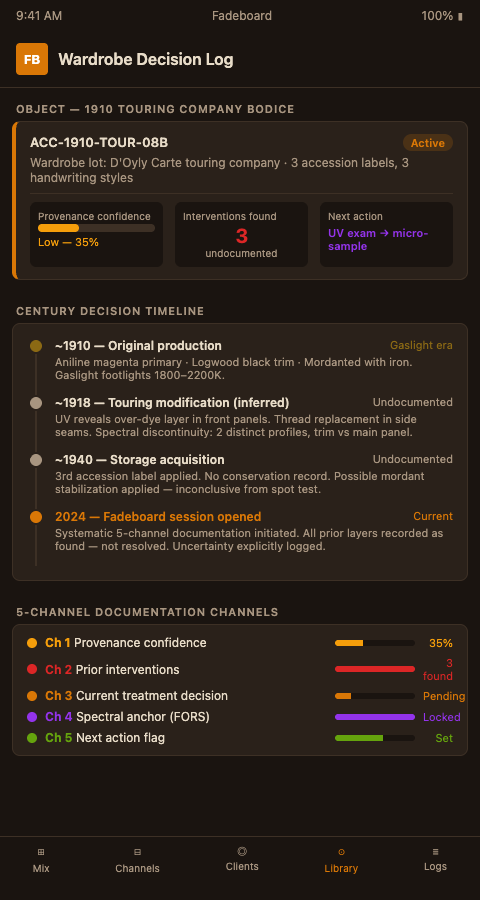
The value of Fadeboard in this context is not primarily analytical — it is documentary. A Fadeboard session for a century-old wardrobe piece creates a structured record of every decision, the evidence that supported it, and the uncertainty that remained unresolved. That record becomes an object file entry that any future conservator can read, challenge, and build on.
Channel 1 — Provenance confidence layer. Before any treatment decision is recorded, the provenance confidence channel captures what is known, what is inferred, and what is genuinely unknown about the garment's origin and history. A D'Oyly Carte Archive — Archives Hub (Jisc) garment with a complete institutional acquisition trail has a high provenance confidence; a touring company piece acquired through a dealer with no documentation has low confidence. The channel setting shapes everything downstream: a low-confidence provenance means the restoration target is set with wider tolerances, because the original may differ more from surviving evidence than the conservator can determine.
Channel 2 — Prior intervention identification. The prior intervention channel records all evidence of earlier restoration or alteration work on the piece. This includes: visible thread replacements, color discontinuities that suggest patching, over-dye or overcoating layers identified through UV examination or micro-sampling, and structural repairs to seams or foundation fabrics. Each identified prior intervention is dated where possible (based on materials analysis or documentary evidence) and assigned to a probable treatment era.
This step directly addresses the undocumented layer problem: even if no documentation exists for prior work, systematic recording of the physical evidence creates a record that at minimum captures the sequence of interventions visible to the current conservator. A future conservator will be able to read that record and understand what the previous conservator found — even if neither of them found documents.
Channel 3 — Current treatment decision. The treatment decision channel is where the actual restoration choices are recorded: what colorant was applied where, at what concentration, using which technique, on which specific date, and by whom. Costume Institute Conservation — The Metropolitan Museum of Art describes the Met's digital documentation methods for its 33,000-object costume collection — the institutional scale of that program demonstrates that systematic session-level documentation is not only possible but necessary for collection management at any significant scale.
The treatment decision entry includes the uncertainty annotation: where the conservator had to make a judgment call without complete evidence, that judgment and its basis are explicitly recorded. This is not an admission of inadequacy — it is the scientifically appropriate response to an underdetermined problem. A decision record that says "restored to warm ivory based on surviving fragment comparison; production documentation unavailable; confidence moderate" is more useful than a decision record that presents the treatment as certain when it was not.
Channel 4 — Photographic and spectral anchor. Every treatment session produces a spectrophotometric reading of the treated area before and after treatment, plus controlled-condition photographs at both states. These readings and photographs are attached to the session record as immutable evidence. They cannot be revised; they can only be supplemented by subsequent sessions. This creates a timestamped record that survives any future changes to the object's condition or documentation status.
Channel 5 — Next action flag. The session record includes a next action flag: the conservator's recommendation for the next step — whether that is follow-up treatment, environmental monitoring, structural support, or simply periodic condition checking. Introducing the D'Oyly Carte Archive — V&A Blog describes the V&A's handling of the D'Oyly Carte acquisition as a structured institutional donation and cataloguing effort — the kind of systematic next-action planning that transforms a one-time cataloguing exercise into an ongoing collection management program.
Advanced Tactics for Century-Old Wardrobe Documentation
Use label analysis as provenance evidence. Wardrobe labels, alteration tickets, and property room tags often carry dating information in the form of typeface, label format, and material that can be approximately dated. Photographing and transcribing all labels as part of the provenance confidence assessment — even labels whose content is ambiguous — adds to the physical evidence corpus and may become useful as additional research surfaces related documentation.
Distinguish "production-original" from "touring-modified" colorants. For touring company wardrobes, color modifications were common: a production that moved from a large urban theater to smaller touring venues might have refreshed certain costumes to read better under lower-powered stage lighting. A bodice that shows two distinct spectral profiles across its surface — one in the main panels and a different one in the trim and accents — may reflect this kind of touring modification rather than degradation. The prior intervention channel should flag this possibility and document the spectral evidence for the hypothesis.
Cross-reference the session record with the institutional acquisition record. Every Fadeboard session record for a century-old wardrobe piece should reference the institution's formal accession record for that object. For archives that lack robust accessioning infrastructure, the session record itself may become the de facto primary acquisition document. Screen and Stage Costume History — UCLA Library Research Guides aggregates primary and secondary resources for tracing provenance of historic stage garments — a starting point for building out thin acquisition records from external research.
Feed the session record into the opera archive evidence framework when the wardrobe includes operatic material. Opera archives have developed particularly robust evidence documentation practices because operatic staging is extensively reviewed and documented in press materials — feeding your session records into that existing evidence infrastructure extends their utility considerably.
Use the session export to build a wardrobe-lot cross-reference. When treating multiple pieces from the same touring company or production season, exporting the session records for the full lot and cross-referencing the provenance confidence, prior intervention, and spectral baseline data across all pieces reveals patterns that are invisible at the individual piece level: which colorants were used consistently across the lot, which pieces were altered later than others, and which pieces carry the most complete original state.
For archivists managing dye decision tracking across multi-month restoration projects, the Fadeboard session architecture for wardrobe documentation provides a directly transferable framework — the same channel structure that tracks dye decisions across a quilt lot tracks treatment decisions across a wardrobe lot, with the addition of the provenance confidence and prior intervention layers specific to theater archive material.
Theater archivists who have never systematically documented their restoration decisions should start with one complete wardrobe lot — even a small one — and run every piece through the full Fadeboard session workflow before treating anything. The documentation exercise will surface prior interventions, provenance uncertainties, and spectral profiles that would otherwise remain invisible, and will produce an object file for each piece that is immediately more useful than any prior record the archive holds.
The theater archive pipeline provides the operational framework for scaling this workflow from a single lot to a full collection program — once the documentation architecture is established, the per-piece overhead drops significantly.