Tracking Dye Decisions Across Multi-Month Quilt Projects
What Gets Lost Between Sessions
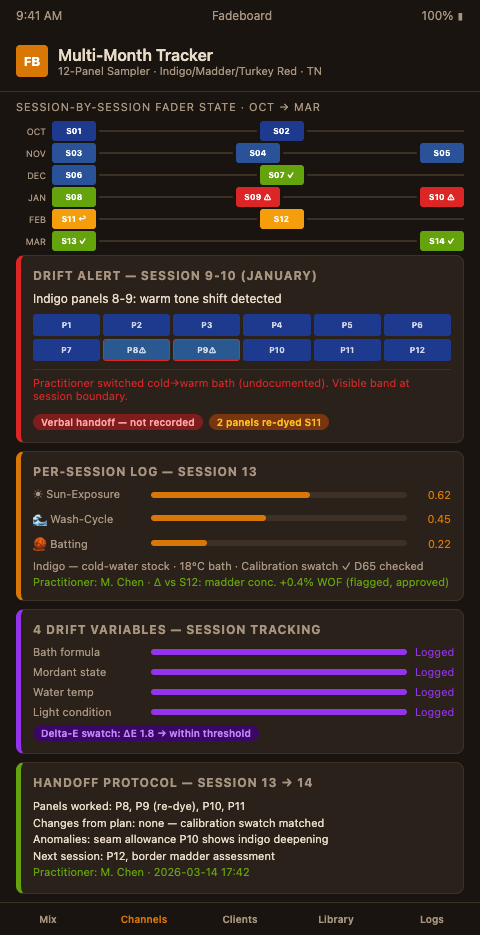
A Tennessee workshop was restoring a 12-panel sampler quilt — indigo grounds, madder borders, turkey red center medallion — across a five-month timeline. Three practitioners worked at different points in the project. At the four-month mark, the restorer picked up where a colleague had left off and noticed that the last two indigo panels showed a slightly warmer tone than the preceding panels. The colleague had switched from a cold-water indigo stock to a warm-water bath to improve absorption in cold weather. The decision was made verbally, not recorded, and was not communicated at handoff.
The result was a visible band across the quilt at the session boundary — the seam where cold-bath and warm-bath indigo sat adjacent. Correcting it required re-doing two panels, plus a calibration bath to confirm the cold-water formula.
Conservation standards require permanent written and pictorial records of every dye, material, and treatment step. That standard exists precisely because the failure mode described above is not unusual — it is the default outcome when practitioners work sequentially on a multi-month project without a formal per-session record system. Smithsonian Museum Conservation Institute establishes that records must be accurate, complete, and permanent for all conservation interventions. "Verbal understanding between colleagues" is none of those things.
Federal museum standards require examination reports, treatment reports, and photographic logs for all treatments. For workshop-level quilt restoration, the equivalent standard is a per-session treatment record that captures the four variables most likely to drift: bath formula, mordant state, water temperature, and lighting condition under which the color assessment was made.
Fadeboard as the Session Log
Fadeboard's session record structure is designed around the four drift variables that matter most in multi-month quilt projects. Each session creates a time-stamped record that includes: (1) fader positions for each active panel at the start of the session; (2) bath formula modifications made during the session; (3) mordant adjustments applied; and (4) calibration swatch result under the reference light.
The fader positions are the most important element. A new practitioner picking up the project reads the fader positions for each panel — sun-exposure, wash-cycle, batting-contact, mordant-saturation — and immediately understands the restoration depth target for that panel. They do not need to reconstruct the diagnostic reasoning; the fader positions encode it. If the previous session's restorer set a high sun-exposure fader for panels 8 and 9 but a lower fader for panels 10 and 11, the incoming practitioner knows that panels 8 and 9 received more corrective depth than 10 and 11, and will match that gradient rather than applying a uniform correction.
Digital documentation methods enable reproducible color-matching workflows across extended restoration timelines. Fadeboard's session record is exportable as a structured document that can be stored in the project folder alongside photographic documentation, allowing a conservator reviewing the work years later to reconstruct exactly what was done, when, and by whom.
The bath formula record within each session note captures the dye weight per liter, mordant concentration, water temperature, immersion time, and rinse pH. These are not optional parameters — each one affects final color depth independently, and a change in any one of them between sessions can introduce drift. Professional practice requires post-treatment reports with dye formulas, mordants used, and care recommendations. Fadeboard's per-session structure provides this documentation automatically as a byproduct of the session workflow rather than as a separate documentation task.
For projects that will eventually contribute to historical society records and quilt archives, the Fadeboard session logs are the primary technical record. A historical society receiving a donated quilt along with ten years of workshop treatment records can trace every color decision back to the session in which it was made, the practitioner who made it, and the lighting conditions under which it was assessed.
Advanced Tactics for Multi-Month Documentation
Session handoff protocol. Implement a formal handoff note at the end of every session, separate from the automatic Fadeboard record. The note covers: which panels were worked, what decisions were changed from the previous session plan, what anomalies were observed, and what the next session should address first. This note is written by the practitioner who completed the session, not the one who begins the next one. The distinction matters — the practitioner who made decisions during a session can articulate the reasoning behind them; the practitioner who arrives to read a record is interpreting, not explaining.
Spectrophotometer delta-E tracking. For high-value quilt restoration where color accuracy must be documented to archival standards, spectrophotometers generate reproducible color data records including spectral curves and Delta E values for dye-batch tracking. A Delta E measurement of the calibration swatch before and after each session provides a numerical record of color stability that supplements the visual and descriptive session log. Fadeboard's annotation field captures the Delta E readings alongside the fader positions.
Threshold flagging for batch consistency. Set a threshold rule in the Fadeboard session record: if any bath formula parameter changes by more than 10% from the previous session, the change is flagged for review before the bath is applied. This prevents the silent drift scenario — the practitioner who adds slightly more alum to a cold-weather bath without noting the change. The threshold flag does not prevent the change; it creates a decision point that requires explicit acknowledgment.
Workshop growth documentation integration. Multi-month project records feed directly into the workshop growth documentation practice — the aggregate of session records across projects builds the workshop's institutional knowledge of which bath formulas work for which fabric types, mordant histories, and dye families. Over three to four years, the Fadeboard project archive becomes a practical reference library that can significantly reduce session setup time on new projects.
Theater archive tracking parallel. The multi-month tracking problem is consistent across all restoration contexts: archive decision tracking in theatrical costume work documents how theater archive projects manage dye decision continuity across seasonal closures and crew changes. The core principle — every decision documented at the time it is made, with enough specificity for reproduction — is identical to quilt workshop practice.
The Record Is the Repair
Multi-month quilt restoration projects fail at handoffs more than anywhere else. The session that goes undocumented, the formula change that is communicated verbally, the lighting condition that shifts without notice — each of these is a failure of documentation discipline, not a failure of dye technique.
Fadeboard's session log structure does not add documentation work to the session; it captures documentation as a byproduct of the workflow. The restorer who sets fader positions, records bath formula, and runs the calibration swatch check is creating the session record automatically. The five-minute documentation discipline at the end of each session — handoff note, calibration swatch photo, fader state export — is what makes the next session possible without loss.
Workshops that have implemented the Fadeboard session log consistently report that multi-month projects run with fewer re-dyeing incidents and cleaner handoffs between practitioners. The documentation is not overhead — it is the mechanism that makes the project behave as a continuous, coherent body of work rather than a sequence of individual sessions that each start from scratch.