Building a Swatch Library From Single-Client Doll Work
The Knowledge That Walks Out the Door
A Jumeau Tête arrives on day one. You spend forty minutes reading the degradation, set your Fadeboard channels, mix three swatch variations, and find the right one by swatch three. You apply the restoration over three sessions, return the doll, and archive the client folder with the swatch attached.
Six months later a second Jumeau Tête arrives from a different client. You have the swatch from session one, but you cannot remember exactly which channel settings produced swatch three rather than swatch one or two. The dated recipe log shows the mix formula but not the channel positions. You spend thirty minutes re-reading the new head's degradation before you find swatch three's equivalent again.
The swatch was there. The channel context was not. That is the gap a structured swatch library closes.
The Market Decipher dolls collectibles market report documents that the antique doll segment is growing at 6.58% CAGR, with single-client restoration studios serving the high-value heirloom segment. As volume grows, studios that compress setup time through accumulated reference have a structural advantage over those that start from zero with each client.
What a Usable Swatch Library Contains
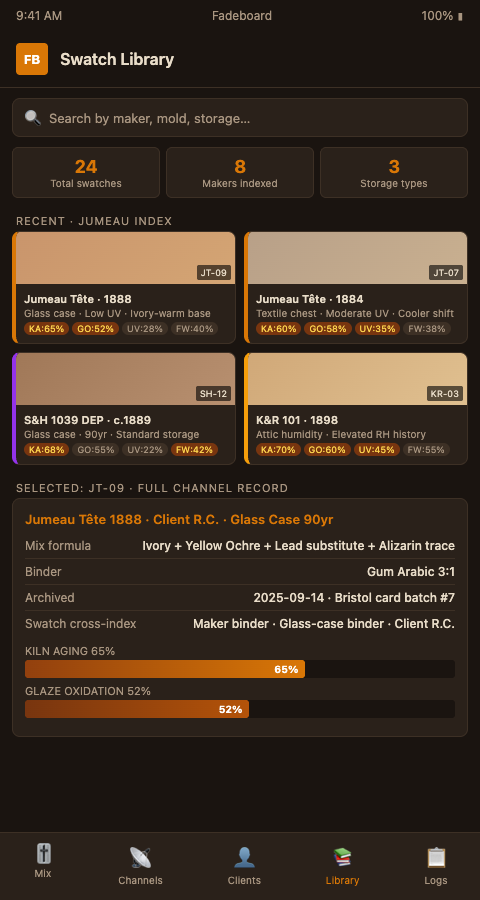
A swatch library is not a folder of loose Bristol card fragments. It is a cross-indexed system that lets you retrieve a specific calibration point by maker, era, channel configuration, and storage history combination. The difference between a useful library and a pile of swatches is the indexing.
Each swatch card in a well-structured library contains:
Physical swatch. A 1×2 inch Bristol card sample, labeled with the mix formula on the back — pigment names, proportions, and binder type. Dried under the same conditions as the restoration application. The Forbes Pigment Reference Collection at Harvard Art Museums prepares each of its 2,500 reference samples with multiple binder types precisely because the same pigment in different binders reads differently. Your swatches should note binder (gum Arabic, egg tempera, casein, watercolor) because binder choice affects drying tone.
Channel log attachment. A printed or written record of the Fadeboard channel settings that produced this swatch: kiln-age position, glaze-oxidation position, UV-darkening position, face-paint-wear position. This is the "why" behind the formula — the record that lets a future session start at the same channel configuration rather than rebuilding it from visual inspection.
Maker and era identification. Manufacturer, mold number, production decade, and any dual-mark information (S&H bisque assembled by K&R, for example). The LOC pigment documentation project demonstrates the value of systematic cross-referencing: colorant identification only becomes useful as a reference when it is indexed to the material it describes.
Storage history note. Three lines maximum: what the provenance documentation said about storage conditions, estimated UV exposure (display versus closed storage), and any notable condition observations (glass case, textile chest, attic humidity). A swatch without storage history is a mix recipe. A swatch with storage history is a degradation model.
The Library of Congress Forbes Pigment Reference Collection data documents each pigment prepared with gum Arabic, egg tempera, acrylic, and linseed oil — a multi-binder approach that enables cross-media comparison. Your single-client swatch library can achieve a narrower but more specific version of this: multiple mix variations for the same maker-era-storage combination, each on a separate swatch card, so you can see how binder choice interacts with a specific bisque type.
Building the Library Session by Session
The swatch library builds itself if the session protocol includes three additional habits.
Cut three swatches per approved mix, not one. One stays in the client folder. One goes in the maker-era index binder. One goes in the storage-history index binder. The cross-indexing takes thirty seconds per session and means you can retrieve a reference by maker (all Jumeau swatches) or by storage condition (all glass-case dolls) depending on which axis is relevant to the next client.
Photograph the swatch against the doll face before archiving. A photograph of the approved swatch adjacent to the cheek zone it was matched to provides a visual confirmation record that no description can replace. The AMNH condition reporting standard documents location and character of each condition issue with precise measurements — your swatch-to-face photograph is the pictorial equivalent of that location record for your mix.
Date every swatch card. Bristol card swatches yellow slightly over years. A swatch made in 2024 will read differently than one made in 2019 for the same maker profile. Dates let you weight older swatches appropriately and eventually retire them when drift becomes significant.
Fadeboard's channel log format travels with the physical swatch. The channel positions recorded in the session become the index metadata for the card, making retrieval by channel configuration possible — not just by maker name.
Tracking pigment decisions across two-week restoration timelines is the operational discipline that connects swatch library building to active project management: the approved swatch from day one becomes the reference anchor for every subsequent session decision within a single project.
The AIC Code of Ethics, Article VII requires permanent records for every examination and treatment performed. A structured swatch library satisfies this requirement in a form that is simultaneously compliant and practically useful — each swatch card is both an AIC-compliant treatment record and a searchable reference asset.
Advanced Tactics for Library Growth
Group swatches by mold number within each maker. A Kestner 147 and a Kestner 171 may share factory pigment chemistry but differ in application depth. Grouping by mold number reveals which specific heads benefit from their own sub-profile rather than sharing a maker-level reference.
Note anomalous swatches explicitly. When a Kestner reads significantly outside the expected channel range — perhaps due to atypical storage that accelerated oxidation — flag the swatch as an outlier and note the probable cause. Outliers are as informative as typical samples: they tell you the range of variation you should be prepared for with that maker.
Share anonymized channel data with the professional community. Independent restorer networks that pool channel-log data from across their libraries can build factory profiles far more detailed than any single studio accumulates. This is how the Ceramics Condition Reporting standard at Alaska State Library works: collective documentation standards become more useful as more practitioners adopt them.
The painted boot pigment workflow for 1890s dolls is a natural extension of the swatch library: once you document face pigment channel settings, extending the same record-keeping to accessory and costume pigments — particularly the boot paints that differ by factory and are frequently damaged — creates a complete reference for each maker era rather than a face-only partial record.
For restorers who manage both doll and textile clients, the quilt dye reference from surviving corner samples addresses the same cross-indexing challenge in fabric: surviving color samples are only useful as reference if they are systematically indexed to the piece they came from and the storage conditions that produced their current state.
The Library Pays Back on Client Twelve
Solo doll restorers building a practice from single-client heirloom work are building a reference library whether they know it or not. Swatches that are filed with channel logs and maker identification become a searchable asset; swatches that drift loose in a drawer become waste paper. Fadeboard's channel log format gives the Bristol card context it needs to function as a reference rather than a reminder.
The Fadeboard waitlist is open for independent restorers who want to start building a structured swatch library now, before the next eleven-day deadline arrives. Join with a note on how many makers you encounter regularly in your studio — Kestner, Jumeau, S&H, K&R, Bru — and the early-access release will include maker-indexed channel presets that give your first swatch cards a professionally grounded starting configuration.