Building a Dye Reference From Surviving Quilt Corners
Why Corners Tell the Truth
A workshop specialist unrolled a circa-1890 sampler quilt to assess its color state. The top surface was almost uniformly pale — the indigo had shifted to blue-gray across the board, the madder had moved to a dusty rose at the block faces, and the weld yellow was barely detectable as a warm cream tint in what the construction showed had been bright yellow border triangles. The first instinct might have been to call this a "moderately faded" quilt and mix baths to match the observed color.
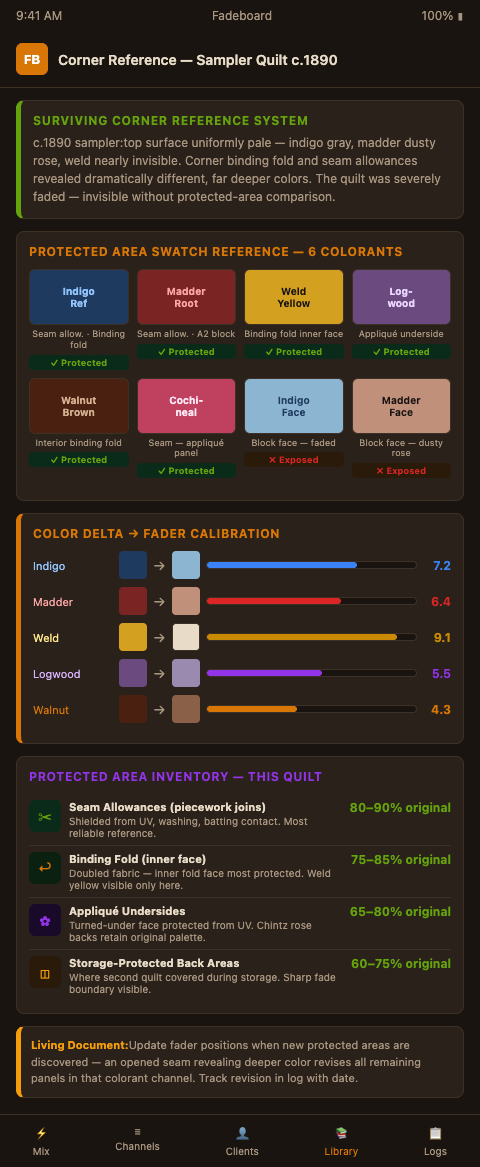
Instead, she folded back the binding at the corner and looked at the seam allowance fabric tucked underneath. What she found there was deep, rich indigo — the color the quilt had started with. The madder at the seam allowances was a clean, vibrant red-orange, nothing like the pale dusty rose on the block faces. The weld yellow at the tucked binding fold showed a clear, warm gold that had been completely invisible on the displayed surface.
The quilt was not "moderately faded." It was severely faded — the difference between the corners and the face was dramatic — but that severity had been invisible because there was no reference point on the displayed surface for comparison.
Research on 19th-century American textiles and natural dye palettes confirms that corner selvages and seam allowances consistently retain the highest dye concentration in antique quilts — they are the most reliable evidence of original starting color available to the restorer without destructive sampling.
What Counts as a Protected Area
Protected areas are places on the quilt where the original colorant has been shielded from the primary degradation forces — UV light, mechanical abrasion from washing, and batting contact. On a typical 19th-century pieced or appliqué quilt, the protected areas include:
Seam allowances tucked into the interior of piecework joins. These are protected from all three major degradation forces: they never face the light, they are not agitated directly in washing, and they are not in contact with the batting. On a well-constructed 1880s quilt, the seam allowance fabric may retain 80–90% of its original dye depth while the block face is at 40–50%.
Binding folds: The folded outer edge of the binding protects the fabric at the innermost fold point. Unfold the corner binding carefully and examine the protected inner fold surface. This is typically the most saturated surviving color on the entire quilt.
Appliqué undersides: Where a chintz or calico patch has been appliquéd to a ground fabric, the underside face of the patch — the face that was turned toward the ground — is protected from UV. On Baltimore Album and mid-19th-century appliqué quilts, comparing the top face of an appliqué rose with its underside often reveals a striking difference in saturation.
Protected back areas: Some quilts were stored folded, with a second quilt or fabric layer on top. The area protected by that top layer may retain significantly more color than the surrounding areas. Look for edges with clean lines of differential fade that correspond to a folding or storage boundary.
The International Quilt Museum's conservation team uses unexposed seam and binding areas as the color reference baseline for all color-matching work in their collection — confirming that this is the established professional standard, not a workshop shortcut.
Building the Reference System: FORS and Workshop-Level Alternatives
At the laboratory level, FORS surveys of unexposed textile areas establish the original dye baseline non-invasively — the spectroscopic method correlates with HPLC dye identification and is suitable for building a structured dye reference map across a large quilt. For the workshop practitioner without laboratory access, the equivalent approach is systematic visual comparison combined with small-sample test dyeing.
The workshop-level reference-building process runs as follows: photograph each protected area under identical, controlled lighting (the same illuminant, same camera settings, same background). Create a labeled reference sheet with the photograph of each protected area alongside its location identifier. This becomes your color reference document — the visual target for every panel's restoration bath.
Spectrophotometric matching removes subjective visual bias by measuring the reflectance curve of the protected area and giving you a K/S value — a measure of dye concentration relative to fiber substrate — that can be matched instrumentally. Where a spectrophotometer is available (increasingly common in well-equipped restoration workshops), taking a reading at each protected area provides a numerical reference to supplement the visual comparison. HunterLab's restoration work with spectrophotometry confirms that spectrophotometric matching minimizes metamerism — the problem where two colors that match under one light source look different under another.
Translating Corner References Into Fader Calibration
With the reference sheet built, the translation to Fadeboard fader calibration is systematic. For each block panel in the zone map, identify the nearest available protected area reference. Calculate the color delta between the protected area and the block face — visually, this means comparing them side by side under the same lighting; instrumentally, it means comparing their K/S values or Lab* coordinates.
The magnitude of that delta determines the panel's fader position. A small delta (the face is close in color to the protected area) means a low fader setting — the panel needs only minor color correction. A large delta (the face is dramatically paler than the protected area) means a high fader setting — the panel needs substantial corrective concentration.
The direction of the delta — which component has changed most — tells you which channel to elevate. A delta that is primarily in luminosity (lighter but same hue) points to the sun-exposure or wash-cycle fader. A delta concentrated at the stitching lines (halos rather than global lightening) points to the batting-contact fader. When both are present, both faders are elevated independently.
The Met's HPLC approach to micro-sampling from protected zones confirms that protected areas yield higher dye concentration readings and more reliable colorant identification than exposed surfaces — the same principle that drives the workshop-level corner reference methodology.
Multiple References on a Multi-Colorant Quilt
A sampler quilt with 12 different natural dye colorants — indigo, madder, cochineal, weld, walnut, logwood, and their mordant variants — requires a reference reading for each colorant, not just one overall color reference. The indigo seam allowance tells you where the indigo started; it does not tell you about the original weld yellow, because weld and indigo are completely different chromophore systems with different fade trajectories.
Build the reference sheet with a separate entry for each colorant present on the quilt. For each colorant, identify the best protected area available — sometimes a seam allowance, sometimes a binding fold, sometimes the underside of an appliqué patch. If two different blocks with the same apparent colorant show different reference colors at their protected areas, record both: you may be looking at two different dye sources (natural root madder vs. synthetic alizarin, for example) that started at different colors and should be treated as separate channels.
Advanced analytical FORS techniques confirm that FORS correlates well with HPLC dye identification and is suitable for building a non-destructive dye reference map across a large quilt — the systematic, multi-colorant approach that the workshop-level visual reference methodology approximates.
For tracking dye decisions across a multi-month restoration project, the corner-reference document and the linked Fadeboard channel settings serve as the fixed anchor throughout the project — every bath decision references back to the protected-area baseline established at intake, not to the practitioner's evolving memory of what "looked right" in an earlier session.
Using the Reference for Apprentice Handoff
The corner-reference document is the single most useful tool for an apprentice handoff on a multi-session quilt restoration. An apprentice who has not examined the original quilt can still mix accurate corrective baths if they have the reference photographs, the channel settings in Fadeboard, and the resulting bath recipes from previous sessions.
The reference also catches drift: if the apprentice's test swatch for panel C4 reads noticeably different from the seam-allowance reference photo for that panel, the discrepancy is visible before the bath is applied to the full panel. Without the reference, a drifted color might not be noticed until the quilt is finished and compared to an adjacent panel — at which point correction means re-treating an already-dyed block.
For vat vs mordant dyes, the reference-building logic differs slightly between vat-dyed indigo (which stores in the fiber core and shows less concentration at seam allowances than at deep-pile areas) and mordant-fixed dyes (which are more evenly distributed and show more consistent reference readings at seam allowances). Understanding those differences makes the corner-reference method more accurate across the full natural dye palette.
For conservators working with liturgical textile collections where similar corner-reference methodology applies to silk and brocade vestments, the liturgical color reference approach for parish collections covers the equivalent protected-area reference method adapted for the different substrates and mordant chemistries of European ecclesiastical silk work.
The Reference as a Living Document
The corner-reference document is not finalized at intake and then archived. It should be updated throughout the restoration as new protected areas are discovered — an opened seam that reveals a deeper reference color than the binding fold, or an appliqué patch that, when lifted for structural repair, shows an even more saturated underside than predicted.
When new reference readings improve on the original baseline, update the corresponding Fadeboard fader positions and note the revision in the documentation record. A restoration that started with a binding-fold reference for the madder channel at position 7 may revise upward to position 8 when a seam allowance reveals deeper color than the binding fold showed. That revision changes the target concentration for all remaining panels in the madder channel — and the documentation records both the original reading and the revision, so the logic of every subsequent bath decision remains traceable.
This habit of treating the corner reference as a living, updatable document rather than a fixed initial snapshot is what separates systematic restoration practice from one-session improvisation — and it is what makes the Fadeboard panel-indexed recipe system valuable across projects that span weeks or months of workshop time.
Learn more about building your first structured corner-reference document by joining the Fadeboard waitlist — open to quilt workshops taking on multi-colorant 19th-century sampler projects now. Bring a quilt with at least three distinct natural dye colorants and we will build the reference sheet together at the intake session.