Tracking Pigment Decisions Across 2-Week Restoration Jobs
What Gets Lost Between Sessions
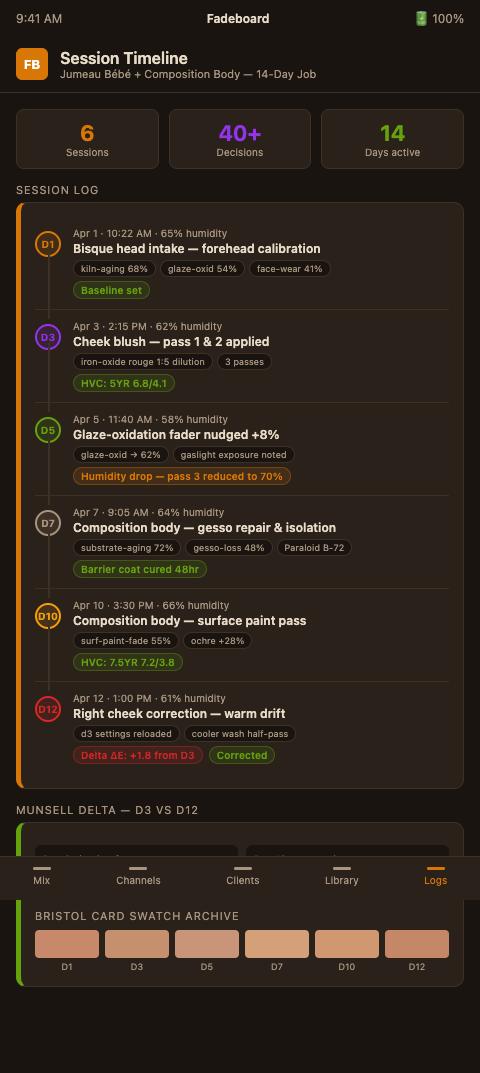
A conservative estimate: a two-week bisque and composition restoration that spans six working days generates roughly 40 individual decisions that affect the final visual outcome — fader positions for each session, dilution ratios for each formula wash, pass counts per zone, drying times, humidity readings at application, and the specific observations that led you to push the oxidation fader slightly higher on day five. Most of those decisions interact with each other. The dilution ratio on day three affects how the day-seven application layers over it. The humidity reading on day five affects whether the day-seven formula even dried at the predicted rate.
NPS Museum Handbook Chapter 8 conservation treatment standards require condition reports to be updated before, during, and after treatment, with all materials noted and photographs taken at each stage. That standard exists in institutional conservation because the complexity of multi-stage treatment makes memory unreliable — and institutional conservators are working with the same piece for months at a time. A solo home restorer on a two-week deadline is working under the same complexity with no institutional support system.
The practical failure mode: on day twelve, you notice the right cheek zone reads slightly too warm compared to the face as a whole. You want to correct it with a half-pass of a cooler wash. But you can't remember exactly what you applied on day three, what dilution you used, or whether the warmth was already present in the day-five session and you decided to leave it. So you apply the corrective wash based on current visual impression, and the result either overcorrects or applies too much film over an already adequate surface.
The Market Decipher doll collectibles market report identifies antique doll collecting as the second most popular adult collecting hobby in the US — the high-value restorations flowing through independent studios demand traceable records, not because the restorer doubts herself but because the client, appraiser, or future conservator will need to reconstruct what was done.
Fadeboard's Session Log Structure
Every Fadeboard session generates a timestamped record: the lighting-correction fader setting, the chemical degradation channel positions, the formula output with ratios, the dilution applied, and any notes entered at the time of the session. These records accumulate automatically across the project timeline, giving you a dated log that functions like the treatment record NPS requires — without the overhead of maintaining a separate conservation worksheet by hand.
Think of the session log as the equivalent of saving a mix in a digital audio workstation: each saved state captures every fader position, and you can reload any prior state instantly to see exactly what the soundboard looked like at day three. You're not looking at what you remember deciding; you're looking at what you actually set, captured at the moment of application. For the scaling question — how to maintain this documentation discipline when juggling multiple simultaneous client jobs — the scaling solo studio workflows post covers how solo operators can batch and systematize the session logging process across a full booking window.
The AIC Code of Ethics requires full documentation of all treatment decisions including materials, techniques, and rationale. Fadeboard's session log satisfies this requirement for the colorimetric decisions specifically, while pairing with your hand-written or digital treatment notes for the structural decisions (consolidant applications, gesso repairs, structural stabilization steps).
Photo documentation best practices from UC Libraries specify raking, UV, and transmitted light imaging at each treatment stage. The photographic record and the Fadeboard session log together cover the documentation requirements completely: photographs document the visual state at each stage, and the session log documents the decisions that produced each visual state. If a client or appraiser asks why the cheek on day twelve looks different from day six, you can answer with specific fader settings and pass counts, not with recollection.
Munsell Notation as the Objective Anchor
Munsell HVC notation creates unambiguous pigment records reviewable by any conservator across sessions. For a two-week restoration, the Munsell protocol is: take a reading of each reference zone before the first session, record it in the dated recipe log, and take a new reading of each treatment zone after each session. The HVC numbers are your objective anchors — they don't drift with memory, and they allow you to calculate the exact delta between day three and day twelve without relying on subjective visual impression.
Fadeboard's formula outputs include Munsell coordinates for the target match point, so the session log automatically generates the Munsell record as a byproduct of normal workflow. At the end of a two-week project, the session archive contains a complete chronological Munsell record of every treated zone — the kind of documentation that an appraiser or insurance company can rely on as a conservation standard.
Gallery Systems' TMS Conservation Studio — the museum software standard for tracking surveys, reports, media files, and multi-session treatment data — provides the institutional model that Fadeboard's solo-restorer session log adapts to home studio scale. You don't need TMS; you need the same underlying discipline: every session decision recorded at the time of the session, not reconstructed afterward.
Practical Decision Hygiene
Beyond the Fadeboard session log, three practices keep a two-week restoration tractable:
Physical swatch archive. Cut a small Bristol card swatch from each mixing session and attach it to a dated index card alongside the Fadeboard formula printout. At any point during the project, you can line up the swatch cards chronologically and see exactly how the formula evolved across sessions. This physical record complements the digital log and is instantly accessible without opening Fadeboard.
End-of-session protocol. Before leaving the workbench at the end of each session, photograph the current state of each treatment zone under raking light and add the image filename to the session notes. This creates a visual log that pairs with the formula log — the photographs show what happened, the Fadeboard record shows what was applied to produce it.
Decision rationale notes. When you make a judgment call — pushing the glaze-oxidation fader slightly higher than the initial calibration suggested, or choosing to skip a planned third pass — write the rationale in the session notes at the time. "Cheek zone drying faster than predicted; humidity 58% vs 65% yesterday; reduced pass 3 to 70% dilution." That kind of real-time note is irretrievable after 48 hours. At the time, it takes 30 seconds.
The Number Analytics documentation on conservation practice confirms that condition reports track pigment, binder, and structural changes, and that digital tools aid year-over-year comparison. The two-week restoration is the compressed version of that multi-year documentation arc: the same discipline, applied at single-project scale.
When the documented decisions need to be synthesized for client communication — specifically for Parisian fashion doll work where the client has detailed color expectations — the accent color work on Parisian fashion dolls addresses how to translate the session log into a client-facing account of the restoration choices.
Ecclesiastical conservators managing multi-month diocesan vestment approval cycles face the institutional version of this problem — decisions made in month one must be documented with enough precision to be reviewed by a diocese committee in month four. The vestment decisions through diocesan approval cycles documents the approval-cycle tracking workflow with useful parallels for independent restorers facing their own client-review milestones.
The Record Is the Work
Documentation is not overhead separate from the restoration — it is the restoration, from the perspective of the doll's long-term history. Forty years from now, when a future conservator examines a Jumeau that you restored in 2026, the session log is what allows them to understand what was done, with what materials, and why. Without it, they start from zero.
If you have a two-week restoration project running right now — or a completed project whose documentation exists only in your memory — open Fadeboard and build the session log retroactively from your physical swatch cards and any photographs you took during the work. Even a reconstructed record is more useful than none, and it establishes the habit that makes the next project's documentation automatic from day one.