Preserving Original Crazing While Restoring Flesh Tones
Crazing as Evidence
An antique doll appraiser examining a crazed Kämmer & Reinhardt bisque head can date the crazing pattern within a decade based on crack morphology. Fine, uniform crazing that developed slowly under thermal cycling looks different from stress crazing caused by rapid temperature changes, and both look different from the micro-crazing that develops in high-humidity storage. That network of hairlines is a timeline. It tells the story of where the doll has been.
According to the Journal of Antiques and Collectibles' documentation on crazing, historical ceramics context is clear: crazing causes aesthetic disruption and allows organic staining in hairline cracks — but the staining itself becomes part of the historical record over time. The dark organic material that has migrated into craze lines over 130 years is, paradoxically, part of what confirms the doll is original. A freshly painted bisque face with clean, unfilled craze lines looks suspicious to a trained eye; a properly aged craze network with natural organic darkening at the crack edges reads as authentic.
Appraisily's antique doll valuation guide confirms that bisque face color integrity is a primary driver of antique doll value, with post-restoration prices cited in ranges that reflect whether the original surface structure was preserved or obscured. A Jumeau or Simon & Halbig head that has been over-inpainted loses value even if the color appears correct to a casual observer, because appraisers view the face under UV light and raking light, where filled craze lines are immediately visible.
The Dual-Layer Challenge
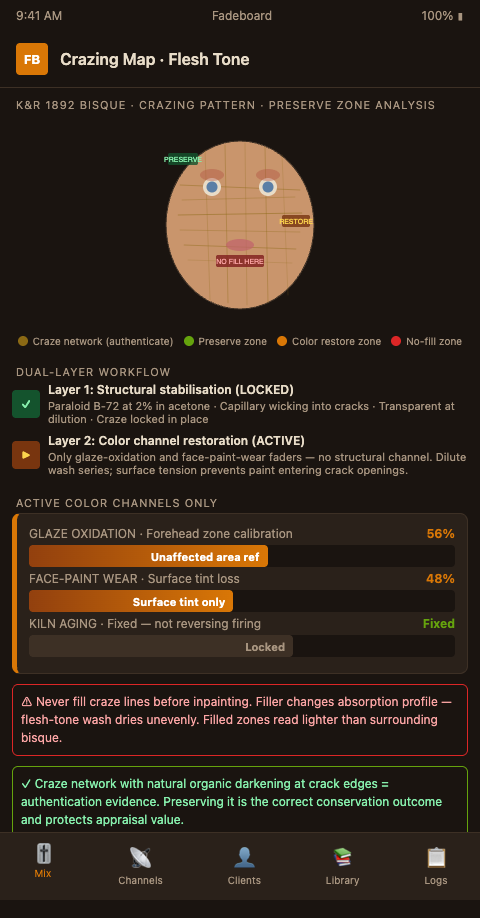
The technical problem: you need to restore flesh tone across a surface that has complex micro-texture (the craze network), without filling that texture. This sounds impossible until you separate it into two independent problems: stabilizing the craze network first, then addressing the flesh tone as a second, completely separate operation.
The AIC Conservation Wiki's documentation on crazing treatment is explicit: treatment of crazed ceramics requires consolidant application first; soaking risks glaze flaking, and dirt penetrates cracks if the surface is not sealed before cleaning. The consolidation step — dilute Paraloid B-72 at 2% in acetone, applied with a fine brush and wicked into crack openings by capillary action — locks the craze network in place without filling it visually. The consolidant is essentially transparent at working dilution.
Once the craze is consolidated, the flesh-tone restoration uses Fadeboard's channel model to target only the pigment degradation pathways, not the structural ones. Set the glaze-oxidation fader based on the unaffected areas of the bisque surface — forehead, ear area, crown — that show the ambient aging without localized damage. Set the face-paint-wear channel to approximate the loss of applied flesh tint across the affected zone. Leave the kiln-aging baseline fixed; you're not trying to reverse the firing, only to restore the surface color layer.
Think of it as a soundboard where the structural channel (crazing consolidation) is already mixed and locked — you're now only working with the color channels. Fadeboard keeps those channels independent, which means your flesh-tone formula is not trying to compensate for crack depth or surface irregularity. The formula output is a surface tint, not a filler. The same structural-first principle governs composition arms with gesso loss — the dual-layer thinking translates directly to non-bisque materials where the substrate problem and the surface color problem are equally independent.
Ceramic glaze crazing causes are well-documented: thermal expansion mismatch between clay body and glaze is the primary driver, and crazed ware shows significant strength reduction post-firing. That structural information matters for treatment decisions — you cannot use any technique that requires pressure or solvent saturation on a crazed surface without risking further delamination.
Application Over Crazing
The application method for flesh tone over a consolidated craze network must avoid two failure modes: filling the cracks with pigment-loaded paint, and creating a surface film that bridges across crack openings and peels when the bisque expands and contracts with humidity changes.
Both failures are caused by over-application. The correct technique uses extremely dilute washes — more water than pigment, applied in multiple passes — with the first pass functioning as a color key rather than a coverage layer. At this dilution, surface tension prevents the paint from flowing into crack openings; it sits on the micro-peak of the bisque surface between cracks rather than sinking in. Subsequent passes build opacity in the flat zones while leaving the crack shadows intact.
NPS Museum Handbook Chapter 8 policy requires that restoration be minimally interventive, fully documented, and use reversible materials. The dilute wash approach satisfies all three: each layer remains water-soluble, the cumulative film thickness is minimal, and the process is documented in the dated recipe log as a numbered wash sequence with the Fadeboard formula and dilution ratio for each pass.
Traditional flesh tone palette documentation from Natural Pigments identifies period formulations — lead white, vermilion, ochre, and lake in precise layering sequences — that inform the pigment selection for each wash. You're not using lead white in a restoration context, but the ratio logic — a dominant white carrier, a warm secondary, and a small lake component — gives you the structural framework for your Fadeboard formula.
What to Avoid
Never use a filler medium (gesso, acrylic putty) to level crazing before flesh-tone restoration. Even a micro-skim coat of fill material in the crack openings creates a different absorption profile than the surrounding bisque, and your flesh-tone wash will dry unevenly — the filled zones will read lighter because the filler doesn't absorb the same way bisque does.
Never apply isopropyl alcohol near consolidated crazing. Paraloid B-72 remains solvent-sensitive, and any alcohol-based cleaning step after consolidation risks re-mobilizing the consolidant and losing the structural stabilization.
When crazing intersects with microscope-level examination needs — particularly for hairline cracks that are barely visible at studio magnification — the microscope-aided crazing and soundboard work covers the magnification tools and documentation protocols used for fine crack networks.
Ecclesiastical conservators dealing with couching preservation on crazed historical brocade face a structurally identical challenge: the couching preservation and brocade color restoration workflow documents how surface color restoration is separated from structural thread preservation — the same conceptual separation that underpins the dual-layer approach described here.
Preserving What Time Built
The right frame for crazing is not "surface damage to be hidden" but "evidence layer to be preserved while treating what surrounds it." Clients often arrive expecting you to make the craze lines disappear; part of your job is explaining why preserving them is the correct conservation outcome and why it protects their doll's value.
If you have a crazed German or French bisque head with faded flesh tones, run a Fadeboard session using only the color channels — glaze oxidation and face-paint wear — while treating the structural channel (crack consolidation) as a separate prior step. The resulting wash sequence, swatched on Bristol card and applied in dilute layers, restores the tone without touching the network. Your client gets a visually correct restoration and a doll that passes appraisal because the authentication evidence is still there.
If you're currently managing crazed bisque by filling crack lines before inpainting and losing appraisal value in the process, join the Fadeboard waitlist now. Bring your next crazed Kämmer & Reinhardt or Jumeau to the first session and start working the color channels without touching the craze network.