Soundboard Calibration for Low-Light Home Studios
The Warm-Drift Problem in Home Studios
A 2023 market report cited by PR Newswire documented 42% year-over-year growth in doll collectibles with an 8.2% CAGR projected through 2033. As the market expands, the restoration work flowing through independent home studios is increasingly headed for professional appraisal, auction consignment, and insurance photography — environments where the lighting bears no resemblance to most home studios.
The specific failure mode is warm drift: a match made under a 2700K or 3000K warm-white light source will read warmer than the surrounding original surface under daylight-balanced 5500K-6500K lighting. This is not a subjective impression; it is a physical phenomenon documented by metamerism research: metameric failure causes matched colors to diverge under different light sources, and whites and pinks — the dominant tones in bisque doll work — are the most vulnerable to this divergence.
The practical consequence: a restorer who matched a cheek inpaint perfectly under her kitchen lamp delivers a doll to a client who photographs it for insurance under a window, and the repaired cheek reads completely different from the surrounding original face paint. The restoration that looked correct for two weeks in the studio reveals its flaw the moment it enters a different light environment.
What Studio Lighting Actually Requires
ISO 3664 standardized viewing conditions require D50 illumination at 2000 lux with a Color Rendering Index of at least 90 for reliable color comparison in professional viewing booths. That standard exists because color-critical work — printing, photography, conservation — fails systematically without it.
For independent restorers, the relevant practical standard is somewhat less demanding than a full ISO viewing booth but still specific. Art studio lighting research from Yuji International establishes that art studios need 5000K or 6500K (D65) LEDs at CRI 95 or higher to reveal true pigment hue under home conditions. That is achievable with off-the-shelf LED panels at a cost of $40-$120, not $18,000 for a spectrophotometer.
The Color Rendering Index documentation explains that CRI measures a light source's fidelity relative to a reference; art studios require CRI 95+ for accurate pigment evaluation. Most standard warm-white household LEDs operate at CRI 80-85, which introduces systematic color error across the entire visible spectrum. On bisque, the error manifests specifically as a warm-tone bias: the CRI 80 LED renders warm pinks and ivories more saturated than they are, so a formula mixed to match under that source will be too cool and too desaturated when viewed under higher-CRI conditions.
Fadeboard's Calibration Protocol for Low-Light Studios
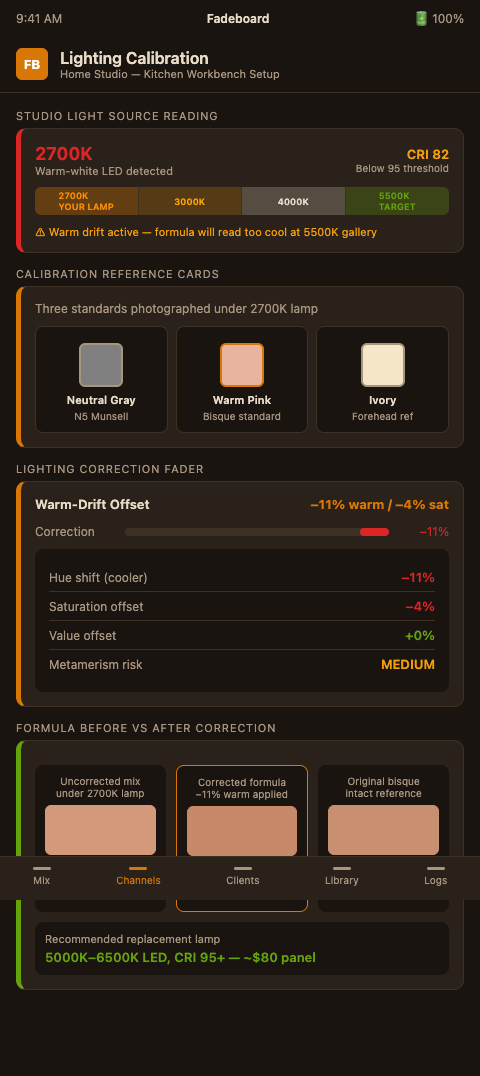
Fadeboard's lighting calibration feature treats the studio light source as one more variable in the fader model — the same conceptual approach as the chemical degradation channels. The soundboard analogy extends here: just as you set independent faders for UV oxidation and kiln aging, you set a lighting-correction fader that offsets the systematic color error introduced by your specific studio light source.
The calibration procedure uses a neutral gray reference card and two known pigment standards — one warm-pink and one ivory — to characterize your studio light. You photograph or observe these references under your studio light and under a known-standard source (or against a calibrated reference image on a properly calibrated screen). The differential tells Fadeboard's lighting-correction channel how much your studio light is biasing the formula outputs. From that point forward, every session formula is automatically compensated for your viewing environment.
For a restorer working under a 2700K warm-white lamp, the correction factor typically runs about 8-12% toward cooler and slightly desaturated — counterintuitive to mix, but exactly what produces a formula that matches correctly under the full range of downstream lighting environments the doll will encounter. The scaling solo doll studio workflows post addresses how single-operator studios can build calibration documentation into their standard process without adding significant overhead to a multi-piece booking window.
Spectrophotometric metamerism detection from HunterLab confirms that spectrophotometry detects metamerism risk in color matches before committing to inpainting application. Fadeboard's lighting-correction fader is a practical field approximation of this capability: it doesn't measure the spectral reflectance curve of your pigment mixture, but it accounts for the most common source of systematic metamerism in home studios — the lighting bias — and adjusts the formula accordingly.
Practical Setup for a Kitchen Workbench Studio
The minimum effective home studio setup for calibrated bisque restoration work requires three changes from a standard domestic workspace:
Light source. Replace any warm-white working lamp with a 5000K-6500K LED at CRI 95+. Panel-style lights (not bulb-style) provide more even coverage with fewer shadows. Position it so the bisque surface receives direct diffuse light without glare from the firing glaze.
Reference card. Keep a neutral gray card and your warm-pink and ivory calibration standards within the work zone. Before each session, view the references under your lamp and confirm the calibration fader setting still matches. Studio lighting changes — bulbs age toward warmer color temperatures, windows change with season and time of day.
Isolation from ambient. Ambient light from windows, other room lights, and screen glow all contaminate your color judgment. Work in the section of the room where your calibrated lamp dominates; if possible, use a simple daylight-exclusion screen around the work zone to prevent window light from mixing with your lamp.
These three changes cost under $150 in equipment and eliminate the largest source of home studio color error before any Fadeboard session begins.
Cross-Session Consistency
The second benefit of the lighting calibration protocol beyond individual session accuracy is cross-session consistency. If a Jumeau bébé returns to your studio six months later for additional work, you can confirm that your current lighting calibration is unchanged, reload the prior session's fader settings, and pick up exactly where you left off. Without calibration documentation, you're re-matching from scratch each time.
When microscope-based examination is added to the studio toolkit — particularly for fine crazing or micro-loss evaluation — the lighting calibration question extends to microscope illumination as well; the microscope and soundboard work for hairline crazing covers that specific setup.
Ecclesiastical vestment conservators working in candlelit sanctuary environments face the extreme end of the lighting calibration problem — their match environment during treatment (studio conditions) bears no resemblance to the final viewing environment (candlelit sanctuary). The candlelit sanctuary soundboard calibration workflow documents how vestment conservators use a two-environment calibration approach to compensate, with parallels that apply directly to home studio restorers whose work ends up in gallery or auction house lighting.
Calibrate the Environment Before Calibrating the Color
No amount of Fadeboard session precision overcomes a systematic lighting bias that sits between the formula and your eyes. The calibration step described here takes about 20 minutes to perform the first time and about two minutes to verify at each subsequent session. It is the single highest-leverage improvement available to a home studio restorer, ahead of better brushes, better pigments, and more reference photographs.
If you've experienced the problem of a restoration that looked correct in your studio and wrong everywhere else, run the Fadeboard lighting calibration before the next session. Set up the 5000K-6500K CRI 95+ lamp, perform the gray-card calibration, and store the lighting-correction fader setting in your session log. From that point forward, the formula Fadeboard outputs is compensated for where the doll will actually be seen — not just where you painted it.