Soundboard Calibration for Candlelit Sanctuary Preview
Why Candlelight Changes Everything
A conservator completed a technically rigorous restoration of an episcopal cope's crimson orphrey panels, achieving ΔE* < 2.0 against the spectral target under ISO D65. The bishop wore the cope at a cathedral chapter Mass illuminated primarily by beeswax candles. The orphrey panels read as a muddied brownish-red under the candlelight — not wrong enough to require re-treatment, but visibly different from the adjacent unrestored areas of the cope, which retained a warmer, more saturated hue under the same light.
The problem was metamerism. Color Matching Challenges in Textiles: Detecting Illuminant Metamerism (HunterLab) explains: two fabric areas can match perfectly under one illuminant (ISO D65, approximately 6500 K) and diverge substantially under another (beeswax candle, approximately 1850 K) if their reflectance curves cross in the visible spectrum. The restoration dye and the original surviving dye had matched under studio daylight but diverged in their red-channel reflectance at long wavelengths, which the warm candle light heavily weights.
Color temperature (Wikipedia) establishes the baseline: beeswax candlelight sits at approximately 1850 K on the Planckian locus, while a standard household incandescent is 2700–3000 K and ISO D65 is a simulated 6504 K. These illuminants differ by a factor of 3–4 in color temperature, meaning the weighting of different spectral regions shifts dramatically. Color Rendering Index (Wikipedia) explains why a CRI-90+ warm LED can approximate candlelight for calibration purposes while a CRI-65 fluorescent cannot — the CRI value quantifies how faithfully the lamp renders object colors relative to the reference illuminant at the same color temperature.
Physico-chemical characterisation and light stability of dyes in cultural heritage (Wiley/Color Research) documents how dye appearance varies dramatically under different illuminants, with particular severity for red and purple natural dyes that have reflectance contributions in the 600–700 nm range — exactly where candlelight's spectral power distribution is concentrated relative to daylight.
The Fadeboard Candlelight Calibration Protocol
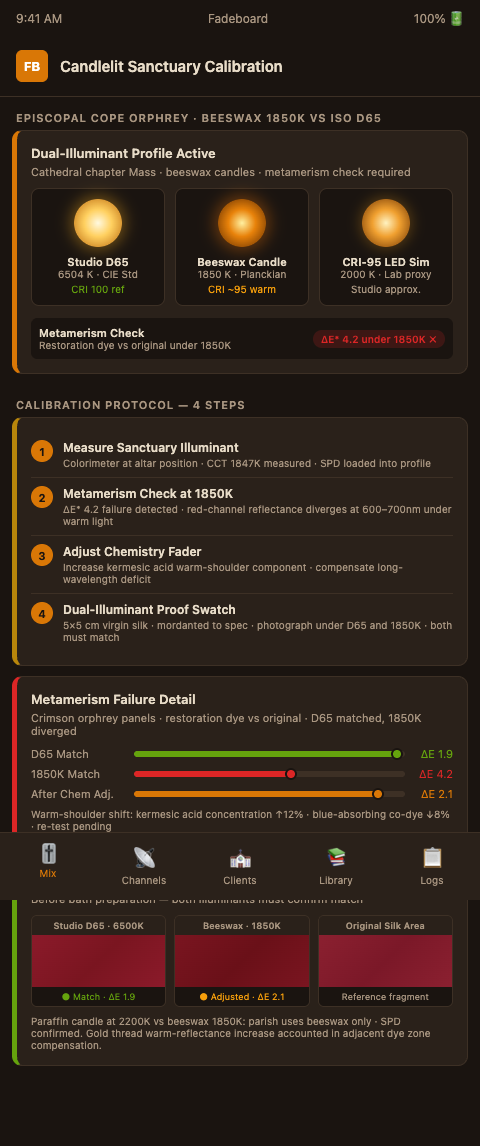
Fadeboard's candlelit sanctuary calibration begins by defining a second illuminant profile alongside the standard ISO D65 measurement. The protocol has four steps.
Step 1: Measure the sanctuary illuminant. Bring a calibrated colorimeter or spectrophotometer to the active sanctuary during a candle-illuminated service or a candle-only rehearsal lighting session. Measure the illuminant's CCT and spectral power distribution (SPD) at the location where the vestment will be worn — the altar or the center aisle, as appropriate. Conservation reports — The Church of England documentation standards require recording lighting conditions for treatment decisions; this illuminant measurement satisfies that requirement directly. Load the measured SPD into Fadeboard as the sanctuary illuminant profile.
Step 2: Check for metamerism in the proposed restoration dye. With the sanctuary illuminant profile active, Fadeboard models the proposed restoration dye's reflectance under that illuminant and displays it alongside the original surviving dye's reflectance. A color difference of ΔE* > 3.0 under the sanctuary illuminant indicates a metamerism failure that will be visible in liturgical use even if the studio match is perfect. Evaluation of color degradation on unearthed silks: microfading spectrometry (ScienceDirect) demonstrates how in-situ illuminant variation produces measurable color shifts in real silk samples — the same mechanism that drives sanctuary metamerism.
Step 3: Adjust the chemistry fader for warm-illuminant compensation. If the metamerism check shows a failure, adjust the chemistry channel fader in Fadeboard to shift the restoration dye's long-wavelength reflectance toward better alignment with the original under warm light. For red orphrey work, this typically means increasing the warm-shoulder component of the dye blend — a slightly higher concentration of kermesic or carminic acid relative to blue-absorbing co-dyes. For purple or Marian blue zones, the adjustment works in the opposite direction.
Step 4: Produce a dual-illuminant proof swatch. Before bath preparation, dye a 5 × 5 cm test swatch on virgin silk mordanted to the same specification as the vestment's ground. Photograph the swatch under the studio D65 light source and under the sanctuary candle light. Both photographs should show a match with the surviving original. Photodegradation and photostabilization of historic silks in the museum environment (UCL Papers) notes that the 50-lux display limit for historic silks in museum contexts is far lower than typical sanctuary candle levels; confirm that the proof swatch exposure during the test does not accumulate significant lux-hours on the historical vestment's surviving areas.
The vestment studio expansion workflow that comes after this calibration step is documented in vestment studio soundboard pipeline expansion, which covers how to scale the dual-illuminant protocol across a studio handling multiple simultaneous commissions.
Advanced Tactics for Sanctuary Calibration
Use a CRI-95 Warm LED for Lab Simulation
When a site visit to the active sanctuary is not possible before restoration begins, use a CRI-95 warm LED panel set to 2000 K as a candlelight simulation in the studio. This CCT is slightly higher than beeswax candle (1850 K) but within practical reach of commercial photography LEDs. Fadeboard's sanctuary illuminant profile can be loaded with the LED's manufacturer-provided SPD as an approximation, with a note that a live sanctuary measurement should be obtained for final approval.
Gold Thread Adds a Second Metamerism Layer
Gold thread couching in orphrey panels introduces a second illuminant-dependent reflectance: gold returns a different proportion of warm-wavelength light under candlelight than under daylight, visually brightening relative to dyed silk zones. This can make a well-matched restoration appear to desaturate relative to the gold at service. Account for the gold thread's warm-light reflectance increase when setting the chemistry fader for dyed areas adjacent to couching, allowing a slightly stronger dye concentration to compensate.
Low-Light Calibration Parallel
The calibration logic for warm, low-light sanctuary conditions parallels soundboard calibration for low-light doll studio environments, where the studio illuminant differs significantly from the display illuminant. In both cases, the Fadeboard channel calibration must account for the final viewing illuminant, not just the measurement illuminant.
Diocesan Commission Proof Documentation
When candlelit sanctuary calibration is used, include both the D65 proof photograph and the warm-light proof photograph in the diocesan commission submission. Diocesan commission proofs and soundboard evidence notes that commissions increasingly ask specifically whether the restoration was verified under in-situ lighting rather than studio conditions. The dual-illuminant proof swatch is the answer to that question.
Beeswax Candle Chemistry Variation
Sanctuary candles vary between beeswax (CCT ≈ 1850 K, standard reference) and paraffin (CCT ≈ 2200 K, slightly warmer than incandescent). Some high-liturgy parishes also use oil lamps, which produce a distinctly different SPD. Ask the parish about their lighting practice before measuring the sanctuary illuminant, and use the specific candle or lamp type present in active liturgical use as the calibration reference. A restoration approved against paraffin candle light will produce a slightly different result at a beeswax-only Mass.
Final Note for Sanctuary Calibration
The congregation experiences liturgical vestments under candlelight, not under a laboratory D65 lamp. Fadeboard's dual-illuminant calibration protocol is the step that connects technically correct spectrophotometric work to the actual visual experience that gives the restoration its liturgical purpose. Skipping this calibration is how technically excellent studio work fails in the sanctuary.
For every vestment restoration where the piece will return to active liturgical use under warm candlelight, build a sanctuary illuminant profile in Fadeboard before beginning bath preparation. The dual-illuminant proof swatch takes less than an hour to produce; the diocesan or episcopal review that requires repeating the work because of a candlelit metamerism failure takes weeks. Visit the Fadeboard waitlist to start your first dual-illuminant session — vestment conservators preparing for Advent or Holy Week commissions benefit most from getting the candlelight calibration in place well before the liturgical season begins.