Privacy and Consent in Convention Center Crowd Monitoring
The conversation about crowd monitoring at convention centers and trade shows carries a weight that differs significantly from the same discussion in stadium or concert contexts. When a sports fan enters a stadium, they generally accept that they are in a public entertainment setting where surveillance cameras are part of the expected environment. When a business professional enters a trade show, they carry different expectations. Their badge contains their name, company affiliation, and often their job title. Their movement through the exhibition hall reveals their business interests, competitive intelligence activity, and commercial relationships. The companies they visit, the panels they attend, and the amount of time they spend at specific booths constitute commercially sensitive behavioral data that exhibitors, competitors, and data brokers would pay significant sums to access.
This is not a theoretical concern. A 2023 investigation by the Electronic Frontier Foundation documented multiple instances of trade show organizers selling or sharing attendee movement data derived from badge scanning and beacon tracking systems without adequate disclosure to attendees. The International Association of Privacy Professionals (IAPP) surveyed 2,400 trade show attendees in 2024 and found that 71% were unaware that their movement through exhibition halls was being tracked, 83% expressed discomfort when informed, and 44% said they would be less likely to attend future events from the same organizer if they learned their movement data had been shared with third parties. The General Data Protection Regulation (GDPR) in Europe and the California Consumer Privacy Act (CCPA) have both been applied to trade show data collection practices, resulting in enforcement actions that have cost event organizers millions in fines and reputational damage.
Under the CCPA, a conference organizer that uses on-site tracking would be required to disclose that they are tracking attendee behavior as well as the purpose for tracking, potentially through a privacy policy or signage at check-in (Bryan Cave Leighton Paisner - CCPA Privacy FAQs). The security imperative, however, is real. Convention centers need to monitor crowd density to prevent crush incidents. They need to track flow patterns to manage chokepoints. They need behavioral analysis to identify emerging conflicts before they escalate. The question is not whether to monitor, but how to monitor in a way that delivers the spatial intelligence necessary for safety without creating a surveillance apparatus that compromises attendee privacy and trust.
CrowdShield was designed from the outset to solve this tension through a privacy-by-design architecture that operates on three core principles: spatial aggregation, data minimization, and purpose limitation.
Spatial aggregation means that CrowdShield processes all crowd data at the zone level, not the individual level. The system divides the convention facility into monitoring zones, typically corresponding to rooms, aisle segments, and corridor sections. Sensor data is aggregated to produce zone-level metrics including occupancy count, density estimate, flow rate, and movement direction. At no point does the system create or maintain individual tracking profiles. An attendee moving through the exhibition hall is counted when they enter a zone and counted when they leave. Their identity, their badge data, their device identifiers, and their personal characteristics are never captured, stored, or processed.
Data minimization means that CrowdShield collects only the sensor inputs necessary for spatial tension analysis and discards everything else at the point of collection. When the system processes a CCTV feed through its computer vision pipeline, it extracts crowd density estimates and movement vectors, then discards the underlying video frame. No facial imagery is stored. No biometric data is generated. When the system uses Wi-Fi probe data for zone-level occupancy estimation, it processes device counts in randomized, time-bucketed aggregations that make it mathematically impossible to reconstruct individual device trajectories. The system is designed so that even if its data storage were fully compromised, an attacker would find nothing that could be linked to any individual attendee.
Purpose limitation means that CrowdShield's data processing is restricted exclusively to safety-related spatial analysis. The system does not provide exhibitor traffic counts, attendee interest profiling, dwell time analytics for commercial purposes, or any other data product that serves marketing or business intelligence functions. Convention center operators who deploy CrowdShield receive crowd safety intelligence. They do not receive a surveillance platform that could be repurposed for commercial data collection.
The choose-your-own-adventure decision framework reinforces this privacy architecture. When the system presents response options to security operators, those options are framed in spatial terms, not individual terms. The system says that Zone C-14 has reached a density of 5.2 persons per square meter and recommends specific interventions. It does not say that specific individuals or demographic groups are causing the density increase. This spatial framing is not just a privacy feature. It is better security practice. Crowd safety is a spatial problem, and solutions that focus on spaces rather than individuals are more effective and less likely to produce discriminatory outcomes.
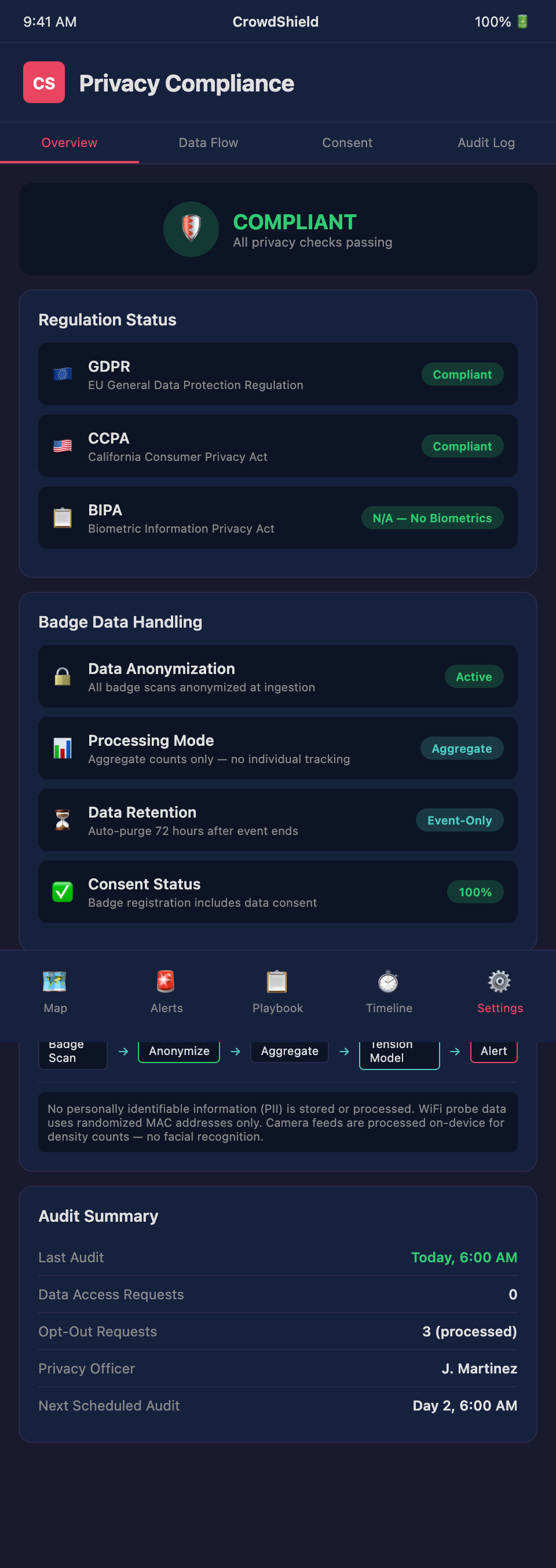
Implementing privacy-preserving crowd monitoring at conventions requires attention to several advanced considerations. First, the legal landscape varies significantly by jurisdiction. Events held in European Union countries must comply with GDPR requirements for data processing transparency and data subject rights. Events in California must address CCPA provisions. Events in Illinois must navigate the Biometric Information Privacy Act (BIPA), which imposes strict requirements on biometric data collection. CrowdShield's architecture is designed to meet the most stringent of these requirements by default, so that convention operators do not need to reconfigure the system for different jurisdictions.
The IAPP (International Association of Privacy Professionals), in its Privacy Governance Report, examines privacy governance and compliance strategies across industries and geographies, providing a framework that convention center operators can use to assess their own crowd monitoring practices against global standards (IAPP Privacy Governance Report). Second, transparency with attendees builds trust even when the monitoring system does not collect personal data. CrowdShield recommends that convention operators include clear, prominent signage at all facility entrances stating that crowd density monitoring is in use for safety purposes and describing the aggregated, anonymized nature of the data collection. This transparency serves both legal compliance and attendee confidence. When attendees understand that crowd monitoring is happening for their safety and that their individual movements are not being tracked, the monitoring becomes a trust-building feature rather than a privacy concern.
Third, the relationship between crowd safety monitoring and exhibitor badge scanning systems must be carefully managed. Many conventions use RFID or NFC badges that exhibitors can scan to capture leads. These badge systems are separate from CrowdShield's safety monitoring, but attendees may conflate the two. Clear communication about the distinction between commercial badge scanning, which requires affirmative attendee consent, and anonymized crowd safety monitoring, which operates on a different legal basis, helps prevent confusion that could undermine trust in either system.
Fourth, data retention policies should be aggressive. CrowdShield's default retention policy deletes all raw sensor data within 24 hours and retains only aggregated zone-level statistical summaries for post-event analysis. Convention operators who want to use historical data for future event planning receive anonymized, aggregated reports that contain no information capable of identifying individual attendees.
Fifth, the vendor data protection dimension is particularly relevant at trade shows where exhibitors may ask for or expect access to attendee traffic data. Some exhibitors, particularly those who have invested significantly in premium booth placements, may pressure show management to provide data about foot traffic patterns, attendee dwell times at specific booths, or demographic breakdowns of visitors to their area. CrowdShield's architecture makes it technically impossible to provide this data because it is never collected at the individual level. This is by design. By making individual tracking architecturally impossible rather than merely policy-prohibited, CrowdShield eliminates the risk that future management decisions, business pressure, or data breaches could compromise attendee privacy after the system has been deployed.
Navigating the intersection of GDPR and CCPA in event technology requires that organizers audit data flows, update registration forms, define retention policies, train staff, and partner with compliant vendors to ensure lawful data handling across jurisdictions (Ticket Fairy - Navigating Global Data Privacy in Event Tech). Sixth, the international exhibitor and attendee dimension introduces additional privacy complexity. Major trade shows attract participants from dozens of countries, each with different privacy expectations and legal requirements. European attendees protected by GDPR have specific rights regarding data processing notification and consent. Chinese attendees are subject to the Personal Information Protection Law. Brazilian attendees are covered by the LGPD. A convention center that deploys crowd monitoring must ensure compliance with the privacy frameworks applicable to all attendee nationalities, not just the jurisdiction where the facility is located. CrowdShield's privacy-by-design approach satisfies this requirement by default, since a system that does not collect personal data complies with personal data protection regulations regardless of jurisdiction.
Seventh, the audit and accountability framework ensures that privacy commitments are verifiable rather than aspirational. CrowdShield maintains a detailed processing log that records exactly what data was collected, how it was processed, when it was aggregated, and when raw inputs were deleted. This log is available for independent audit by privacy regulators, convention center legal teams, or third-party assessors. The ability to demonstrate compliance through auditable records is increasingly important as privacy enforcement agencies worldwide shift from complaint-driven to proactive audit models.
For a broader view of how CrowdShield handles the unique privacy challenges in different venue types, see our discussion of crowd monitoring in stadium and arena environments where the privacy calculus differs significantly. Within the convention context, privacy-preserving monitoring is foundational to social media threat monitoring and multi-agency security coordination, both of which require clear data governance frameworks to function effectively.
Privacy and safety are not competing values. CrowdShield proves that convention centers can deploy powerful crowd intelligence systems that protect attendees from crush incidents and crowd conflicts without compromising the privacy that professional event attendees rightfully expect. Join the CrowdShield waitlist for convention center operators to learn how privacy-by-design crowd monitoring works in practice. Our team includes privacy engineers who will work with your legal counsel to ensure full compliance with applicable regulations.