Registration Chokepoint Management at Large Conventions
At 7:48 AM on the opening day of a major technology expo in Las Vegas in January 2024, approximately 14,000 pre-registered attendees were queued in a space designed to hold 4,000. The line extended out of the convention center lobby, down a corridor, through a parking garage connector, and into the adjacent hotel. Attendees at the front of the line had been waiting since 5:30 AM. Those at the back could not see the registration desk and had no information about wait times. When the doors opened twelve minutes early due to crowd pressure, the resulting surge compressed attendees against temporary stanchion barriers that buckled under the load. Seventeen people were treated for minor injuries. Two were hospitalized. The event had spent $2.3 million on security. None of it was positioned at the right place at the right time.
This scenario is not unusual. The Exhibition Services and Contractors Association (ESCA) surveyed 180 show managers in 2023 and found that 67% had experienced at least one registration-related crowd incident in the previous three years. The Center for Crowd Management and Security Studies at National Western University documented that registration areas account for 31% of all crowd compression incidents at convention facilities, despite representing less than 5% of total floor space. A 2024 analysis by the International Association of Exhibition and Events (IAEE) identified the opening morning registration window as the single highest-risk period at multi-day conventions, with incident rates six times higher than any subsequent period during the event.
The Event Safety Alliance, in its comprehensive Event Safety Guide, emphasizes that crowd management must be distinguished from crowd control, noting that proactive crowd management through proper venue design, communication, and flow planning is far more effective than reactive crowd control measures after dangerous conditions develop (Event Safety Alliance - Standards and Guidance). The physics of the problem are straightforward. Convention registration areas are typically designed for throughput, not holding capacity. They feature multiple check-in counters arranged in a row, with queue lanes feeding into them. The design assumes a steady flow of arrivals distributed across a multi-hour window. But attendee behavior does not follow this assumption. Pre-registered attendees overwhelmingly arrive during the first ninety minutes of the published opening time, creating a demand spike that can exceed the system's throughput capacity by a factor of five or more. The result is a growing queue that quickly outstrips the physical space allocated for waiting.
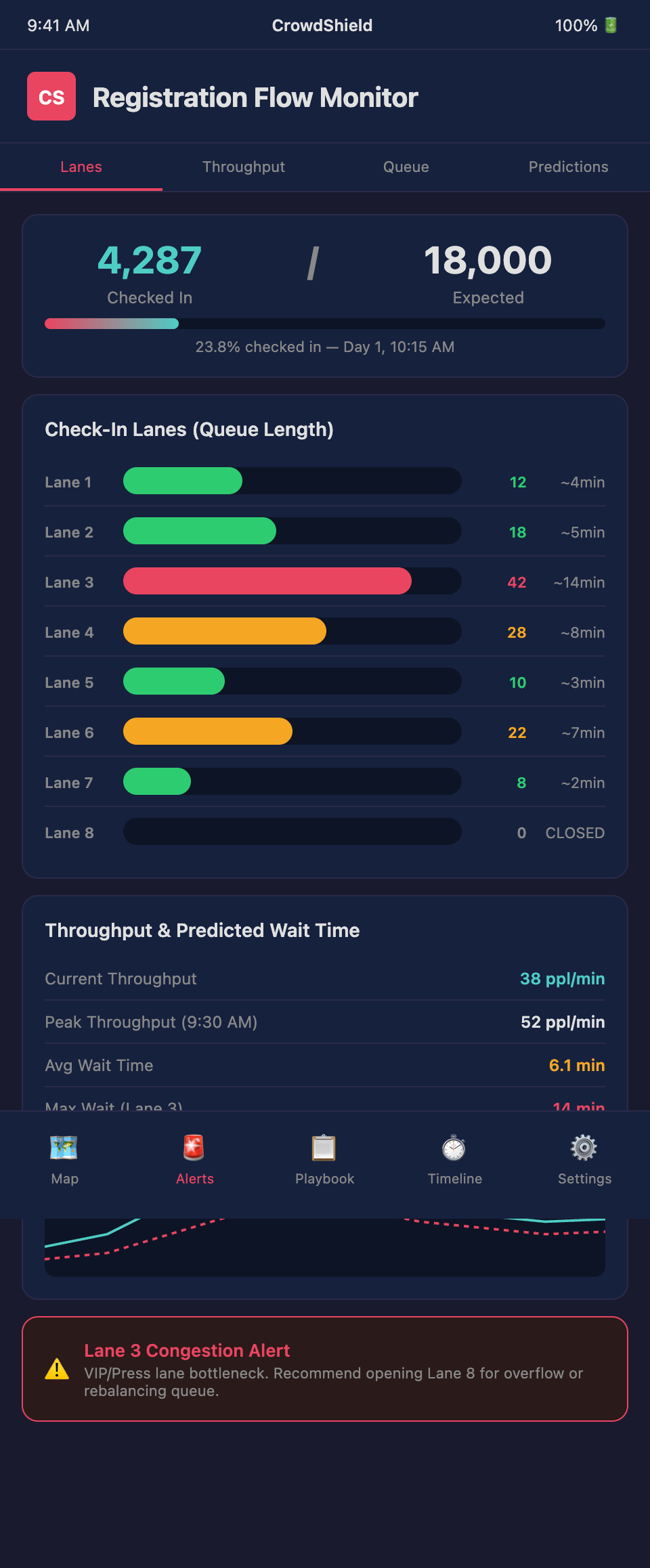
CrowdShield approaches registration chokepoint management as a spatial tension problem with a predictable timeline. The system begins monitoring the registration approach zone hours before the published opening time. Using passive infrared counters, anonymized device density data, and external camera feeds covering approach corridors and parking areas, CrowdShield builds a real-time model of arriving crowd volume and projects when the queue will exceed safe density thresholds.
The critical innovation is early intervention through branching decision prompts. When CrowdShield projects that registration area density will exceed safe thresholds within the next thirty minutes, it presents the security operations center with a set of choose-your-own-adventure response options calibrated to the specific situation.
If the projected overcrowding is moderate, the system might recommend activating overflow queue space by opening an adjacent hall or corridor for queuing, deploying additional wayfinding staff to distribute the crowd across multiple approach paths, and sending push notifications through the event app advising attendees of current wait times and suggesting staggered arrival windows. Each option is presented with an estimated impact on peak density, the resources required to execute, and a timeline for when the intervention needs to begin to be effective.
If the projected overcrowding is severe, the options escalate. The system might recommend opening additional registration stations at satellite locations, such as hotel lobbies or parking structure entrances, to intercept attendees before they reach the main registration area. It might recommend activating a timed-entry system that assigns arriving attendees to thirty-minute windows, physically separating the waiting crowd into manageable segments. In extreme cases, it might recommend delaying the published opening time and communicating the delay through all available channels, a decision that show managers historically resist but that CrowdShield can support with real-time density data showing why the delay is necessary.
The spatial tension map provides something that traditional queue management systems fundamentally lack: visibility into the entire approach zone, not just the registration desk itself. A traditional queue management system can tell you how many people are in line at the registration counters. CrowdShield can tell you how many people are in the parking garage walking toward the convention center, how many are in the hotel skybridge connector, how many are in the main lobby, and how many are in the corridor leading to registration. This upstream visibility is what makes early intervention possible. By the time the queue at the registration desk is dangerously long, the opportunity for low-cost interventions has already passed. The density problem is not at the desk. It is in the funnel of space that feeds into it.
FEMA's Special Events Contingency Planning guidance (IS-15) stresses that pre-planning and the appropriate deployment of personnel and resources throughout a crowded venue are the keys to managing a successful mass event, with access and ingress/egress planning identified as a primary planning area (FEMA Special Events Contingency Planning). Advanced registration chokepoint management requires attention to several factors that are often overlooked. First, the queue itself generates secondary risks. Long wait times in enclosed spaces increase heat stress, dehydration, and frustration. CrowdShield monitors environmental conditions in queue areas and can trigger comfort interventions such as activating additional HVAC zones, deploying water distribution, or opening exterior doors for ventilation before conditions become dangerous.
Second, the queue composition matters. Convention registration queues often contain a mix of attendee types with different processing requirements. Pre-registered badge pickup takes thirty seconds. On-site registration takes three to five minutes. VIP and speaker check-in may require credential verification. When these different processing streams share the same queue space, slower-processing attendees create localized compression even when overall throughput is adequate. CrowdShield's spatial model can detect these localized density spikes and recommend dynamic lane reallocation to balance processing loads.
The NFPA's strategies for crowd management safety emphasize that effective crowd management combines proactive venue design, real-time density monitoring, and comprehensive staff training to mitigate risks and maintain a secure environment (NFPA - Strategies for Crowd Management Safety). Third, the registration chokepoint problem is not limited to Day 1. While the opening morning is the highest-risk period, subsequent mornings also generate arrival spikes, particularly when popular keynote sessions are scheduled early. CrowdShield uses Day 1 arrival data to predict Day 2 and Day 3 patterns and pre-positions resources accordingly. The system also learns from the specific event population. A trade show with a high proportion of international attendees may have later arrival patterns due to jet lag. A fan convention with a young demographic may have earlier arrival patterns driven by exclusive merchandise drops or signing events.
Fourth, the post-registration dispersal pattern creates its own challenges. Once attendees clear registration, they typically move toward the exhibition hall entrance, creating a secondary chokepoint. CrowdShield maps the full attendee journey from arrival through registration through dispersal, identifying every potential compression zone in the chain and ensuring that solving one bottleneck does not simply shift the problem downstream.
According to Prof. G. Keith Still's crowd science research, understanding the relationship between crowd density and flow rate is critical at entry points, as flow increases with density only until a critical threshold of 2-3 people per square meter is reached, beyond which flow rate decreases and dangerous compression can develop (Prof. G. Keith Still - Flow versus Density). Fifth, the credential verification failure scenario requires specific planning. When badge printing systems malfunction, network connectivity drops, or scanning equipment fails, the registration process slows dramatically and the upstream queue grows at an accelerating rate. CrowdShield monitors registration throughput velocity and detects sudden drops that indicate a system failure. When throughput drops below a critical threshold, the system immediately escalates the urgency of queue management interventions and presents contingency options such as switching to manual credential verification, opening bypass lanes for attendees with digital confirmation codes, or activating a temporary hold-and-release protocol that pauses queue advancement until the system is restored rather than allowing the queue to build against a non-functional bottleneck.
Sixth, the VIP and media entrance management dimension adds complexity to the registration chokepoint picture. High-profile conventions maintain separate entrance paths for VIP attendees, speakers, media, and exhibitor staff. These separate paths reduce load on the general registration queue, but they also introduce navigation confusion when attendees approach the wrong entrance and must redirect, creating cross-traffic that interferes with the main queue flow. CrowdShield monitors all entrance paths simultaneously and can detect when misdirected attendees are creating cross-flow interference, recommending additional wayfinding staff or signage to intercept confused attendees before they enter the main queue area.
Seventh, the re-entry pattern after the initial morning rush deserves attention. Once the exhibition hall opens, attendees who entered early may leave for hotel room breaks, off-site meetings, or meals and return later in the morning. This re-entry flow intersects with late-arriving first-entry attendees at the registration area, creating a secondary congestion pattern that security teams often do not anticipate because their staffing for the registration area has already been reduced after the initial rush. CrowdShield tracks re-entry volume and can recommend maintaining registration area staffing above minimum levels during periods when re-entry flow is predicted to be significant.
For a broader perspective on how spatial tension mapping works across different venue types, see how CrowdShield handles festival gate management where similar arrival-spike dynamics play out in outdoor environments. Within the convention context, registration chokepoint management connects directly to multi-day event risk scoring and escalator and vertical circulation management, as the post-registration crowd flow feeds directly into these downstream systems.
Your registration area does not have to be a crisis waiting to happen. CrowdShield's spatial tension mapping gives convention center security teams the upstream visibility and branching response options to manage opening-day crowds safely. Join the CrowdShield waitlist for convention center operators to get early access to registration chokepoint management tools designed for events of 10,000 or more attendees. Pilot deployments include full sensor integration and real-time decision support from thirty days before your event.