Managing Crowd Density at Open-Air Festival Grounds
The Open-Air Density Problem
Indoor venues provide structural cues that simplify crowd-density measurement. Walls define boundaries. Seats define capacity. Turnstiles count entries. A stadium security team knows, within reasonable precision, how many people are in Section 214 at any given moment. An open-air music festival offers none of these conveniences.
Festival grounds are typically flat or gently rolling terrain — fields, polo grounds, farmland, desert flats — overlaid with temporary infrastructure: stages, fencing, vendor rows, and portable facilities. The crowd is free to distribute itself across this space in whatever pattern emerges organically. There are no assigned positions. The boundary between "the crowd watching the main stage" and "people walking to the food trucks" is not a wall or a fence — it is a gradient that shifts continuously.
This makes density measurement exceptionally difficult. The Event Safety Alliance's "Event Safety Guide," a foundational resource for the U.S. live-events industry, acknowledges that open-air density assessment is "significantly more challenging than in permanent structures" and recommends a combination of camera-based estimation, manual counting, and flow-rate analysis at controlled access points (Event Safety Alliance — Standards and Guidance). The UK's Health and Safety Executive guide for mass-gathering events, commonly known as the "Purple Guide," establishes recommended maximum densities of 2 persons per square meter for moving crowds and 4 persons per square meter for static standing audiences, but notes that enforcement in open-air settings depends on effective monitoring systems (The Purple Guide to Health, Safety and Welfare at Music and Other Events).
Professor G. Keith Still's crowd-science research provides the quantitative framework. His analysis of crowd disasters worldwide identifies the 4-to-6-persons-per-square-meter range as the critical transition zone where a crowd shifts from uncomfortable to dangerous (Still, G. Keith — Introduction to Crowd Science, CRC Press). Below 4, individuals retain enough personal space to self-regulate — they can turn, raise their arms, and step away from conflict. Above 6, the crowd behaves as a fluid, and individuals lose agency. The challenge at an open-air festival is determining where within the festival's sprawling footprint these thresholds are being approached.
A Zone-Based Density Framework for Open Terrain
The solution is to impose a virtual zone grid on the festival map and measure density within each zone independently. This is what CrowdShield's spatial tension mapping does — but the zone design requires careful thought because, unlike a stadium, the zones are not architecturally defined.
Zone classification by function. Not every part of a festival ground serves the same purpose, and the safe density threshold varies accordingly. A static viewing area in front of a stage can tolerate higher density than a pedestrian pathway, because the crowd in the viewing area has chosen to stand still while the crowd on the pathway needs space to walk. CrowdShield classifies festival zones into functional categories, each with its own density threshold:
- Stage viewing zones: Maximum recommended density of 4 persons per square meter, with alerts beginning at 3.5.
- Pedestrian pathways: Maximum recommended flow density of 2 persons per square meter, with alerts at 1.5 to allow for continued movement.
- Vendor and concession areas: Maximum recommended density of 2.5 persons per square meter, with queuing patterns monitored separately.
- Campground and rest areas: Maximum recommended density of 1 person per square meter, reflecting the need for personal-space norms in residential zones.
- Entry and exit funnels: Dynamic thresholds based on flow rate rather than static density, with alerts triggered when flow rate drops below a minimum threshold indicating congestion.
Measurement technology for open terrain. Indoor venues can rely on fixed CCTV cameras mounted on permanent structures. Festival grounds require a different sensor deployment. The most effective approach combines elevated camera positions (mounted on temporary towers, scissor lifts, or tethered drones) with ground-level sensors. Elevated cameras provide the overhead perspective needed for density estimation across large areas. Ground-level sensors — including LiDAR-based people counters at pathway chokepoints and Wi-Fi probe-request analysis for approximate headcounts within defined zones — fill in the gaps where camera coverage is limited.
A 2019 study by researchers at the Crowd Management Strategies consultancy found that combining overhead video analysis with ground-level flow sensors improved density-estimation accuracy by 40 percent compared to either method alone in outdoor festival environments (Crowd Management Strategies — Fruin Analysis).
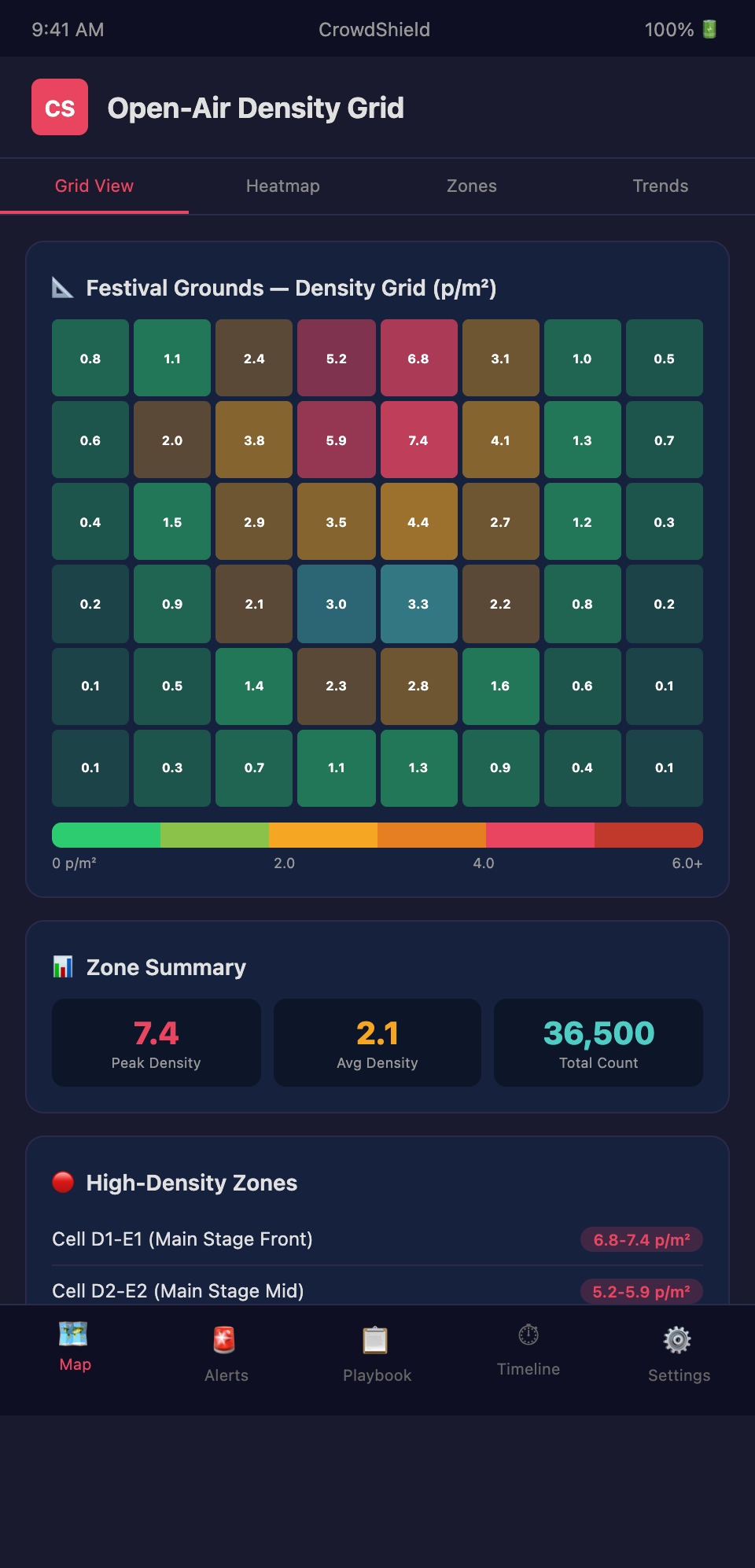
The CrowdShield density dashboard. The system presents the festival map as a grid of color-coded zones, with each zone's current density displayed as a numerical overlay. The color coding follows the standard traffic-light model: green for within safe parameters, yellow for approaching threshold, orange for at threshold, red for above threshold. Critically, the dashboard also displays the density trend — an arrow indicating whether density in each zone is rising, stable, or falling — and a projected time-to-threshold for yellow and orange zones.
This transforms density management from a reactive task ("that area looks crowded, send someone over") into a proactive one ("Zone B-7 will reach threshold in approximately four minutes if current inflow continues — deploy stewards to redirect foot traffic now").
The choose-your-own-adventure prompts for density management are calibrated to the zone type. For a stage viewing zone approaching threshold, the prompt might offer: (A) Close rear access points to cap zone population. (B) Request stage MC to direct crowd to spread laterally. (C) Open additional viewing areas with secondary screens. (D) Escalate to operations center. For a pathway bottleneck, the options shift to flow management: (A) Open parallel route to redistribute traffic. (B) Deploy stewards for manual traffic direction. (C) Close upstream pathway to halt inflow.
Advanced Tactics: Dynamic Thresholds and Environmental Adjustments
Static density thresholds are a starting point, but real-world festival conditions demand dynamic adjustment. Several factors can lower the safe density threshold significantly.
Heat. When ambient temperatures exceed 30 degrees Celsius (86 degrees Fahrenheit), the safe standing density drops because the crowd generates additional body heat. Research from the University of Greenwich on crowd thermodynamics found that core body temperature in a dense outdoor crowd can rise 1.5 to 2 degrees Celsius above ambient-adjusted norms when density exceeds 3 persons per square meter in direct sunlight (University of Greenwich — Crowd Dynamics Research). CrowdShield integrates live weather data and adjusts zone thresholds downward when heat index rises.
Terrain. A density of 3 persons per square meter on flat ground is manageable. The same density on a slope introduces fall risk and uneven pressure distribution. Festival grounds are rarely perfectly flat. The zone model must account for elevation data and apply stricter thresholds to sloped areas.
Time of day and event phase. Late-night crowds at multi-day camping festivals are more fatigued and more likely to be under the influence of alcohol or other substances, reducing their ability to self-regulate in dense conditions. The system can apply time-based threshold adjustments — tightening density limits during late-night headliner sets when the crowd is at peak impairment.
Interaction with adjacent zones. A zone at safe density can become dangerous if an adjacent zone is over threshold and people begin to spill across the boundary. The density model must account for inter-zone pressure, not just intra-zone counts.
Alcohol and substance effects on density tolerance. The standard density thresholds established in crowd-science literature assume a sober, alert crowd. At a music festival — particularly during evening and late-night programming — a significant portion of the crowd is under the influence of alcohol or other substances, which impairs balance, spatial awareness, and the ability to self-regulate within a dense group. The UK's Purple Guide acknowledges that impaired crowds require lower density thresholds but does not specify exact adjustments, leaving this to operational judgment. CrowdShield addresses this gap by integrating time-of-day and event-phase data as proxy indicators for impairment and applying a graduated reduction to density thresholds during high-impairment windows — typically reducing the maximum safe density by 10 to 15 percent during late-night headline sets.
Density measurement validation. No single measurement technology is perfectly accurate in an open-air environment. Camera-based density estimation is affected by lighting conditions, weather, and camera angle. Wi-Fi probe analysis overcounts when attendees carry multiple devices and undercounts when phones are off. The system cross-references multiple sensor inputs and flags discrepancies, providing the operations team with a confidence interval alongside the density estimate rather than a single number that implies false precision.
For more on how crowd crush develops when density thresholds are exceeded, see Understanding Crowd Crush Risk at Music Festivals: Lessons from Astroworld and Roskilde.
For a detailed examination of how density measurement differs in the confined spaces of nightclubs, see Understanding Crowd Density Thresholds and Aggression Risk in Venues.
For more on how weather conditions compound density risk at outdoor events, see Weather Contingency Planning for Outdoor Festival Crowd Safety.
Start Measuring What Matters at Your Festival
You cannot manage what you cannot measure, and most festivals still rely on visual estimates and gut instinct for density management. CrowdShield gives your operations team real-time, zone-by-zone density data with actionable prompts — purpose-built for the open-air environments where traditional tools fail. Join the CrowdShield waitlist to bring quantitative density management to your next festival.