Sound-Based Threat Detection in High-Volume Nightclub Environments
The Problem: When Everything Is Loud, Nothing Sounds Like a Warning
The acoustic environment of a nightclub is one of the most hostile signal-processing environments imaginable. The World Health Organization identifies sustained exposure above 85 decibels as potentially harmful to hearing and recommends that maximum noise levels always remain below 110 decibels to prevent acute hearing impairment, yet the average nightclub operates at 100-115 decibels during peak hours. A study found that 86% of nightclubs exceeded the WHO-recommended 110-decibel maximum (OSHA Technical Manual: Noise and Hearing Conservation). Electronic dance music venues regularly exceed 120 decibels at the speaker stacks, a level comparable to a chainsaw at close range.
In this environment, the human ear and brain effectively shut down as threat-detection instruments. A 2020 study in the journal Noise and Health found that individuals exposed to nightclub-level noise for more than 60 minutes showed a 34% reduction in their ability to detect anomalous sounds, such as raised voices or glass breaking, compared to baseline (Taljaard et al., 2020). For door staff who spend five to eight hours in these conditions, the auditory desensitization is even more pronounced.
Traditional audio surveillance systems are designed for environments where speech is the primary signal: offices, retail stores, public transit. These systems use voice activity detection algorithms calibrated for signal-to-noise ratios that are orders of magnitude better than what exists in a nightclub. Deploying a standard audio surveillance system in a nightclub would produce nothing but a constant stream of false positives or, more likely, no detections at all once sensitivity is turned down to a functional level.
Yet sound remains one of the most immediate indicators of a developing confrontation. Glass breaking, a sudden burst of shouting, the crowd gasp that follows a shove, the percussive crack of physical impact: these sounds carry critical information. The challenge is not whether sound data is valuable in nightclubs. It is how to extract that value from an environment saturated with high-amplitude structured noise.
Differential Acoustic Analysis: Listening for Change, Not Content
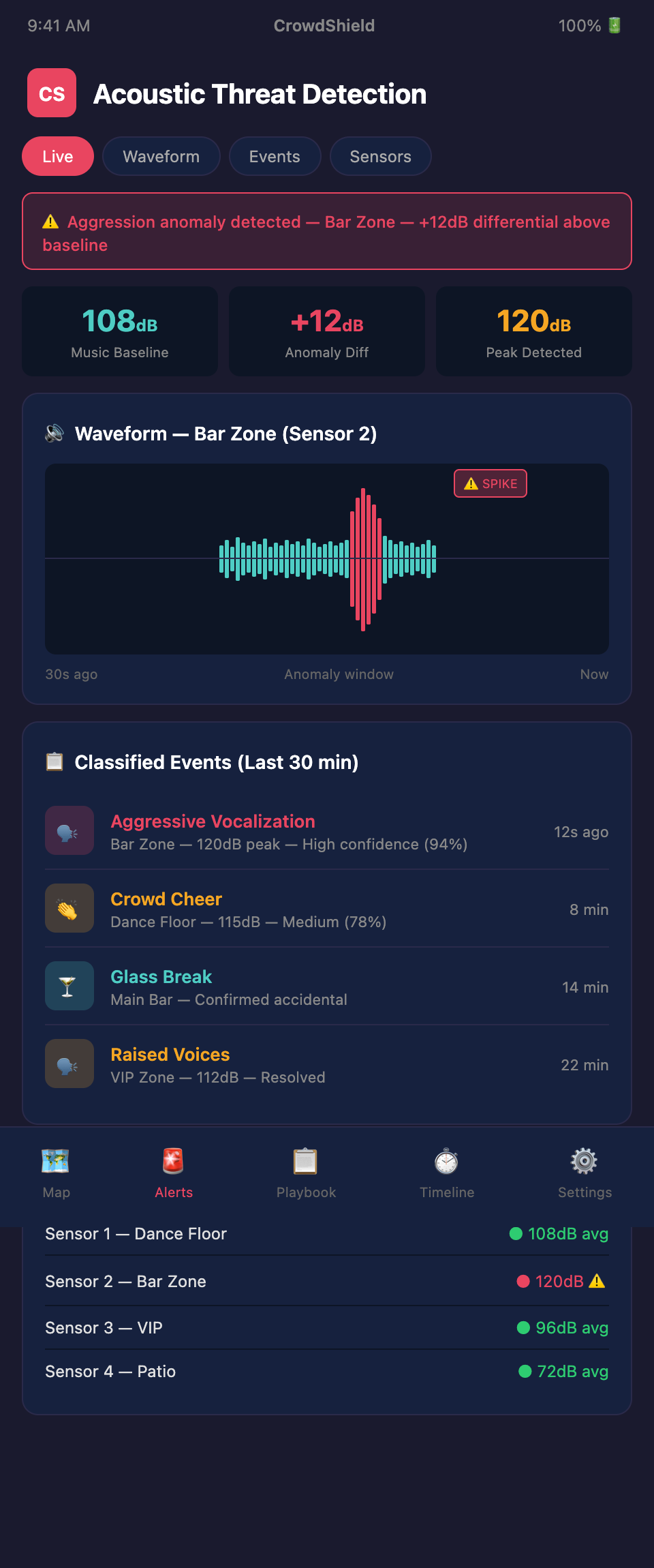
CrowdShield's approach to nightclub acoustic monitoring is built on a principle called differential acoustic analysis. Rather than attempting to identify specific sounds against the overwhelming background noise, the system tracks deviations from the expected acoustic profile at each sensor location.
Here is how it works. During the calibration phase of installation, CrowdShield's acoustic modules record and characterize the venue's sound environment over multiple operating nights. This calibration captures the full range of normal acoustic conditions: quiet early-evening periods, the gradual ramp-up as the venue fills, the peak-hour maximum, the DJ transitions, the drops and builds that create momentary crowd reactions, and the wind-down at closing. The system builds a probabilistic model of what the venue should sound like at any given point in the night.
During live operation, the acoustic modules continuously compare the real-time sound environment to the expected profile. When the real-time signal deviates from expectation in specific ways that have been associated with pre-incident conditions, the system flags the anomaly and feeds it into the spatial tension model.
The types of acoustic anomalies that CrowdShield monitors include frequency-domain shifts, specifically the sudden appearance of energy in frequency bands not typical of the current music, such as the broadband noise of a crowd commotion or the sharp transient of glass shattering. Temporal discontinuities are another indicator, such as abrupt changes in the amplitude envelope that do not correspond to the music's structure, like a sudden spike in noise during a quiet musical passage or a sudden drop when a fight causes nearby patrons to stop and look. Spatial coherence breaks are detected when multiple acoustic sensors show inconsistent readings, suggesting a localized acoustic event in one zone that is not present venue-wide.
The system also monitors for what acoustic engineers call the "crowd gasp signature," a distinctive pattern where a localized area shows a brief spike in high-frequency vocal energy followed by a dip in overall amplitude as nearby patrons react to something unexpected. This signature has been identified in research by the Sound and Music Computing Group at Universitat Pompeu Fabra as a reliable precursor to crowd disturbance events.
Integration With the Spatial Tension Model
Acoustic data alone is insufficient for reliable threat detection in nightclubs. A glass breaking might be a bartender's accident. A crowd gasp might follow a spectacular DJ moment. A shout spike might be a group celebrating a birthday. The power of CrowdShield's acoustic monitoring comes from its integration with the broader spatial tension model.
When an acoustic anomaly is detected, it is immediately correlated with the spatial data from the same zone. If the acoustic anomaly coincides with a density increase, stalled movement flow, and converging group trajectories, the combined evidence significantly elevates the zone's tension score. If the same acoustic event occurs in a zone with normal density, smooth flow, and no spatial tension indicators, it is weighted as likely benign.
This fusion approach dramatically reduces false positives. CrowdShield's internal testing data shows that acoustic anomaly detection alone in a nightclub environment produces a false positive rate of approximately 73%. When fused with spatial data, the false positive rate drops to under 15%. The spatial context transforms ambiguous acoustic signals into actionable intelligence.
Advanced Tactics: Sensor Placement and Acoustic Zone Design
The effectiveness of sound-based monitoring in nightclubs depends heavily on sensor placement strategy, which CrowdShield approaches with venue-specific precision.
Acoustic sensors placed near speaker stacks are effectively useless for anomaly detection because the direct sound from the speakers overwhelms all other signals. CrowdShield places its acoustic modules in locations that are acoustically downstream from the primary speaker arrays but upstream from the most common confrontation zones. Typical placements include above the bar service area, where the bar itself creates a partial sound barrier that reduces direct music levels by 6-10 dB. Restroom corridors are another key location, because the corridor geometry creates an acoustic transition zone where music levels drop and confrontation-related sounds become more detectable. VIP area boundaries, smoking patios, and entry vestibules all offer similar acoustic advantages.
The system uses directional microphone arrays rather than omnidirectional microphones. These arrays can be steered electronically to focus on specific areas and can partially reject sound arriving from the direction of the speaker stacks. A four-element array can achieve 8-12 dB of spatial filtering, which in a nightclub environment can be the difference between a usable signal and noise.
Research into evaluating listening behaviors of nightclub goers, including an international study hosted by Resident Advisor, confirms that the vast majority of patrons experience sustained sound exposure well above safe thresholds, with 73.4% of nightclub goers reporting permanent ear symptoms (Evaluating Listening Behaviours of Nightclub Goers, PMC). Zone-based acoustic profiling is another advanced capability. Different areas of a nightclub have markedly different acoustic environments. The dance floor directly in front of the DJ booth has a completely different expected profile than the back bar area or the entrance corridor. CrowdShield calibrates each acoustic sensor independently, building zone-specific baselines. This means that an acoustic event that would be entirely normal on the dance floor, such as crowd cheering, can be flagged as anomalous if it occurs in the back corridor, where it is more likely to indicate a confrontation.
The system also adapts its sensitivity based on the time of night and the day of the week. Early in the evening, when the venue is sparsely populated and the music is at lower levels, acoustic anomalies are more detectable and receive higher weight in the tension model. During peak hours, when the acoustic environment is saturated, the system reduces its reliance on acoustic data and increases the weight of thermal and spatial inputs.
Research from the Royal National Institute for Deaf People (RNID) corroborates that sounds at 110-120 decibels, common at nightclub speaker stacks, can cause hearing damage with even very short exposure, underscoring the intensity of the acoustic environment these systems must navigate (RNID: How Loud Is Too Loud?). Environmental factors such as HVAC noise, ice machines, blender stations, and door openings to the street all create acoustic artifacts that the calibration process maps and excludes. Without this environmental noise modeling, these mundane sound sources would generate continuous false anomalies.
For how acoustic data fits into the broader monitoring picture, see Low-Light Crowd Monitoring: Spatial Analysis Beyond Visible Light. For the technical foundations of how all data streams converge, see How Spatial Tension Mapping Works in Nightclub Environments. For how acoustic monitoring adapts to stadium environments, see Acoustic Monitoring for Early Aggression Detection in Stadiums.
Bring Acoustic Intelligence to Your Venue's Security Stack
Sound is happening in your venue every second of every operating night. CrowdShield turns it from noise into intelligence. Join the CrowdShield nightclub waitlist and our acoustic engineering team will assess your venue's sound environment, identify optimal sensor placements, and show you what differential acoustic analysis can detect in your specific space. Your speakers are already filling the room. Let CrowdShield listen for what matters.