Designing Choose-Your-Own-Adventure Security Playbooks for Game Day
Why Radio Dispatch Isn't Enough
The standard security communication model at live events is broadcast radio. A command center operator spots something on a monitor, keys the radio, and tells the nearest unit to "check out Section 214." The officer walks over, assesses the situation with their own eyes, and makes a judgment call. If they guess wrong, the situation escalates. If they guess right, the resolution goes unrecorded and the organization learns nothing.
The National Center for Spectator Sports Safety and Security (NCS4) documented this pattern in their 2022 training framework, noting that "unstructured radio dispatching produces high variance in response quality, with outcomes dependent almost entirely on the individual officer's experience and temperament" (NCS4 Professional Development and Training Guide). A veteran officer with 200 games of experience may intuitively choose the right approach. A first-game temp staffer will not.
The root problem is that radio gives location without context and context without structure. The officer arrives at Section 214 knowing only "something is happening." They don't know the zone's current density, alcohol consumption rate, or tension trend. They don't have a menu of validated response options. They have a radio, a flashlight, and their gut.
The Branching Playbook Model
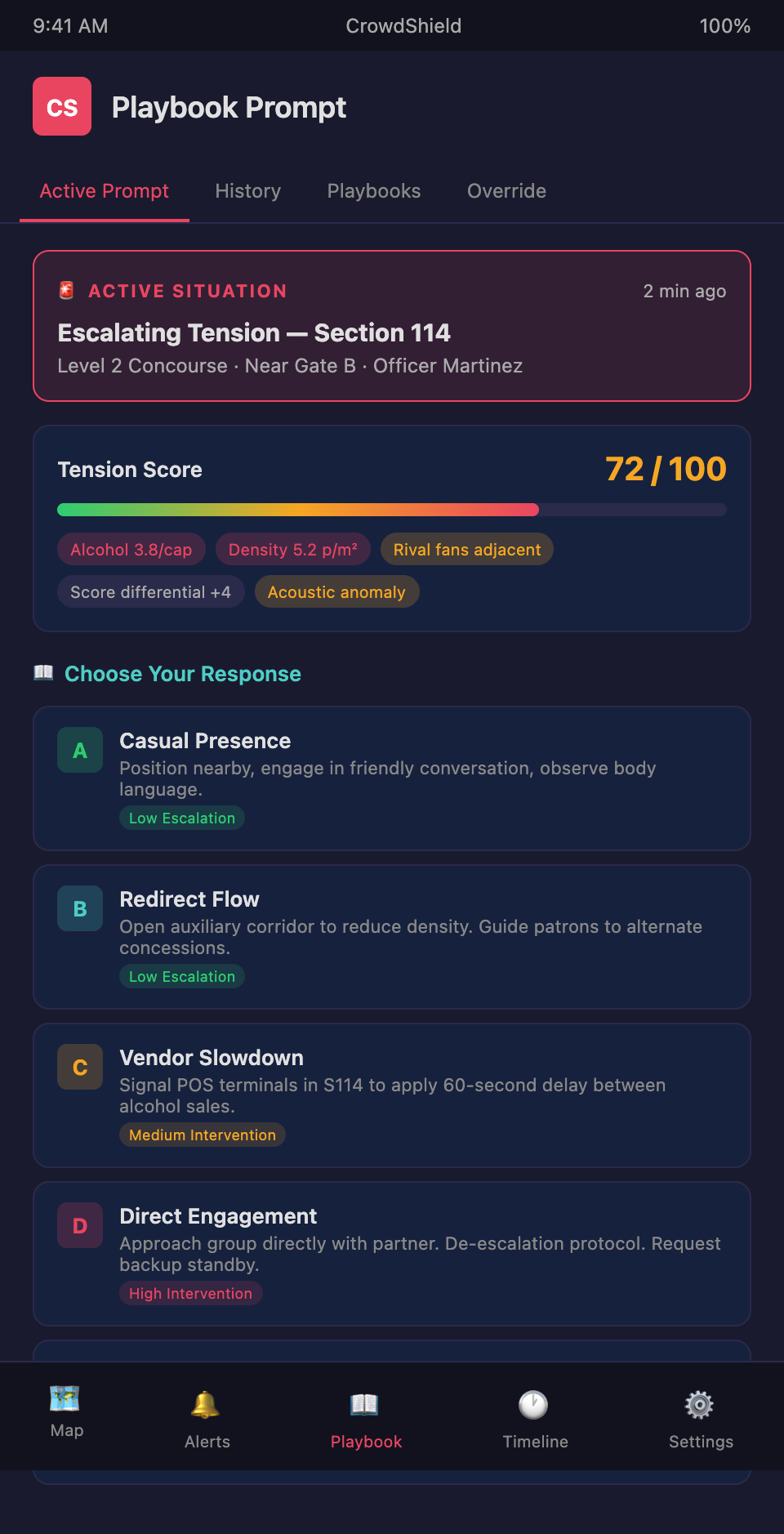
Choose-your-own-adventure playbooks replace unstructured judgment calls with guided decision trees. When a zone's tension score crosses a threshold, the system pushes a context-rich prompt to the assigned security team member's device:
Prompt example:
Section 214 — Tension Score: 7.4/10 Density: 3.8/m² (orange) | Alcohol index: 2.6 drinks/person (elevated) | Game state: Rivalry, home trailing by 2, Q4
Two clusters of opposing fans within 15m. Verbal aggression detected (acoustic). No physical contact observed.
Choose your approach:
- (A) Visible deterrence — Move two uniformed officers to section boundary. Make presence known without engaging.
- (B) Hospitality intervention — Deploy fan ambassador with water/snacks to the area between clusters. Redirect attention.
- (C) Flow management — Open gate 214-B to reduce density. Announce concession specials in adjacent section to draw crowd.
- (D) Direct engagement — Approach the more agitated cluster. Identify the focal individual. Conversational de-escalation.
- (E) Escalate — Flag for supervisor review. Request law enforcement standby.
Each option is not a guess — it's a validated tactic pulled from the venue's incident history, best-practice literature, and the specific conditions of the moment.
How Branching Responses Feed the Model
The power of structured playbooks is not just in the prompt — it's in the feedback loop. When an officer selects option C and opens gate 214-B, the system records: trigger conditions, intervention chosen, and outcome (tension score change over the next 5–15 minutes).
Over a season, this builds a dataset of thousands of intervention-outcome pairs, contextualized by density, alcohol, game state, and section. The system learns: "In rivalry games, when tension is at 7+, hospitality interventions (option B) reduce tension scores 40 percent faster than visible deterrence (option A) in upper-deck sections, but the reverse is true in lower-bowl sections near the field."
This evidence base is what transforms security from an art practiced by experienced veterans into a discipline that can be taught, measured, and improved. The RAND Corporation's 2021 research on protective security noted that structured decision frameworks with feedback loops produced measurable improvements in both response time and outcome quality within 6–12 months of adoption (RAND — Improving Protective Security).
Building Effective Playbook Branches
Start with your top 10 scenarios. Review the last two seasons of incident reports. Identify the 10 most common trigger conditions (e.g., "rival fans converging at concourse chokepoint post-game," "intoxicated fan confronting usher over seating dispute"). Design branching playbooks for these first.
Limit options to 4–5 per tier. Cognitive load research consistently shows that decision quality degrades beyond 5 options under time pressure. The Miller's Law principle suggests that 4 ± 1 options is the sweet spot for rapid, accurate selection (Miller, G.A. — The Magical Number Seven, Plus or Minus Two, Psychological Review, 1956).
Design two-tier depth. The initial prompt presents first-response options. If the chosen option does not reduce the tension score within a defined window (e.g., 5 minutes), the system presents a second-tier prompt with escalated options. Rarely should a situation require more than two tiers before supervisory involvement.
Include a "this doesn't match" escape. Real situations don't always fit the model. Every prompt should include an option for the officer to report that the situation doesn't match the described conditions, triggering a supervisor review and a model-training data point.
For the foundational overview of how tension scores trigger these playbooks, see What Is Crowd Tension Mapping and Why Stadiums Need It Now. For a comparative look at how branching playbooks adapt for the very different response dynamics of nightclub bouncers, see De-Escalation Playbooks for Nightclub Door Staff.
Build Smarter Playbooks with CrowdShield
Stop relying on radio calls and gut instinct. CrowdShield gives your field teams structured, context-aware decision prompts — and learns from every choice they make. Join the waitlist to start building playbooks that actually improve over time.