How Spatial Analytics Integrates with Existing Stadium Security Infrastructure
The Silo Problem in Stadium Security
Walk into any modern stadium's security command center and you'll see the same layout: a wall of CCTV monitors, a radio dispatch console, a separate screen for access-control turnstile counts, and — somewhere on a clipboard or spreadsheet — the incident log from last week's game. Each system works. None of them collaborate.
This fragmentation is not a technology failure; it's an architectural one. According to a 2022 report from the International Association of Venue Managers (IAVM), 78 percent of surveyed venues described their security technology stack as "partially integrated at best," with camera systems, access control, and incident management running on separate platforms with no shared data layer (IAVM Venue Security Technology Survey). The UK's Sports Grounds Safety Authority (SGSA) noted in its 2023 guidance that siloed security systems contribute to delayed response times because operators must mentally correlate information across multiple screens and interfaces (SGSA Guide to Safety at Sports Grounds).
The result is that a stadium with 500 cameras and 200 radios still reacts to incidents rather than predicting them. The cameras record; they don't analyze. The radios transmit; they don't coordinate. The turnstile data sits in a database until someone runs a report next Tuesday.
The Integration Layer Approach
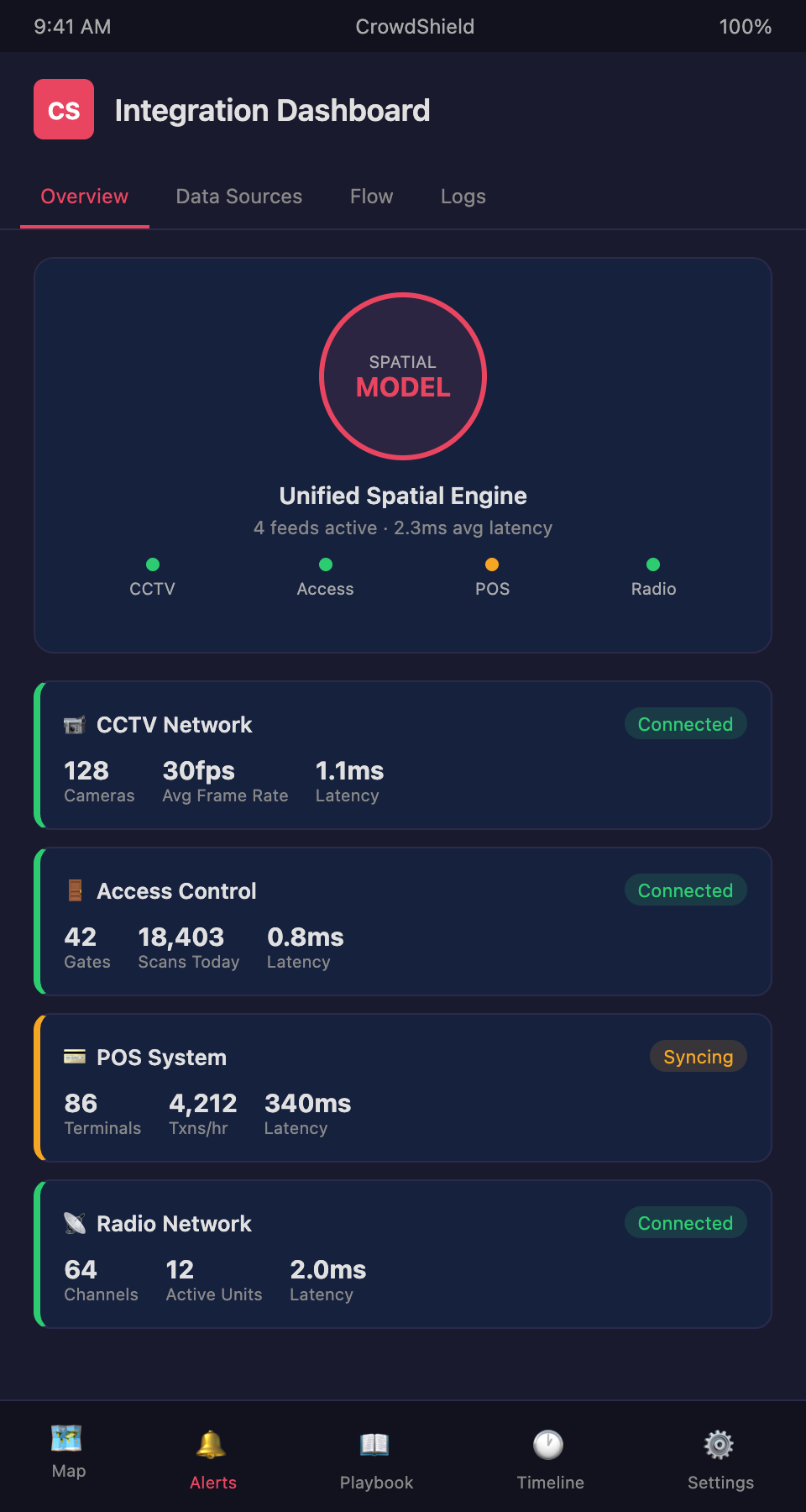
Spatial analytics does not require replacing these systems. It sits on top of them as an integration layer that ingests data from every existing source and produces a unified spatial model.
CCTV feeds become the primary input for computer vision processing. Modern IP camera systems output standard RTSP video streams that a spatial analytics platform can consume without modifying the camera hardware. The platform runs density estimation, movement-vector analysis, and anomaly detection on the feeds, extracting behavioral data that the raw video never surfaces.
Access-control systems provide real-time headcounts by zone. When a venue uses electronic ticketing with section-level granularity, the spatial model knows exactly how many ticketed attendees should be in each area versus how many are actually detected by camera-based density estimation. Discrepancies — more bodies than tickets — flag potential gate-crashing or unauthorized zone migration.
Point-of-sale data from concession stands and beer vendors provides an alcohol-saturation overlay. Research from the University of Minnesota's School of Public Health found that per-capita alcohol sales above 2.5 standard drinks per attendee correlated with a 1.8x increase in ejection rates at collegiate football games (University of Minnesota Alcohol and Stadium Safety Study). When the spatial model sees that Section 312 has consumed 40 percent more beer than the venue average and density is climbing, the tension score adjusts accordingly.
Radio dispatch logs, when digitized, provide a feedback loop. Every dispatch, response, and resolution becomes a training data point. Over time, the model learns which intervention types work for which tension patterns in which sections.
Technical Architecture in Practice
The practical integration follows a hub-and-spoke model. Each existing system connects to the spatial analytics platform via its native API or data export protocol. Most enterprise CCTV platforms (Genetec, Milestone, Avigilon) support RTSP streaming and event webhooks. Access-control systems (Lenel, AMAG, Gallagher) expose occupancy data through standard APIs. POS systems vary more widely, but even basic integrations can push per-transaction records at 30-second intervals.
The spatial analytics hub normalizes these inputs into a common coordinate system — the venue's floor plan — and runs its models. Outputs push back to operators through existing interfaces: tension scores overlaid on the CCTV command display, prioritized alerts in the radio dispatch queue, and summary dashboards on supervisor tablets.
A critical design principle is non-disruption. The 2021 NCS4 Best Practices Guide for venue security technology emphasizes that "any new system that requires operators to learn an entirely new interface during a live event will be abandoned under pressure" (NCS4 Best Practices). The spatial layer must enhance what operators already see, not replace it.
Common Integration Pitfalls
Legacy analog cameras. Venues with older analog CCTV systems face a bottleneck: analog feeds require encoding to digital before the spatial platform can process them. Encoders add latency and cost. For venues in this position, a phased migration — starting with high-risk zones like concourses, exits, and rivalry-seating sections — is more practical than a full replacement.
Data privacy regulations. Spatial analytics processes video feeds, which in the EU falls under GDPR and in the U.S. may trigger state-level biometric privacy laws like Illinois' BIPA. The key distinction is that crowd tension mapping analyzes aggregate crowd behavior — density, flow, acoustic patterns — not individual identification. Platforms that operate on anonymized spatial data rather than facial recognition sidestep the most significant regulatory exposure. For a deeper look at how to design crowd analytics with privacy constraints, see Privacy-First Crowd Analytics: What Stadium Operators Need to Know.
Bandwidth constraints. Streaming hundreds of camera feeds to a centralized processing engine demands significant network capacity. Edge-computing architectures — where initial video processing happens on devices co-located with camera clusters — reduce bandwidth requirements by transmitting only extracted metadata (density scores, movement vectors) rather than raw video to the central hub.
For foundational context on what crowd tension mapping is and why stadiums need it, see What Is Crowd Tension Mapping and Why Stadiums Need It Now. For operators exploring how these same integration patterns work in enclosed, high-noise nightlife environments, see Integrating Spatial Analytics in Nightclub Security Systems.
Get Early Access to CrowdShield
Your stadium already has the hardware. CrowdShield provides the intelligence layer that connects it all into a predictive, actionable system. No rip-and-replace — just smarter use of what you already own. Join the waitlist to see how CrowdShield integrates with your specific venue stack.