Building a Demolition Timeline Around Peak Traffic Windows
When the Window Closes Before the Work Is Done
On the weekend of April 9, 2026, Interstate 75 northbound was closed at 11 PM Friday for the Linn Street Bridge demolition in Cincinnati — with a planned reopening at 5 AM Monday, per FOX19's reporting on the I-75 closure. That 54-hour window was not chosen arbitrarily — it reflects the structural work required to remove the span and the traffic reality of a regional freight corridor where every unplanned extra hour translates to congestion and economic disruption.
The Cape Cod Commission's economic impact study of long-term bridge closures found that the Sagamore Bridge closure alone caused $10 million in travel delay costs. At the regional level, FHWA Work Zone Road User Costs research estimates highway disruption costs at $8 million to $256 million per day depending on route criticality. These are not abstract numbers — they appear in liquidated damages clauses, in political pressure from elected officials, and in contractor penalties when windows overrun.
Nighttime demolition adds a specific risk dimension. FHWA Work Zone Safety data shows that nighttime accounts for 36% of fatal work zone crashes despite carrying lower traffic volumes than daytime. The combination of reduced visibility, crew fatigue, and compressed timelines creates conditions where even well-planned sequences produce higher incident rates than equivalent daytime work. A demolition timeline built around peak traffic windows must account for this nighttime risk explicitly — not by avoiding night work, which is often structurally necessary, but by designing the work scope for each window so crews are not compressed into overruns.
Composing the Timeline Around Traffic Reality
The Demolition Symphony Planner builds the demolition timeline peak traffic windows as score timing — not as a calendar overlay but as an intrinsic constraint on when each measure can begin and end. Just as a musical composition specifies tempo and timing for each phrase, the demolition score specifies the traffic window within which each phase measure is permitted to execute.
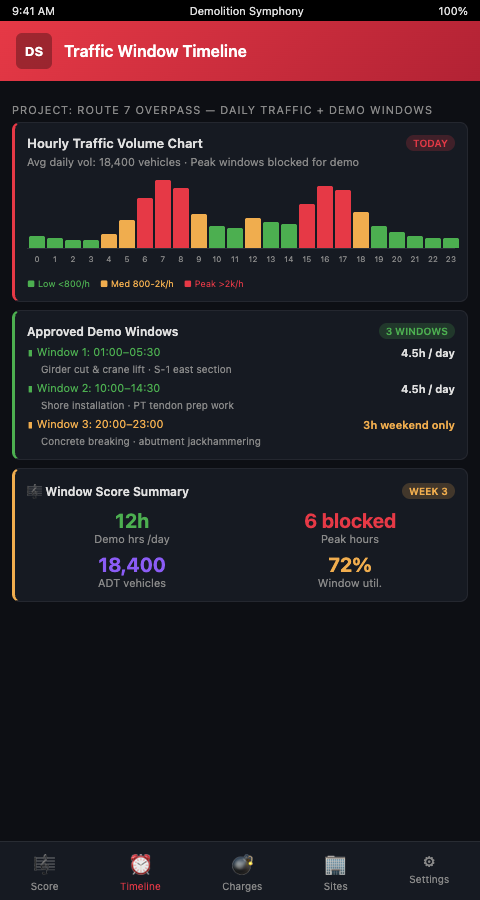
Traffic Window Mapping. The score begins with a traffic window map: peak hours, off-peak hours, weekend closures, and nighttime windows for each direction of affected traffic. Off-peak bridge demolition scheduling starts with route-specific volume data — not generic assumptions about when traffic is light. California DOT TMP Guidelines note that full closures during off-peak periods minimize project duration, and the Demolition Symphony Planner accepts route-specific traffic count data to calculate the actual off-peak windows for each corridor rather than applying a generic assumption.
Structural Task Duration Against Window Duration. Each phase measure in the score carries a structural task duration estimate — how long the saw-cut, crane lift, debris removal, and shoring repositioning will take for that measure. Traffic window optimization for bridge removal requires comparing task duration against available window duration and adjusting scope or method when the task exceeds the window. The Demolition Symphony Planner performs this comparison at every measure and flags overruns. Those measures either require scope reduction (splitting the task across two windows), method acceleration (faster cutting technique), or window extension (additional lane closure time with traffic management approval). Work window scheduling for bridge demolition is most effective when it is built into the score from the first planning session — not adjusted after the structural sequence is finalized.
The Pattullo Bridge Model. The Pattullo Bridge Replacement project demonstrates a multi-window approach: three consecutive weekend demolition windows, each with a defined structural scope, allow traffic to restore between windows while the project advances. The Demolition Symphony Planner replicates this model by writing multi-window sequences for measures whose tasks exceed a single window — the score shows explicitly which scope element is assigned to window 1, which to window 2, and what structural state must exist at the start of each window for that scope to proceed.
Night-Window-Specific Annotations. Night work measures in the score carry additional notations that daytime measures do not: lighting specifications, visibility-related equipment restrictions, fatigue management checkpoints, and heightened communication protocol requirements. These annotations are not optional additions — they are part of the measure definition for any task scheduled in a nighttime demolition window planning period. The score makes this distinction automatic: any measure timed to begin after sunset and before civil twilight triggers the night-specific annotation set.
The connection to traffic management scoring is fundamental — the traffic window timeline and the traffic management score are different views of the same data. The traffic window timeline shows when structural work can proceed; the traffic management score shows how lanes and closures are configured during that work. The Demolition Symphony Planner keeps both views synchronized, so a window change in the timeline automatically updates the traffic management score.
For night-window demolition on urban overpasses — where light rail, pedestrian traffic, and noise ordinances interact with the work schedule — the timeline score provides the baseline document for agency review. Permit applications for extended night windows reference the measure-level scope and duration data in the score, giving reviewers the structural justification for each window duration requested.
Advanced Tactics for Timeline Optimization
Window stacking for complex spans. When a single bridge removal requires multiple structural operations that span more than one traffic window, the Demolition Symphony Planner stacks those operations across windows with explicit intermediate structural states recorded. At the end of window 1, the score specifies the required structural state — what has been cut, what is shored, what load has been transferred — so the crew beginning window 2 knows exactly where the sequence is and what condition the structure is in.
Contingency window protocols. Every traffic-window-based timeline needs a contingency protocol for when the primary window overruns. The Demolition Symphony Planner writes contingency measures — abbreviated scope operations that can be completed within the remaining window time, followed by a safe structural hold state — directly into the score adjacent to the primary measures they cover. The crew does not improvise when the timeline slips; they execute the contingency measure that was pre-written for that situation.
Traffic volume-weighted window selection. Off-peak windows are not all equivalent. A Saturday night window on a freight corridor may have lower passenger vehicle counts but higher truck volumes than a Tuesday night window on the same route. The Demolition Symphony Planner weights window selection by vehicle type and route sensitivity, not just total volume, to identify the lowest-disruption windows for high-impact structural tasks.
Connecting noise scheduling across project types. Teams familiar with noise abatement scheduling from stadium demolition will recognize the window-compliance logic. Stadiums impose noise ordinance windows that define when high-energy demolition methods can operate; bridges impose traffic-window constraints that define when lane closures are permitted. The Demolition Symphony Planner applies the same window-constraint annotation system to both, so teams moving between project types use a consistent planning framework.
Data-driven window refinement. Traffic count data collected during an earlier project phase — collected via automated counters or from regional traffic management centers — can be imported into the Demolition Symphony Planner to refine window selections after the initial score is written. If real traffic data shows that Tuesday nights have 30% lower peak volumes than the model assumed, the score updates the window priority accordingly without rebuilding the sequence from scratch.
The Timeline That Protects Both the Project and the Road Users
A demolition timeline built around peak traffic windows is not just a scheduling convenience — it is the mechanism by which bridge demolition projects protect the traveling public, minimize economic impact, and avoid the penalty clauses that accompany unplanned window overruns. The Demolition Symphony Planner makes traffic window constraints first-class inputs to the project timeline, not afterthoughts that get adjusted when the structural schedule doesn't fit.
When work window scheduling is integrated with the demolition score from the first planning session, the team arrives at each window with a structural scope that fits the available time, contingency protocols that are pre-written, and a traffic management configuration that is synchronized with the structural plan.
Traffic window optimization for bridge removal also creates compliance documentation that protects the project in regulatory and contractual disputes. When a window overrun occurs and a DOT agency questions whether the contractor took all available steps to complete work within the approved window, the Demolition Symphony Planner's timestamped gate log provides a complete record of when each structural action was authorized, when it was completed, and what off-peak bridge demolition scheduling decisions were made at each phase. That documentation is the difference between a defensible position and an unsupported verbal account. Work window scheduling for bridge demos, when managed through the score, automatically generates the compliance record the project needs without additional administrative effort.
Build the Timeline Before You Request the Permits
Bridge and overpass demolition teams should define their work window schedule in the Demolition Symphony Planner before submitting traffic management plan permit applications. The measure-level scope and duration data the planner generates provides the regulatory documentation agencies need to approve closure windows — and the structural justification that supports the window duration you are requesting.
When the closure duration in the permit application is derived from the demolition score's measure-level analysis — not from a contractor's general estimate — agencies have a defensible technical basis for the approval decision. Traffic window optimization for bridge removal that is backed by measure-level scope data also reduces the risk of permit rejections based on insufficient justification, which can add weeks to the pre-demolition phase.
Plan your bridge demolition timeline with the Demolition Symphony Planner and build a schedule that matches actual traffic windows, flags window overruns before they happen, and gives your permit applications the measure-level justification that agencies require. Start your off-peak bridge demolition scheduling with the Demolition Symphony Planner and give your bridge and overpass demolition team a traffic window score that is built into the structural plan from the first session — so the timeline you submit to the DOT is the same timeline your crew executes from in the field.