How to Choreograph Night-Window Demolition for Urban Overpasses
The Overpass That Had to Be Back by Morning
In New Rochelle, New York, the North Avenue Bridge overnight demolition required 20-minute full traffic stops coordinated with a tight reopening window before the morning commute. The compressed schedule left no room for phase overruns — if demolition exceeded the window, the bridge would reopen with debris on the road surface or equipment not yet cleared. That constraint is not unique to New Rochelle. Virtually every urban overpass removal in a populated corridor runs against the same clock: work starts after the last traffic dies down and must be invisible to the first commuter.
Night-window demolition urban overpasses impose a discipline that daytime operations rarely require. Noise ordinances add a legal ceiling to the operation — New York City's construction noise rules and San Francisco Public Works night noise permits require after-hours authorization for work exceeding ambient levels by 5 dBA, with specific measurement methods and complaint response protocols. Equipment choices made for structural efficiency — hydraulic breakers, high-frequency saws — may be prohibited or curtailed in residential corridors. The overnight bridge demolition choreography that works in an industrial zone may require a completely different equipment complement in a dense urban setting.
The Clear Path 465 project in Indiana set its work windows at 9 PM to 6 AM — nine hours on paper, roughly five hours of effective work time after setup and site clearing. Teams executing compressed night schedule bridge demolition must treat those effective hours as the only time that exists. Every phase overrun borrows from a reserve that is already depleted.
Writing the Night Score
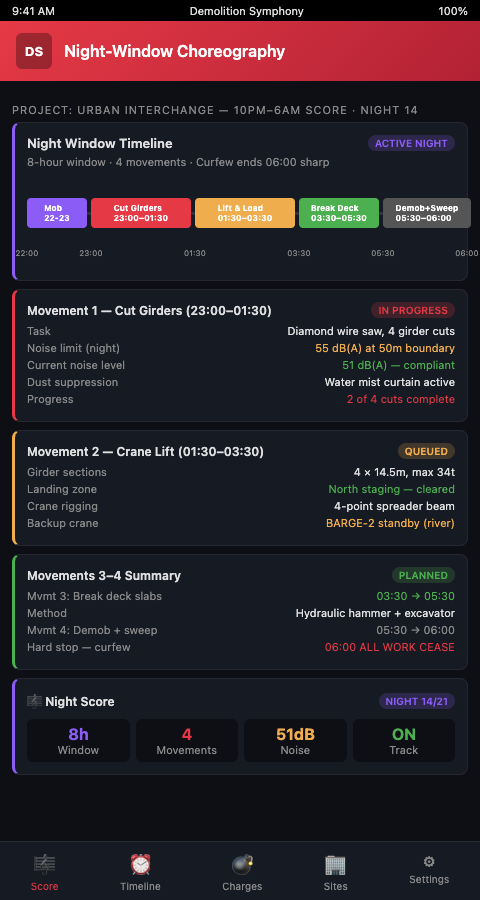
The Demolition Symphony Planner approaches overnight urban overpass work as a score with a fixed measure count and an unyielding final bar line. The conductor cannot add measures at the end. Every structural action, equipment move, crew rotation, and noise-curfew hold must fit within the notation before the performance begins.
Pre-window staging as the opening movement. In a standard daytime demolition, equipment staging can happen during the work period. In night-window overpass removal planning, staging is the opening movement — the preliminary bars played before the main score begins. The Demolition Symphony Planner writes staging as a separate phase block, typically starting two hours before the official closure window. Lane taper installation, saw setup, crane positioning, and exclusion zone fencing are each notated as sequential setup beats. If any setup beat overruns, the opening movement runs long and compresses everything that follows.
Noise-curfew holds as written rests. The most common improvisation error in urban bridge demo noise curfew management is treating the noise restriction as a field call — the superintendent listens, judges whether equipment is too loud, and decides whether to continue. That approach produces inconsistent compliance and leaves the team exposed to stop-work orders. The Demolition Symphony Planner writes noise-hold cues explicitly into the score: at the start of Measure 3, if work involves hydraulic impact tools within 300 feet of residential receivers, the operation switches to wire-saw cutting or abrasive disc methods, and the noise monitor posts dBA readings every 15 minutes. The equipment substitution is pre-planned, not improvised.
Traffic reopening as the final movement. The FHWA Work Zone Traffic Management guidance requires lane closure requests to be submitted at least two weeks in advance, with reopening conditions specified in the permit. The Demolition Symphony Planner writes the reopening sequence as the final movement of the overnight score: taper removal, equipment egress, debris clearance certification, and lane-open signal are each a beat in the final bars. The final bar line — the moment traffic re-enters — is fixed. Structural completion is achieved before that bar line, or the current phase is declared incomplete and the structure is stabilized in a defined intermediate state that safely accepts traffic above or adjacent.
Crew rotation notation for sustained performance. A nine-hour night shift operating heavy demolition equipment is physically demanding. Fatigue-driven errors peak in the 3 AM to 5 AM window, precisely when the compressed schedule pushes the hardest. The Demolition Symphony Planner includes crew rotation notation — similar to how the traffic-aware demolition timeline approach marks the peak-volume windows that require additional oversight — by flagging the high-fatigue hours and specifying the crew assignments that maintain coverage without overextending individual operators.
The real-time traffic feed that governs when the window opens is documented in detail in the real-time traffic data integration approach. For night-window operations, the feed is not just about traffic volume — it is about confirming that the road has cleared sufficiently for the closure taper to extend without creating a queue trap.
Advanced Tactics for Overnight Urban Operations
Luminance planning as a safety score element. Night demolition requires artificial lighting that meets visibility requirements for equipment operators without creating glare that impairs highway driver vision near the closure taper. The Demolition Symphony Planner writes luminance zones into the work area diagram: high-intensity work zone lighting in the exclusion area, reduced directional lighting at the perimeter, and blackout zones at the taper edge to avoid headlight-confusing spill. Lighting transitions between zones are noted as pre-phase setup actions that must be confirmed before structural work begins.
Phase fallback notation for partial completion. If Measure 4 — say, the concrete deck demolition on the first span — cannot be completed within the night window, the team does not simply stop and leave the structure in an undefined state. The Demolition Symphony Planner writes a fallback notation for each measure: a defined intermediate structural state that the phase must achieve before the closure ends, even if full completion is not possible. A deck partially cut must be cut to a defined shear-break point, temporary shoring must be confirmed in position, and exclusion netting must be installed before traffic reopens. Fallback notation turns an incomplete night into a recoverable sequence rather than an emergency.
Coordination with adjacent residents. The UDOT overnight demolition approach maintained emergency access commitments while managing overnight closures — and proactively communicated work windows to affected residents. Urban bridge demo noise curfew compliance is easier to maintain when the community has been briefed in advance, because complaints tend to generate stop-work orders even when dBA levels are technically within permitted thresholds. The Demolition Symphony Planner includes a pre-work communication notation: the date and method of resident notification is recorded alongside the permit reference, giving the team documentation that the adjacent property owners were informed before the first overnight operation.
Connecting night-window planning to neighbor communication protocols. The community engagement approach developed for urban implosion neighbor communication applies directly to overpass demolition in dense corridors. Night work amplifies community sensitivity — mechanical noise that goes unnoticed at noon becomes a grievance at 2 AM. The Demolition Symphony Planner's communication notation references the same stakeholder matrix used for high-rise demolition, adapted to the specific audience of residents, businesses, and local government contacts affected by the overpass removal.
Equipment substitution tables pre-built into the score. For each structural action in the overnight score, the Demolition Symphony Planner maintains an equipment substitution table: the primary method, the noise dBA output at 100 feet, the secondary method if the primary exceeds the curfew threshold, and the production rate differential. A hydraulic breaker at 95 dBA at 100 feet may be substituted with a diamond wire saw at 78 dBA, accepting a 40% reduction in production rate. The night score uses that substitution when residential receivers are within 500 feet — automatically, not as a field judgment call.
The Cost of Improvising at Midnight
Urban night-window demolition that runs without a written score relies on a superintendent's field judgment to balance structural progress, noise compliance, equipment management, and reopening timing simultaneously — under fatigue conditions, in the dark, with a time constraint that does not move. The probability of a misjudgment that results in either a noise complaint stop-work order or a schedule overrun that delays reopening is high. Either outcome is recoverable, but both are preventable.
The Demolition Symphony Planner turns that series of field judgments into a pre-written score that the team reads and executes. The superintendent's role shifts from composer to conductor — executing a plan rather than creating one at midnight.
The improvisation cost is not only operational. When a superintendent makes a field call to extend work past the permitted noise window because structural completion is close, that call creates a regulatory record — a complaint log entry, a potential stop-work notice, and documentation that the project was not compliant with its permit conditions. A pre-written score with fallback notation eliminates that call: the fallback specifies exactly when to stop, what structural state to achieve before stopping, and what stabilization actions must be completed before the closure ends. The superintendent follows the score rather than inventing the response under pressure.
Plan Your Next Span Removal
Bridge and overpass demolition teams working in urban corridors need a night-window plan that holds up under real conditions: compressed time, noise constraints, crew fatigue, and a hard reopening deadline that traffic enforces whether the work is finished or not. Score your overnight overpass removal with the Demolition Symphony Planner and give your bridge and overpass demolition team a pre-written night sequence — every measure defined, every noise-hold cue explicit, every fallback path documented — so no one is composing the plan at midnight when execution is the only job that matters.
The overnight overpass removal score written with the Demolition Symphony Planner also creates the documentation record that noise permit compliance and reopening deadline performance require. When a permitting authority asks whether the demolition team complied with the noise window on a specific night, the score's timestamped gate log provides an objective answer — not a field supervisor's recollection. That documentation protects the project's permit standing for subsequent closure windows and gives the team a defensible record if a complaint is filed. Build your night demolition score with the Demolition Symphony Planner and execute each overnight window from a plan that was written in daylight, reviewed by the full team, and designed to succeed — so your bridge and overpass demolition team delivers reopening on time, every night of the project.