Neighbor Communication Best Practices for Urban Implosion Projects
The Regulatory Foundation of Urban Implosion Notification
Chicago's Demolition by Implosion Ordinance requires a 1,000-foot notification radius, a 60-day public comment period, a public hearing, and a 90-day project lead time from permit application to approved shot date. These are minimum requirements — and they are enforceable conditions of the permit, not advisory recommendations. Missing any one of these milestones can void the permit or trigger a regulatory review that delays the shot date by weeks.
The ordinance was enacted directly in response to the Hilco incident. The City of Chicago approved the implosion regulatory framework with an explicit requirement that individual property-owner outreach replace group meetings — a distinction drawn from the finding that group notification formats allowed residents' specific concerns to be drowned out by the overall presentation. The ordinance requires that each property owner within the notification radius receives an individual contact, not just a mailer or a public meeting announcement.
Chicago is not unique. Multiple urban jurisdictions have enacted or are considering similar frameworks. For urban high-rise implosion coordinators operating in any dense metro area, the question is not whether strict notification requirements apply — it is whether your communication plan meets those requirements before the permit application is submitted. Neighbor communication urban implosion project plans in cities with strict ordinances must be designed by someone who understands both the regulatory requirements and the community notification building demolition context — not assembled by a public affairs team working independently of the technical planning process. Implosion public outreach best practices developed in Chicago now set the de facto standard for urban demolition community relations in jurisdictions considering similar ordinances.
The Neighbor Communication Framework for Urban Implosion Projects
Think of the neighbor communication plan as the program notes that accompany a symphony performance. The audience does not need to understand the technical score — the conductor's markings, the delay intervals, the charge weights — but they do need enough information to decide whether to stay in their seat or step outside. Good program notes create informed, cooperative audiences. A poorly executed implosion notification creates an audience of surprised, frightened, and legally motivated neighbors.
Step 1: Map the notification radius and property inventory. Before any outreach begins, generate a complete inventory of all properties within the regulatory notification radius — typically 1,000 feet in urban jurisdictions, though some require more. The inventory should include property owner names, mailing addresses, and occupancy types (residential, commercial, institutional). Schools, hospitals, and assisted living facilities within the radius require separate, more intensive outreach protocols because they serve populations with limited mobility.
Step 2: Develop tiered notification content. Different audiences need different information. Immediate neighbors within 500 feet need specifics: the planned shot date and time window, the exclusion zone boundary, the recommended action during the shot (indoor shelter, distance, window protection), and a direct phone number to reach the project team. Neighbors between 500 and 1,000 feet need the shot date, a summary of safety measures, and contact information. Property owners across the radius need written legal notice with the information required by the applicable ordinance.
Step 3: Conduct individual outreach before the public comment period opens. CDI's framework emphasizes individual property-owner outreach as the foundation of the neighbor communication plan — not the public meeting. The public meeting is a required regulatory event; the individual outreach is where actual concerns are heard and addressed. A neighbor who has spoken with a project representative and had their questions answered is much less likely to submit a public comment opposing the permit than a neighbor who received only a form letter.
Step 4: Address the safety positioning question explicitly in all communications. Johns Hopkins public health research recommends upwind positioning at significant distance, or indoor shelter within a 7.5-block radius for spectators watching urban building implosions. This recommendation should appear — in plain language — in all neighbor communications: if you choose to watch, go upwind and keep your distance; if you are within seven and a half blocks, stay indoors with windows closed and HVAC systems turned off during the shot and for twenty minutes after. This is not a legal disclaimer; it is practical safety guidance that neighbors need and that the project team is obligated to provide.
Step 5: Integrate the notification timeline into the implosion sequence plan. The Demolition Symphony Planner sequence plan is not just the technical firing document — it is the project schedule framework. Neighbor notification milestones should appear on the same timeline as utility disconnection certifications, structural assessment sign-offs, and charge installation windows. The National Demolition Association's industry standards require advance written notice and accessible contact points for urban implosion projects; these requirements have specific deadlines that create hard constraints on the overall project schedule. If notification is treated as a separate workstream managed by a public affairs team, it is at risk of slipping without the technical team knowing — which means the shot date is at risk.
Advanced Tactics: Crisis Communication, Post-Blast Protocol, and Regulatory Relationship Management
Establish a dedicated project hotline before the first notification goes out. Every written and verbal communication with neighbors should reference a phone number and email address that reaches a human within two business hours. This is not a general contractor main line; it is a project-specific contact that a neighbor can call the day before the shot to ask whether they need to move their car. The hotline also functions as an early warning system: if a neighbor calls to say they have a medical condition that makes dust exposure dangerous, you learn this before the shot rather than after.
Connect the neighbor communication plan to the safety zone planning. The exclusion zone boundary and the safety positioning guidance in the neighbor communication plan must be consistent with each other. If the exclusion zone extends 600 feet and the neighbor letter says "stay outside 300 feet," the discrepancy will be noticed and will undermine trust in the project team's communication. The communication plan and the technical safety plan should be reviewed by the same person before either is finalized.
Plan for post-blast communication as carefully as pre-blast notification. After the shot, neighbors within the radius will have questions: Was the dust cloud expected? Why did the ground shake that much? Is there damage to my building? Prepare a post-blast communication in advance — not written from scratch after the shot — that addresses the most common questions and provides a realistic timeline for debris cleanup and public access restoration. Send it within two hours of the shot.
Learn from the public attention dynamics around iconic venue demolition. Stadium demolitions generate intense public and media interest that amplifies every communication failure. A high-rise implosion in a dense urban core generates similar attention — and similar amplification of anything that goes wrong in the notification process. Assume that every neighbor communication will be reviewed by media and regulatory staff, and draft accordingly.
Treat the utility disconnection notification to neighbors as a separate communication event. When gas, electric, or water service to neighboring properties is temporarily disrupted by the disconnection process, affected neighbors should receive advance notice — not discover the disruption when their service goes out. Coordinate with utility companies to identify the timeline for any service disruptions to neighboring properties, and include that timeline in the neighbor communication plan.
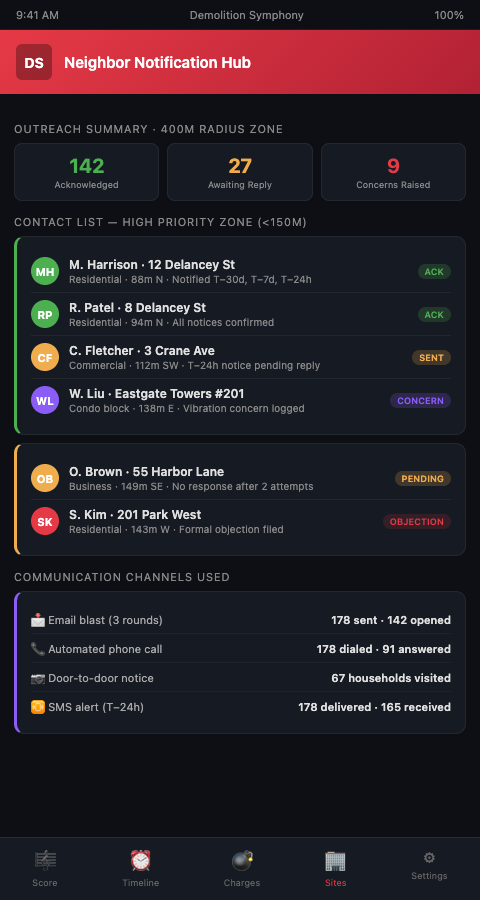
Document all outreach contacts in a communication log. The regulatory record for the project should include a dated log of every individual contact — who was reached, by what method, on what date, and what response or concern was recorded. If the permit is challenged by a neighbor who claims they did not receive notification, the communication log is the project team's evidence of compliance. Build the log format before outreach begins, not after a complaint is filed.
Keep Your Neighbors Informed Before They Become Your Opponents
Demolition Symphony Planner helps urban high-rise implosion coordinators integrate neighbor communication milestones into the same sequence framework as technical preparation activities — so notification deadlines appear alongside charge installation windows, not in a separate calendar that no one on the technical team is watching. Join the waitlist to see how the pre-shot planning environment keeps your communication plan and your sequence plan moving together toward the same shot date.
Resident communication high-rise demolition projects that fail typically fail at the same point: the project team discovers a regulatory deadline for individual property outreach two weeks after the contact was supposed to happen. Building the five-step neighbor communication framework into the same planning document as the utility disconnection schedule and structural assessment timeline ensures that regulatory deadlines for neighbor outreach have the same visibility as technical milestones. A neighbor who becomes an opponent through inadequate communication can generate permit delays that cost more than the initial outreach would have required.