Managing Public Attention During Iconic Venue Demolition
The demolition of the Los Angeles Sports Arena in 2016 drew media coverage that US Sport History described as a cultural reckoning — not because the building was architecturally significant but because of what it had hosted. Concerts, championship games, political conventions, and community events had accumulated over six decades into a civic identity that the structure embodied. The project team that manages an iconic venue demolition public relations strategy without accounting for that accumulated identity will spend the back half of the project in reactive crisis communication rather than proactive schedule management.
WHYY's reporting on Chinatown community opposition to a proposed Philadelphia arena found 93–95% opposition among community survey respondents — near-unanimous resistance that formed around a not-yet-demolished building. For stadium and arena demolition specialists handling a high-profile teardown, the public engagement challenge is not whether the community will have feelings about the project; it is whether those feelings surface through a managed communication process or through media-amplified opposition that creates permitting delays, injunctions, and political pressure on the project owner.
Why Stadium Teardown Community Communication Fails
Iconic venue demolition public relations fails in predictable patterns. The first is timing: community communication is initiated after demolition planning is complete rather than concurrent with it, presenting residents and stakeholders with a finalized plan that leaves no room for their input. The second is channel selection: project teams rely on formal public notices and permit hearings rather than the informal community channels — neighborhood associations, fan groups, alumni networks — that actually shape public opinion. The third is a failure to create structured participation: residents who want to engage with a historic stadium farewell event planning process have no formal mechanism to do so and default to opposition as the only available form of engagement.
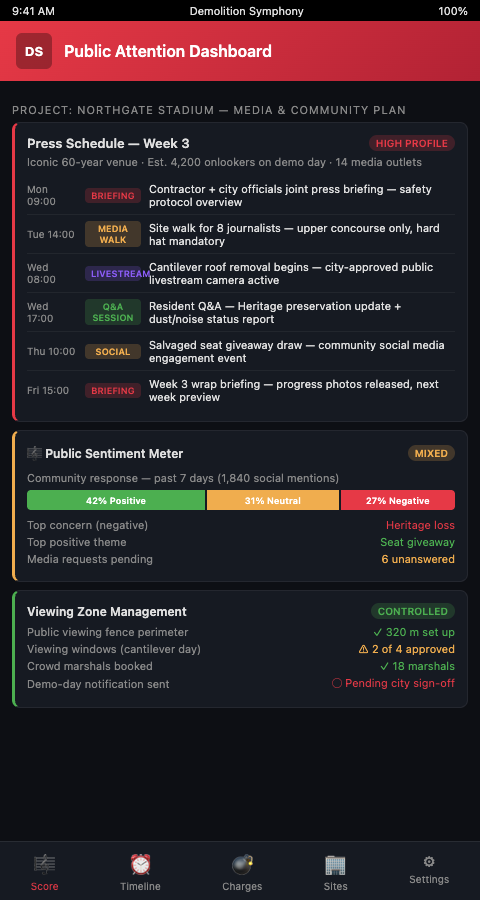
Demolition Symphony Planner treats community communication as a scored parallel track alongside the structural demolition plan — a set of scheduled events, hold points, and information releases that run in coordination with the technical demolition sequence, not after it.
Structuring the Communication Score
A stadium teardown community communication plan organized around the demolition score contains four elements that map directly to the phases of the technical demolition plan.
Pre-phase public briefings. Before each major demolition phase begins, a public briefing is scheduled that explains what will happen, when it will happen, and what it will look and sound like from the neighborhood perimeter. Events DC's community engagement around the RFK Stadium redevelopment area demonstrates how pre-phase briefings reduce reactive media coverage by giving community members accurate information before they observe demolition activity and draw their own conclusions.
Farewell and documentation events. For iconic venues, public participation in the farewell process is a legitimate form of community engagement, not a sentiment to be managed away. Hawaii Public Radio documented the emotional intensity of the Aloha Stadium farewell event — fans sharing memories, photographing the space, attending organized last-visit programs — and noted that the project team's decision to facilitate rather than restrict this engagement significantly reduced opposition to the subsequent demolition. Demolition Symphony Planner schedules farewell events as scored rest periods in the demolition timeline: the site is accessible to the public before structural work begins in a given zone, and the event is formally closed before demolition equipment mobilizes.
Ongoing noise and activity notification. Managing media during arena demolition requires more than a project website. Noise abatement scheduling data from the demolition score feeds a community notification system that sends advance alerts before high-noise phases begin — giving neighbors the ability to plan around demolition activity rather than being surprised by it. The Places Journal analysis of Baltimore Memorial Stadium's demolition and afterlife documents how inadequate activity notification contributed to sustained community friction that outlasted the demolition project itself. The USL Championship's documentation of Detroit AlumniFi Field shows that unanimous council approval was only secured after months of Community Benefits Ordinance engagement — an example that demonstrates how front-loaded community investment prevents the back-end delays that cost projects far more than engagement would have.
Dedicated media contact protocol. Managing media during arena demolition requires a designated spokesperson with access to the demolition score — someone who can answer "what phase are you in and why" without creating a project communication vacuum that media fills with speculation. Demolition Symphony Planner generates phase status summaries in plain-language format, specifically designed for media briefings and stakeholder updates.
Advanced Tactics for Public Engagement on High-Profile Teardowns
Three additional tactics separate projects that maintain community support through demolition from those that lose it mid-project.
Artifact integration in community engagement. Artifact preservation is not just a technical operation — it is a community engagement asset. When community members see that heritage items are being catalogued, preserved, and directed to public institutions, opposition based on cultural loss diminishes measurably. Demolition Symphony Planner's artifact inventory is designed to be shared with community stakeholders in a public-facing summary format, demonstrating that the project team has taken preservation seriously.
Fan and alumni group partnership for farewell programming. The USL Championship's documentation of the Detroit AlumniFi community benefit organization model demonstrates how sports venue stakeholder groups can be integrated as partners in farewell programming rather than managed as opponents. When fan groups co-design the farewell event, they become advocates for the demolition project among their networks — a significantly more efficient communication channel than formal public notices.
Cross-project communication learning from urban implosion. Neighbor communication methodology developed for dense urban implosion projects — where the community is literally within the debris footprint — contains protocols for managing public presence, observation zones, and media access that translate directly to stadium demolition contexts. The safety-driven communication cadence from implosion projects (daily notifications, real-time blast radius updates, community liaison appointment) provides a template for stadium teardown communication intensity that most venue demolition projects underestimate.
Communication as a Schedule Protection Tool
The project management case for public engagement demolition planning is straightforward: a community that is informed, included in farewell programming, and receiving regular notifications about upcoming phases is a community that does not generate permit challenges, city council intervention, or media-amplified protests that create schedule delays. The cost of proactive communication is a fraction of the cost of reactive crisis management. For stadium teardown community communication, the return on that investment compounds through the demolition lifecycle: each phase-gate briefing that proceeds without a community objection preserves the schedule buffer that a later, less predictable phase may need — making front-end communication investment a form of schedule risk management that most venue demolition budgets chronically undervalue.
Demolition Symphony Planner integrates iconic venue demolition public relations planning into the demolition score — not as a soft track that runs in parallel with the real work, but as a structural element of the project schedule that protects every other phase from the disruption that unmanaged public opposition creates. For historic stadium farewell event planning, the scoring discipline provides something the project team typically lacks: a mechanism for confirming that farewell events close before structural work opens. When that confirmation is embedded in the phase gate rather than managed through informal communication, the risk of a farewell event running long and delaying structural mobilization is eliminated at the planning stage rather than managed under time pressure on the day.
Score Your Stadium Teardown with Demolition Symphony Planner and build a communication plan that keeps community engagement on beat with your demolition sequence. Get started before stakeholder outreach begins and integrate farewell programming, public notification windows, and community liaison checkpoints directly into the demolition score.