5 Challenges of Preserving Artifacts During Arena Demolition
Between 1971 and 2024, an estimated 610 deaths occurred in stadium and sports arena disasters worldwide, according to a systematic review published in Public Health (ScienceDirect, 2023). That figure covers structural failures, crowd events, and fire incidents — but it reflects a broader truth about large-venue demolition: these buildings carry human history in ways that create obligations beyond structural safety. When Northeastern University announced the deconstruction of Matthews Arena, the oldest active indoor ice hockey arena in the world, the project team confronted artifact preservation challenges that the demolition permit never mentioned.
Protecting sports memorabilia during teardown is not a soft consideration appended to the hard engineering work. Artifact preservation arena demolition planning is a parallel technical discipline — one that requires its own inventory system, its own extraction windows, and its own coordination with the structural demolition sequence. Demolition Symphony Planner treats artifact salvage windows as scored rests in the demolition timeline, making preservation planning as systematic as load path analysis.
Challenge 1: Incomplete Artifact Inventories Before Mobilization
The first and most consequential challenge in demolition artifact inventory management is that inventories are rarely complete when the demolition contractor mobilizes. Heritage items are distributed throughout a stadium in non-obvious locations: foundation cornerstones, embedded plaques, concourse murals, locker room fixtures, and structural steel stamped with fabricator marks that heritage researchers want to document. The National Park Service's Lost or Saved framework for historic properties documents how incomplete pre-demolition surveys result in irreversible loss of heritage fabric — loss that cannot be remediated after the demolition equipment has passed through.
Demolition Symphony Planner's pre-phase audit module prompts a room-by-room artifact inventory before any zone is cleared for demolition, generating a digitized record that travels with the phase gate checklist. No zone advances to demolition status until its artifact inventory has been marked complete by the designated heritage reviewer.
Challenge 2: Extraction Windows That Conflict With Structural Phases
Historic venue memorabilia salvage often requires access to areas — lower bowl seating, press-level fixtures, field-level infrastructure — that structural demolition sequence has already committed to a specific removal order. When salvage crews need more time in a zone than the structural phase allows, the demolition contractor faces a conflict between contract schedule and preservation obligation.
This is where the musical score metaphor in Demolition Symphony Planner becomes operationally precise. Artifact extraction timing is scored as a rest period within each structural phase — a window that is non-negotiable from a preservation standpoint and that the structural sequence must work around, not through. The system flags any phase scheduling that would compress an artifact window below the minimum extraction time estimated for that zone.
Challenge 3: Protecting Items During Adjacent Demolition Activity
Stadium heritage item extraction is rarely conducted in a structurally quiet environment. Heavy demolition equipment operating in adjacent zones generates ground-borne vibration, airborne dust, and debris trajectories that can damage fragile items — historic glass, ceramic tile, bronze fixtures — during the extraction process itself. The San Diego Sports Arena staff report (OBRag, 2024) documented significant historical impacts from demolition activity on adjacent heritage fabric that was nominally protected but physically proximate to active demolition.
Advanced extraction protocols specify buffer zones around artifact work areas and require vibration monitoring during any extraction activity. Demolition Symphony Planner enforces buffer zones as exclusion notations in the score — adjacent demolition phases cannot run simultaneously with artifact extraction in the same bay unless the structural analysis confirms that vibration levels are below the damage threshold for the artifact category being extracted.
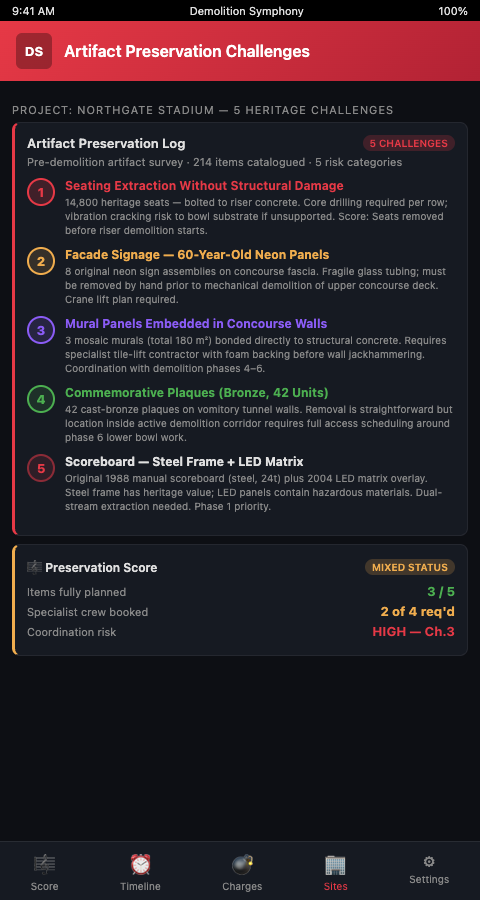
Challenge 4: Chain of Custody and Documentation for High-Value Items
Demolition artifact inventory management breaks down when high-value heritage items — championship banners, retired jerseys, original scoreboard components — move from the extraction team to storage without a documented chain of custody. The Providence Preservation Society has documented salvage operations where 70–90% of reusable building materials were recovered from careful deconstruction, but heritage-item chain of custody is a distinct problem: material recovery rates don't capture whether a signed championship banner ended up in an archive or a skip bin.
Demolition Symphony Planner's artifact module generates a chain-of-custody record for each inventoried item, timestamped at extraction, transfer to temporary storage, and final disposition. The O'Rourke Wrecking historical preservation and salvage methodology formalizes this as a three-party documentation system: the demolition contractor, the preservation agent, and the receiving institution all sign off on each transfer event. The 2025 deconstruction of Matthews Arena at Northeastern University demonstrated this at scale: the CollectU salvage team embedded in the deconstruction process worked zone by zone to catalog and remove memorabilia before structural demolition advanced, establishing the kind of phased clearance workflow that preserves heritage without stalling the schedule.
Challenge 5: Coordinating Multiple Stakeholder Claims on the Same Item
The fifth challenge is the most politically complex. For iconic venues — arenas that hosted championship teams, civil rights events, or concerts that shaped a generation — multiple stakeholders may assert claims on the same artifact: the franchise, the city's heritage authority, a university, a fan organization, and a private collector. The salvageable component mapping process must surface these competing claims before extraction begins, because extraction decisions made in the field without pre-resolved ownership conflicts create legal exposure for the demolition contractor. For demolition artifact inventory management purposes, the key discipline is establishing in writing — before mobilization — which party has authority to designate each item's disposition. When that authority is ambiguous, the system's hold mechanism provides a defensible contractual basis for pausing extraction while ownership is resolved, rather than requiring the contractor to make an unsupported field judgment about competing institutional claims.
Demolition Symphony Planner flags each inventoried artifact with a disposition status: reserved, disputed, or cleared for sale. Items in disputed status cannot be moved from the extraction zone until the dispute is resolved — the system enforces this as a hold on the phase gate, preventing the demolition sequence from advancing past the artifact zone until disposition is confirmed. This mirrors the equipment inventory discipline from industrial plant strip-outs, where ownership of embedded equipment must be resolved before extraction crews mobilize.
From Inventory to Archive
Artifact preservation arena demolition planning that incorporates all five challenges produces a documented inventory, a fully scheduled extraction sequence, a chain-of-custody record, and a resolved disposition map — before a single structural member is removed. That documentation protects the demolition contractor, satisfies heritage authority requirements, and ensures that the community's investment in the venue's history is recovered rather than lost.
The stadium heritage item extraction workflow also creates a project narrative that communities and media can engage with constructively: when the public can see that championship banners, historic scoreboards, and architectural features are being systematically documented and preserved, the demolition project's public legitimacy is strengthened rather than eroded — making artifact preservation a reputational investment for the project owner, not just a compliance exercise. The difference between a project that archives its heritage and one that loses it is almost never a lack of intent — it is the absence of a systematic process that runs the preservation workflow in parallel with the structural demolition plan from day one.
Score Your Stadium Teardown with Demolition Symphony Planner and build an artifact preservation plan that treats every historic item as a voice in the demolition score — one that deserves its own rest period before the structural movement begins. Get started with a pre-mobilization artifact inventory that assigns every heritage item a disposition status and a scored extraction window before structural demolition begins.