Coordinating Artifact Extraction with Demolition Timelines
When Northeastern University announced the demolition of Matthews Arena in late 2025, the project team faced a challenge familiar to any stadium teardown specialist working on a venue with historical significance: how do you extract decades of sports memorabilia — championship banners, retired jersey frames, historic scoreboards — from a building that is simultaneously being prepared for structural demolition, without either losing the artifacts or losing the schedule? The Northeastern Matthews Arena memorabilia documentation shows that the university coordinated with alumni groups, sports historians, and memorabilia collectors across a structured pre-demolition window — a process that required the demolition timeline to accommodate artifact handoff logistics as a first-class phase constraint, not an afterthought.
Artifact extraction demolition timeline coordination is the discipline of making heritage item retrieval before demolition a scheduled operation with defined windows, handoff protocols, and clearance conditions — not a free-for-all in the days before equipment mobilizes.
Why Artifact Extraction Windows Fail
Stadium memorabilia removal scheduling breaks down at three predictable points. First, the artifact inventory is conducted informally — facility managers walk the venue and identify "things that should be saved" without a systematic room-by-room survey, meaning items are missed until demolition has already made extraction impossible. Second, artifact extraction is scheduled as a single pre-demolition phase rather than as zone-specific windows that align with the demolition sequence, so the entire project waits while a heritage consultant catalogues a press box while structural crews stand idle. Third, venue artifact handoff logistics — who takes custody of each item, what packaging and transport is required, where items go — are resolved ad hoc, generating disputes that delay clearance sign-off.
The ScienceDirect salvage plan roadmap research recommends limiting pre-demolition artifact focus to three priority objects per venue zone — an approach that forces project teams to make explicit decisions about what matters most rather than attempting to save everything and succeeding with nothing. The Northeastern Matthews Arena deconstruction case illustrates the cost of the alternative: an informal salvage process that required last-minute extensions to the pre-demolition phase when additional historically significant items were identified after structural work had begun. The entire discipline of artifact extraction timeline coordination connects directly to artifact preservation planning: clearance windows cannot be sized correctly without knowing which items are priority heritage items, which have commercial value, and which can be removed without specialist handling.
The Demolition Symphony Score for Artifact Extraction
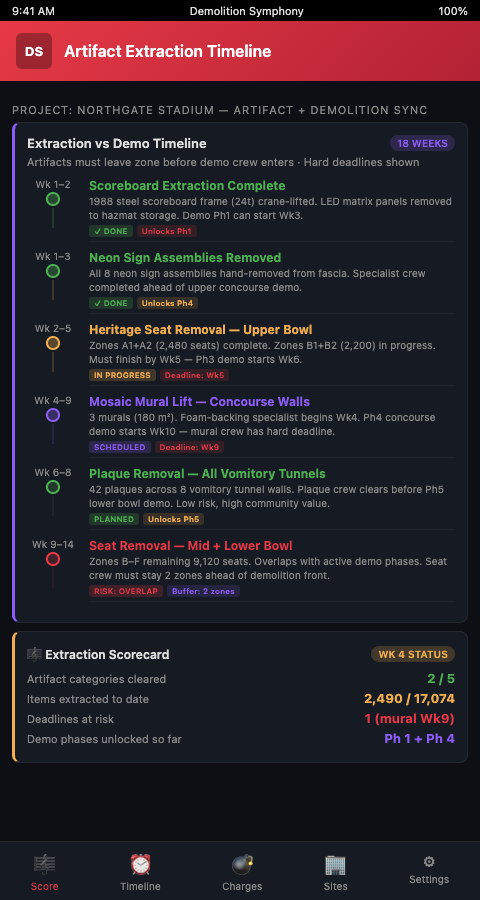
Demolition Symphony Planner treats artifact extraction as a scored sequence embedded within the demolition plan: every salvage window, recycling stream, and structural cut becomes musical notation on a visual demolition score, and artifact clearance windows appear as mandatory rest measures that precede any structural demolition measure in the same zone. The score makes clearance status visible — no structural demolition measure can begin until the artifact clearance rest for that zone is marked complete.
The framework structures artifact extraction timeline coordination across four movements.
Movement 1 — Zone-Specific Artifact Inventory. Rather than a single venue-wide walkthrough, the inventory is conducted zone by zone, sequenced to match the planned demolition order. Zones scheduled for early demolition are inventoried and cleared first. Demolition Symphony Planner generates zone-specific artifact lists that include item description, location coordinates within the zone, designated recipient, packaging requirement, and extraction deadline. The O'Rourke Wrecking historical preservation methodology formalizes this zone-by-zone approach as a best practice for venues where demolition and salvage phases overlap.
Movement 2 — Clearance Windows with Hard Deadlines. Each zone receives a clearance window — a defined time interval during which artifact extraction must be completed before structural demolition begins in that zone. Clearance windows are sized based on the zone inventory count and the extraction method required, not on an optimistic assumption that "heritage consultants will finish in time." Demolition Symphony Planner flags clearance windows that are undersized relative to inventory count, prompting schedule adjustment before mobilization day.
Movement 3 — Handoff Protocols and Custody Tracking. Every item extracted requires a documented handoff: the extractor signs the item out of the zone inventory, the recipient signs it into custody, and the item's destination is logged. This chain of custody documentation protects the demolition contractor from post-project disputes about missing memorabilia — a risk that is real on high-profile stadium demolitions where former players, fan groups, and media organizations all claim interests in specific items. Demolition Symphony Planner tracks custody status as a zone-level clearance condition: the zone does not receive structural demolition clearance until all high-priority items show confirmed handoff status.
Movement 4 — Residual Item Protocols. Some items will be discovered during structural demolition — embedded time capsules, items sealed in walls during renovation cycles, structural elements that reveal historical markings when exposed. The demolition score includes a residual discovery protocol: a defined process for halting the relevant demolition measure, notifying the heritage consultant, and either extracting the item or documenting its location for later recovery. The Providence Preservation Society deconstruction framework identifies residual discovery protocols as the most commonly missing element in artifact salvage plans.
Advanced Tactics for Heritage Item Retrieval
Three advanced tactics address the scenarios that standard artifact planning underestimates.
Tie artifact clearance directly to the artifact preservation framework. The preservation assessment that identifies which items are historically significant, which are commercially valuable, and which are sentimental rather than archival must be completed before the zone-specific inventory begins — not concurrently. Running preservation assessment and inventory simultaneously generates classification disputes mid-extraction that consume time the clearance window doesn't have. The Local Demo selective demolition research confirms that selective crews must phase work around heritage extraction windows to preserve items without delay — reinforcing that the preservation framework must precede and shape the clearance window design.
Coordinate the extraction schedule with the salvage crew scheduling plan. Heritage item extraction and general salvage crew operations often conflict at the zone level — both teams need access to the same concourse or press level at the same time. Building the artifact clearance window into the salvage crew schedule as a zone-lock condition prevents general salvage from inadvertently removing or damaging heritage items that the heritage consultant hasn't yet catalogued.
Apply hazmat sequencing discipline to artifact clearance zones. Older stadium venues contain hazmat materials — lead paint on structural steel, asbestos in floor tiles and ceiling panels, PCBs in light ballasts — that may be co-located with artifact extraction zones. Demolition phase artifact clearance windows must be sequenced after hazmat abatement in zones where both conditions exist. A heritage consultant conducting artifact extraction in an un-abated hazmat zone faces regulatory exposure that can suspend the entire project. Demolition Symphony Planner cross-references hazmat abatement status with artifact clearance zone assignments and flags conflicts before extraction teams enter.
Protecting Heritage and Schedule Simultaneously
The Local Demo selective demolition research documents that heritage item retrieval is most successfully integrated into demolition timelines when clearance windows are defined in the original schedule, not negotiated under time pressure after mobilization begins. Projects that treat artifact extraction as a pre-condition to zone clearance — not an interruption to structural progress — deliver both better preservation outcomes and fewer schedule surprises.
Demolition Symphony Planner exports zone-specific artifact clearance plans that include inventory lists, clearance window duration, custody tracking requirements, and residual discovery protocols in formats readable by heritage consultants, demolition superintendents, and project owners simultaneously. Every stakeholder operates from the same score. Score Your Stadium Teardown with Demolition Symphony Planner and build the artifact clearance architecture into the demolition plan before the first heritage consultant arrives on site. Get started with extraction timing windows that are scored as phase preconditions — not negotiated under schedule pressure after structural mobilization begins.