Understanding Hazmat Sequencing in Facility Demolition
A pre-demolition hazardous building materials survey at a 1960s-era manufacturing facility will typically uncover asbestos-containing materials in pipe insulation, floor tiles, roofing, and sprayed fireproofing—often in locations not identified in original building records. When those materials are not sequenced correctly before structural work begins, the result is what Omega Environmental's HBM survey guide calls a "generation event"—airborne fiber release during demolition that contaminates cleared zones and triggers regulatory stop-work orders.
Hazmat sequencing facility demolition is not about completing all abatement before demolition begins. On a large industrial campus, that approach would add years to the schedule. It is about establishing the correct order of operations within each building and zone so that hazardous material abatement never overlaps with activities that could disturb or spread those materials.
OSHA 1926.1101 requires that all Class I, II, and III asbestos work be performed before any structural demolition that could disturb asbestos-containing materials. EPA's NESHAP for asbestos and 40 CFR 61.145 add notification and inspection requirements that impose minimum lead times before abatement can legally start. Those regulatory timelines are not optional rests—they are mandatory measures in the decommissioning score.
The Hazmat Sequencing Decision Tree
Think of hazmat sequencing as a set of instrument voices that must play before the structural demolition voice can enter. The contamination buffer between abatement and structural work is the rest bar that separates them. Remove that rest, and the voices collide.
The correct industrial demolition hazardous waste order runs in four stages:
Stage 1: Pre-demolition survey. A licensed inspector surveys every building for asbestos-containing materials, lead-based paint, PCBs, and other regulated hazardous materials. 40 CFR Part 61 Subpart M requires this survey before any renovation or demolition that could disturb regulated materials. The survey results define which materials are present, in what quantities, and in which exact locations.
Stage 2: Abatement notification and mobilization. EPA NESHAP requires written notification to the relevant state agency at least 10 working days before asbestos abatement begins on regulated facilities. That 10-day window appears on the decommissioning hazmat schedule as a fixed-duration rest before abatement can start. PCB-containing materials may require separate EPA PCB notification with different lead times.
Stage 3: Abatement in order of structural vulnerability. Materials in locations that will be disturbed earliest in demolition must be abated first. Sprayed-on fireproofing on structural steel is abated before the steel is cut. Pipe insulation in mechanical rooms is abated before those rooms are opened for equipment extraction. Flooring is abated before slab demolition. The ESAA pre-demolition abatement guide provides sequencing logic for each material category based on when it is likely to be disturbed.
Stage 4: Air monitoring, clearance, and buffer release. After abatement is complete in a zone, air monitoring confirms fiber counts are below clearance thresholds. Only after a licensed industrial hygienist issues written clearance can the structural demolition voice enter that zone. This clearance task appears as a dependency in Demolition Symphony Planner—no structural work can be scheduled in a zone until the clearance dependency is satisfied.
Where Facility Demolition Hazmat Workflows Break Down
The UNC hazardous material demolition plan identifies three recurring failure modes in facility demolition hazmat workflow:
Scope gaps from incomplete surveys. A survey that misses pipe insulation in a ceiling plenum creates an undiscovered asbestos pocket that is disturbed during structural demolition. Demolition Symphony Planner cross-references survey scope coverage against building floor plans and flags rooms or areas with no survey record before any phase is released for work.
Notification timeline compression. Project managers under schedule pressure submit NESHAP notifications late and attempt to compress the 10-day window. Regulatory agencies do not compress that window. The result is either a stop-work order or an abatement that begins without legal authorization. The Demolition Symphony Planner decommissioning hazmat schedule treats notification submission as a task with a fixed 10-day successor constraint that cannot be overridden.
Clearance task treated as a formality. Air monitoring results are sometimes used to confirm an expected clearance rather than to verify it. When clearance is not obtained before structural work begins, even trace fiber counts in cleared zones create regulatory liability. The OSHA 1926.1101 clearance requirement is not a checkbox—it is a dependency gate.
Reviewing contamination risks from hazmat overlap reveals that most cross-contamination events on industrial sites trace back to one of these three workflow failures, not to abatement technique errors.
Advanced Hazmat Sequencing for Multi-Material Sites
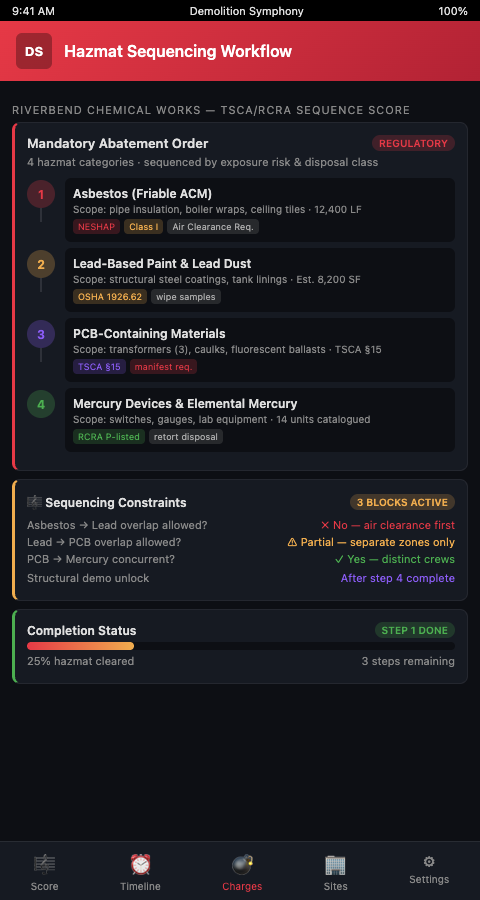
Industrial plants built before 1980 frequently contain multiple regulated materials in the same location: asbestos pipe insulation wrapped around a lead-painted valve in a PCB-containing transformer room. Each material has a different abatement contractor, different regulatory notification requirement, and different clearance standard. The hazardous material abatement order must choreograph these three abatement voices within the same physical space without cross-contamination between abatement crews.
Demolition Symphony Planner handles multi-material zones by assigning each material type its own voice layer within a zone. The software enforces that asbestos abatement is complete and cleared before lead abatement begins in the same space, since asbestos disturbance during lead abatement is an OSHA violation. PCB remediation timelines, which may be governed by EPA rather than OSHA, are tracked as a separate voice with different clearance logic.
For timing context, compare this to asbestos abatement scheduling in active demolition, where the challenge is not just sequencing materials within a zone but sequencing abatement activities concurrent with structural work in adjacent zones.
The cross-niche dimension also applies: artifact extraction timing on stadium demolition projects faces the same problem of material-specific clearance requirements gating subsequent activities, though in that context the materials are structural members with salvage value rather than regulated hazardous waste.
Hazmat Workflow Integration with Equipment Extraction Scheduling
Hazmat sequencing does not exist in isolation from the rest of the decommissioning schedule. Equipment that has asbestos-containing insulation wrapped around it—a common condition for process piping and vessels in pre-1980 facilities—cannot be extracted until that insulation is abated. The abatement sequence must therefore account for equipment disposition: which pieces of equipment are designated for extraction (requiring pre-extraction abatement of all attached regulated materials) and which are designated for in-place demolition (requiring abatement of materials that would become airborne during demolition, but not necessarily intact removal of all attached insulation).
This disposition-linked abatement decision is one of the most complex sequencing intersections in facility demolition. An extraction contractor waiting for abatement to complete on a high-value reactor is on standby at day rate. The abatement contractor cannot compress the timeline without violating clearance standards. The project manager who built the schedule without accounting for this intersection has created a cost overrun that was entirely predictable at planning time.
Demolition Symphony Planner resolves this by linking the equipment disposition system to the hazmat abatement schedule. When a piece of equipment is marked for extraction, the system identifies all regulated materials in the survey database that are attached to or within that equipment's footprint and creates abatement predecessor tasks for the extraction activity. The extraction task cannot be scheduled before those predecessor abatement tasks are complete.
The full industrial demolition hazardous waste order—survey, notification, abatement, clearance, extraction, structural demo—is a single voice structure in the score. Each stage gates the next. Treating any stage as optional or compressible introduces sequence failures that cost more to remediate than the time saved.
Decommissioning Hazmat Schedule: What to Build First
Before any crew mobilizes on a facility demolition hazmat workflow, the following schedule elements must be confirmed:
- Pre-demolition survey scope covers 100% of building area and all above-ceiling spaces
- Material quantities and locations entered into Demolition Symphony Planner by building and floor
- Regulatory notification tasks created with fixed 10-day successor constraints
- Abatement phasing ordered by structural vulnerability sequence
- Equipment disposition records linked to abatement predecessor tasks for extraction-designated assets
- Air monitoring and clearance tasks set as mandatory dependencies before structural voice entries
- Multi-material conflict rules configured for zones with overlapping regulated materials
Demolition Symphony Planner renders the complete decommissioning hazmat schedule as a visual score. Abatement crews see exactly which zones are available, which are in notification buffer, and which are awaiting clearance—without having to request status updates from a project manager.
The visual score format makes the hazardous material abatement order legible to all project stakeholders—not just the project manager and abatement contractor. Structural demolition contractors can see how many weeks remain in each building's abatement and buffer phase without requiring a separate schedule update meeting. Equipment extraction contractors can see which abatement predecessor tasks must complete before their extraction activities can begin. Owners can see the regulatory notification milestones and understand why the schedule cannot advance faster than the 10-day notification window allows. That shared transparency reduces the schedule pressure that drives most hazmat sequencing failures on industrial decommissioning projects.
Map your decommissioning sequence today. Upload your pre-demolition survey results into Demolition Symphony Planner and generate a compliant hazmat sequencing plan before your first contractor coordination meeting. Start your hazmat sequencing plan now and get the compliant abatement schedule your project requires.