Best Practices for Asbestos Abatement Scheduling in Active Demolition
The National Cancer Institute estimates that 1.3 million construction and building trade workers face occupational asbestos exposure annually. A 2024 PMC study of mesothelioma incidence found that 22% of cases were linked to manufacturing facilities—precisely the type of industrial plant where decommissioning projects are most likely to involve large-scale asbestos removal. The connection between those statistics and schedule management is direct: when asbestos abatement and structural demolition overlap without adequate sequencing, the result is fiber release that turns cleared zones into new exposure environments.
Asbestos abatement scheduling in active demolition is not a niche compliance task. It is the central scheduling constraint on most industrial plant decommissioning projects built before 1980. Getting it right requires understanding both the regulatory framework that governs abatement timing and the physical constraints that govern what can happen in adjacent spaces while abatement is underway.
OSHA 1926.1101 categorizes asbestos work into three classes based on disturbance risk, with Class I work (removal of thermal system insulation and sprayed-on materials) requiring the most stringent controls. EPA Asbestos Laws and Regulations add facility-wide notification and inspection requirements under NESHAP. GSA's Asbestos Management guidance provides project-level implementation standards for large federal facilities—standards that translate directly to private-sector industrial decommissioning at comparable scale.
The Regulatory Timeline Before Abatement Can Start
40 CFR Part 61 Subpart M requires written notification to the relevant state agency at least 10 working days before asbestos abatement begins on a regulated facility. For a decommissioning project with multiple buildings entering abatement at different times, each building requires a separate notification window that must appear on the asbestos sequencing plant decommissioning schedule as a fixed-duration predecessor to abatement work.
This means the industrial asbestos abatement timeline for a 20-building campus may contain 20 separate 10-day notification windows, staggered according to the planned abatement sequence. Project managers who fail to build these windows into the schedule discover them when they attempt to start abatement—at which point they have already lost 10 working days.
Demolition Symphony Planner treats NESHAP notification submission as a mandatory task type with a fixed 10-day successor constraint. When a building is added to the abatement schedule, the notification task is automatically created as a predecessor, and the earliest possible abatement start date adjusts accordingly.
Spatial Separation: Where Abatement and Demolition Can Coexist
Concurrent asbestos and demolition workflow is not prohibited—but it requires that abatement and structural demolition occur in physically separated zones with adequate separation to maintain negative pressure containment integrity. The spatial separation requirement depends on:
Containment boundary integrity. Abatement containment must maintain -0.02 to -0.04 inches of water column pressure differential relative to adjacent spaces. Structural demolition that creates new wall or ceiling openings adjacent to an active containment compromises that differential. The minimum separation between active demolition and active abatement containment is determined by the building's wall construction and the distance at which demolition vibration does not degrade containment attachment.
Shared ventilation pathways. Industrial buildings with shared HVAC systems can carry fibers from abatement zones to demolition zones through ductwork even when physical barriers are intact. Before concurrent asbestos and demolition workflow begins, shared ventilation pathways between abatement zones and active demolition zones must be isolated and sealed.
Crane and equipment access paths. Demolition equipment accessing the structural demolition zone must not traverse active abatement zones or their immediate buffer perimeters. Red W's asbestos abatement in large-scale demolition guide identifies equipment access path conflicts as the most common cause of schedule delays in concurrent abatement and demolition projects—more common than containment failures or air monitoring exceedances.
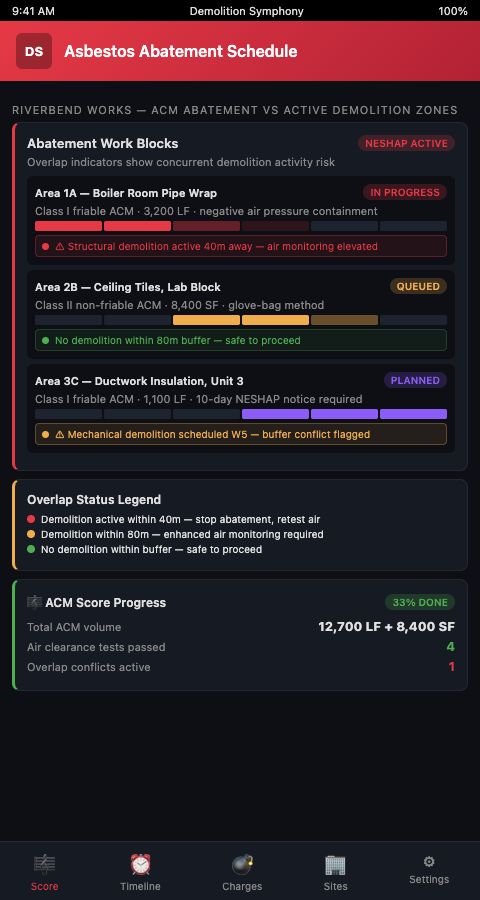
Building the Asbestos Sequencing Plan in Demolition Symphony Planner
The asbestos removal during structural demolition schedule in Demolition Symphony Planner is constructed in four steps:
Step 1: Map asbestos-containing material locations against the demolition sequence. Each ACM location is tagged to the structural element or surface it occupies. The demolition sequence determines when that element will be disturbed. Demolition Symphony Planner identifies all ACM locations that will be disturbed before their scheduled abatement completion date and flags them as sequencing conflicts.
Step 2: Set NESHAP notification windows as predecessors. Each building's abatement start date gets a 10-working-day NESHAP notification task as a mandatory predecessor. The software prevents abatement from being scheduled before the notification task is complete.
Step 3: Draw spatial separation buffers. For each active abatement zone, Demolition Symphony Planner draws a configurable separation perimeter on the facility map. Any structural demolition activity scheduled within that perimeter during the abatement window appears as a collision flag. The project manager must either adjust the demolition schedule or document a structural analysis that confirms the separation distance is adequate.
Step 4: Route equipment access away from containment perimeters. Crane paths and demolition equipment routes are drawn on the facility map. Any path that traverses an active abatement containment perimeter is flagged. Alternative routes are identified and their impact on extraction sequence evaluated before the schedule is finalized.
The connection between asbestos scheduling and the broader hazmat framework is addressed in hazmat sequencing facility demolition, which covers all regulated materials, not just asbestos. Asbestos is typically the longest-lead abatement activity, but PCB and lead abatement may run concurrently and require their own sequencing logic.
Advanced Tactics for High-ACM-Density Buildings
Industrial plants with heavy process insulation—refineries, chemical plants, paper mills—may have pipe insulation, equipment insulation, and sprayed fireproofing in virtually every room of every building. In high-ACM-density buildings, asbestos abatement scheduling in active demolition becomes a building-within-a-building logistics problem.
The practical approach is to abate by floor from top to bottom, maintaining negative pressure from the top floor down so that any fiber migration moves downward into already-cleared space rather than upward into active abatement zones. Structural demolition in high-ACM-density buildings should begin from the top and follow the abatement front downward, maintaining a minimum one-floor separation between the abatement leading edge and the demolition trailing edge.
FieldFlo's asbestos demolition scheduling guidance describes this floor-separation model as the most reliable approach for maintaining concurrent asbestos and demolition workflow in multi-story industrial buildings. Demolition Symphony Planner implements the floor-separation constraint as a configurable minimum vertical separation between the abatement and structural demolition voices on each building's staff line in the score.
The cross-niche parallel to asbestos discovered unexpectedly in bridge demolition illustrates what happens when asbestos sequencing cannot be planned in advance: emergency containment, work stoppage, and schedule recovery that is far more expensive than the proactive scheduling discipline described here.
And for the strip-out connection, sequential strip-out phases for cross-contamination prevention addresses how the strip-out phase sequence must also account for asbestos-insulated equipment, where the equipment cannot be touched until the insulation is abated.
Monitoring Protocols During Concurrent Activity Weeks
When asbestos abatement and structural demolition are running concurrently in different zones, perimeter air monitoring at the containment boundary is not just a best practice—it is the early warning system that prevents a fiber release from becoming a regulatory event. Standard personal monitoring for abatement workers confirms worker exposure. Perimeter monitoring at the containment boundary detects whether the containment is performing as designed under the pressure of adjacent demolition activity.
Demolition Symphony Planner's concurrent-activity monitoring protocol assigns monitoring station locations at the start of each concurrent-activity week and records monitoring results against the relevant zone and activity pair. If perimeter monitoring at Building C's abatement containment boundary shows elevated fiber counts on a day when structural demolition is underway in Building B 40 feet away, the system flags the proximity as a potential contributing factor and surfaces the question for the industrial hygienist's review.
When an exceedance is detected, Demolition Symphony Planner generates a stop-work notification for the affected zone and creates a remediation task in the schedule. That task—investigating the source, reestablishing containment integrity, confirming clearance—must be completed before the concurrent-activity schedule resumes in that zone. The monitoring result, the stop-work notification, and the remediation record are all stored together in the zone's compliance file.
This closed-loop monitoring approach—monitor, record, flag, review—is what distinguishes industrial asbestos abatement timeline management from compliance-minimum scheduling. The GSA Asbestos Management program requires continuous monitoring logs for all concurrent asbestos work activities in federal facilities. Demolition Symphony Planner applies the same documentation standard to private-sector decommissioning projects where the legal exposure from inadequate records can exceed the cost of maintaining them.
Before Any Concurrent Abatement-Demolition Schedule Is Approved
Confirm the following in Demolition Symphony Planner before approving any week where abatement and demolition run concurrently on the same site:
- NESHAP notification tasks complete and 10-day windows satisfied for all buildings entering abatement
- Spatial separation buffers drawn for all active abatement zones, no demolition activities within perimeter
- Shared ventilation pathways between abatement and demolition zones isolated and documented
- Equipment access routes drawn and cleared of abatement containment perimeter conflicts
- Floor separation minimum enforced in high-ACM-density multi-story buildings
- Perimeter air monitoring station locations assigned for all concurrent-activity weeks
- Air monitoring plan for active weeks with concurrent activities, including perimeter monitoring at containment boundaries
Sequence your abatement before demolition crews mobilize. Load your ACM survey results into Demolition Symphony Planner and generate the NESHAP-compliant asbestos sequencing plan with spatial separation buffers before your first concurrent-activity week. Start your asbestos sequencing plan now and get NESHAP notification windows, spatial separation buffers, and clearance gates mapped before any demolition crew enters an adjacent zone.