How to Handle Unexpected Asbestos During Bridge Demolition
How Often Bridge Teams Find Asbestos They Weren't Expecting
Unexpected asbestos in bridge demolition is not an edge case — it is a documented pattern across pre-1980 structures where asbestos-containing materials were used in gaskets, joint fillers, bearing pads, and coating systems as standard practice. A ROSAP bridge asbestos materials survey identified ACM in gaskets, bearing pads, joint sealants, and deck coating materials across bridges built in the decades when asbestos was a standard construction ingredient. ACM testing during bridge structure surveys found materials in components that visual inspection alone would not identify — materials that look like rubber, felt, or caulk but contain chrysotile or amosite at regulated concentrations. A Texas Tech Research report surveying 39 transportation agencies found that bridge structures consistently contained ACM in locations that field teams encountered during demolition without prior warning.
Hazardous material discovery overpass demo is not a rare event — it is a predictable outcome on any pre-1980 bridge structure. Every asbestos response plan bridge demolition requires pre-writing before the first cut, not assembly under regulatory pressure after discovery. Asbestos abatement bridge removal demands a pre-written response branch, and ACM testing bridge structure surveys must feed that branch before phase planning begins. The health risk associated with that exposure is not marginal. A PMC study of mesothelioma risk among construction workers found that construction workers rank third among all occupational groups for mesothelioma incidence, with exposure during demolition activities identified as a primary mechanism. Workers cutting through a deck expansion joint that contains asbestos-impregnated joint filler without respiratory protection and a regulated work area receive an exposure that may not manifest clinically for 20 to 40 years.
The OSHA 1926.1101 asbestos in construction standard requires that when ACM is discovered during demolition, work in the affected area stops immediately, a regulated area is established, and only trained workers with appropriate respiratory protection may enter. An asbestos abatement plan for bridge removal must be pre-written and embedded in the demolition score before the first cut — because teams without a pre-written plan are inventing the response under time pressure, with equipment staged and a traffic closure window counting down. A pre-written response branch converts ACM discovery from a crisis into a managed sequence. This is equally true whether the asbestos was identified in a pre-demolition ACM testing survey of the bridge structure or discovered for the first time mid-phase.
Writing the ACM Response Branch into the Phase Score
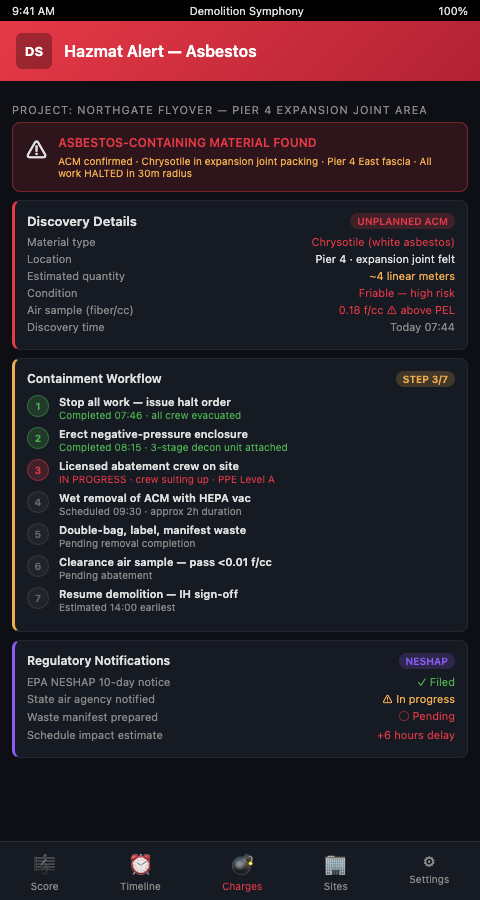
The Demolition Symphony Planner treats unexpected asbestos discovery as a score branch notation — a pre-written alternative passage that the team has rehearsed before the demolition begins. Every phase measure that involves materials with ACM risk carries a branch symbol: if the discovery trigger condition is met, the branch activates. The branch is not a separate document. It is the next passage in the same score the team is reading.
Pre-demolition ACM survey as the key signature. The Demolition Symphony Planner's first entry for any bridge demolition score is the ACM survey status: surveyed and all-clear, surveyed with identified locations logged, or not yet surveyed. If not yet surveyed, the score requires the survey as a prerequisite phase-measure before any Phase 1 structural action may begin. KTA-Tator's bridge ACM location analysis identifies expansion joint filler, bearing pad assemblies, deck membrane materials, pipe lagging in bridge mechanical systems, and caulking compounds as the primary ACM locations in pre-1980 structures. The ACM survey maps each of these locations and records the material type, fiber concentration, and accessibility — information that the Demolition Symphony Planner uses to assign ACM risk ratings to each phase measure that encounters those materials.
Discovery trigger conditions per phase. Not every phase of a bridge demolition encounters ACM risk equally. Deck cutting phases encounter the materials most frequently; pier demolition phases may encounter wrapped pipe in underbridge mechanical systems; abutment work may encounter expansion joint components. The Demolition Symphony Planner writes a discovery trigger condition for each phase based on the ACM survey results: if deck saw-cutting in Phase 2 encounters a joint material that does not match the expected profile (color, texture, friability), the discovery branch activates. The trigger condition is specific enough to catch genuine ACM discovery without generating false branch activations for every non-conforming material.
Regulated area establishment as the first branch measure. When the discovery branch activates, the first measure in the branch sequence is regulated area establishment: exclusion barrier perimeter, wind direction assessment, and personal air sampling initiation. The EPA NESHAP requirements for asbestos govern the notification obligations — state environmental agency and the EPA regional office must be notified within a defined period for regulated quantities. The Demolition Symphony Planner writes the notification contact information directly into the branch notation — not as a separate reference document the superintendent must locate during a response, but as a score annotation they read in the same motion as the regulated area instructions.
Abatement phase integration into the structural sequence. Once ACM is confirmed, abatement must be completed before structural demolition may resume in the affected zone. The abatement phase is written as a nested score within the discovery branch: licensed abatement contractor engagement, regulated area air sampling initiation, material removal using wet methods, waste packaging and labeling, final air clearance testing, and regulatory documentation. The structural demolition measures for the affected zone are locked in the score until the abatement phase's final air clearance gate is logged as cleared. This is how unexpected asbestos bridge demolition response integrates with the structural schedule — as a gated branch that unlocks the blocked structural measures after completion.
Lead co-exposure notation. The CDC NIOSH guidance on lead poisoning in construction documents compound exposure risk in bridge structures where lead paint coatings and asbestos-containing materials occur in the same location — a condition documented in the ROSAP joint lead and asbestos handling study. The Demolition Symphony Planner writes lead co-exposure notation alongside ACM notation for every bridge built before 1978: if the ACM discovery branch activates in a zone where lead-based paint is also present, the personal protection requirements escalate to the combined standard — respiratory protection must address both fibrous and metallic particle exposure simultaneously.
Connection to utility line mapping and hazard sequencing. The spatial mapping discipline required for utility line identification in overpass demolition applies directly to ACM location mapping. In both cases, the hazard is a material condition embedded in the structure that is not visible from the surface, must be identified before work begins, and must be flagged in the phase score at the measures that encounter it. The Demolition Symphony Planner uses the same spatial notation framework for both utilities and ACM — the hazard layer on the phase map that governs which measures require a pre-action survey and which carry an active response branch.
Advanced Tactics for ACM Risk Management in Bridge Demolition
Material sampling protocol during survey. The OSHA 1926.1101 standard allows a "presumed ACM" designation for materials that appear to be asbestos-containing and are located in structures built before 1980 — treating them as regulated without requiring bulk sample confirmation. The Demolition Symphony Planner supports both approaches: where presumed ACM designation is used, the discovery branch activates automatically at the phase encounter point rather than waiting for sampling confirmation. Where sampling is used, a sampling hold is written into the phase measure: work stops at the encounter point, samples are collected and submitted for analysis, and the phase resumes only after laboratory results are received and logged.
Abatement schedule buffering for multi-phase projects. Bridge demolitions that span multiple phases over weeks or months will typically encounter ACM at multiple locations in different phases. The Demolition Symphony Planner writes an abatement schedule buffer into the project timeline: a pool of unassigned workdays between phases that can absorb abatement delays without compressing the overall project schedule. If Phase 2 discovers ACM that requires five days of abatement, the buffer absorbs those five days rather than shifting all subsequent phases forward — provided the buffer was planned.
Protecting rail and traffic infrastructure during abatement. Where bridge demolition is adjacent to active rail, the rail line protection protocols that govern debris management during structural demolition also apply during asbestos abatement. ACM waste in plastic sheeting must not contact rail ballast, and regulated area barriers must maintain the same clearances from the active track that structural exclusion zones require. The Demolition Symphony Planner writes this coordination directly into the regulated area establishment measure within the ACM discovery branch — the rail protection requirements are not suspended during abatement, they are carried through the branch as persistent annotations.
Connecting to industrial plant abatement scheduling. The systematic approach to asbestos abatement scheduling in industrial decommissioning provides a reference framework for how abatement phases integrate with structural phases at the project level. In both bridge and industrial plant contexts, the key planning challenge is the same: abatement work must happen before structural demolition in the affected zone, but the two cannot always be fully separated from each other in time without information on what will be found and where. The Demolition Symphony Planner's discovery branch architecture is designed to handle that uncertainty — not by assuming all-clear until discovery, but by pre-planning the response so that discovery activates execution rather than improvisation.
Post-abatement air clearance gate as a structural gate. The final measure of the ACM discovery branch before structural demolition may resume is the air clearance gate: independent industrial hygienist personal air sampling and area sampling, with results below the clearance threshold before the regulated area is released. The Demolition Symphony Planner writes the clearance gate as a structural prerequisite for the blocked demolition measures — structurally identical to a sensor threshold gate or a structural analysis approval gate. The structural engineer does not clear the gate. The industrial hygienist does. But the gate mechanism is the same: a qualified professional's documented finding is the prerequisite for advancing the score.
The Risk of Discovering Asbestos Without a Pre-Written Response
Bridge demolition teams that encounter ACM without a pre-written response branch face a convergence of pressures: a traffic closure window that is expiring, a crane with a rigged load waiting for clearance, a contractor superintendent managing regulatory calls with no pre-established contacts, and OSHA and EPA notification obligations that have different timing requirements. The improvised response to this situation is consistently slower, less complete, and more likely to produce regulatory violations than a pre-written branch that activates on discovery and walks the team through the required steps in order.
The Demolition Symphony Planner does not prevent ACM discovery — that depends on the quality of the pre-demolition survey. It does ensure that discovery activates a competent response rather than a crisis.
The cost comparison is straightforward: a pre-written asbestos response plan for bridge demolition requires a few hours of planning session time to write the discovery branch, specify the regulated area protocol, and log the notification contacts. An improvised response to an ACM discovery on a bridge with an active traffic closure window may require stop-work orders, OSHA notification, regulatory penalties, and closure window renegotiation — all under the pressure of field conditions that are the worst possible environment for making regulatory decisions. The Demolition Symphony Planner writes the decisions before the pressure exists.
Hazardous material discovery on overpass demolition projects also cascades through the structural schedule in ways that cannot be managed without a pre-written branch. When ACM testing for bridge structures confirms friable asbestos in a pier column that was scheduled for demolition in Phase 3, the abatement timeline becomes the critical path for the full Phase 3 structural sequence — which may include multiple spans and crane positioning events that cannot proceed until Phase 3 clears. A pre-written ACM discovery branch in the score makes that cascade visible immediately, so the project team can realign the downstream schedule from the moment of discovery rather than after the abatement timeline is confirmed.
Plan Your Next Span Removal
Bridge and overpass demolition teams working on pre-1980 structures carry a planning obligation that extends beyond structural analysis and traffic management: every material encountered during demolition must be assessed for ACM risk, and every phase measure that encounters ACM-risk materials must carry a pre-written response branch. Plan your asbestos risk management with the Demolition Symphony Planner and build a score where every pre-1980 bridge your team removes comes with a pre-written response branch — ACM survey results logged, discovery triggers specified, regulated area procedures written, and abatement integration gated — so your crew never invents the response under field pressure.
Asbestos abatement integration for bridge removal managed through the Demolition Symphony Planner also creates the compliance documentation that OSHA and EPA require when ACM is present in a demolition project. When hazardous material discovery on an overpass demolition is documented as a scored gate event — including the ACM testing results, the regulatory classification determination, and the abatement work order authorization — the project record demonstrates that the team followed the regulated response process rather than improvising. An asbestos response plan for bridge demolition documented in the score's audit trail is structured for OSHA inspection review from the moment it is written.
Start your asbestos risk assessment with the Demolition Symphony Planner and give your bridge and overpass demolition team a pre-written hazardous material response framework that is integrated into the structural plan — not a separate document assembled after discovery puts the project under regulatory pressure and the closure window is already running down. Join the bridge demolition teams that are replacing improvised field responses with scored, pre-planned ACM branches that activate on discovery rather than under pressure.